

Xenocyon names a large extinct canid represented mainly by Pleistocene jaws and teeth. The cutting part of its lower cheek teeth is more specialized for meat than in many canids with a broader diet. Fossils establish that anatomy; exact prey, coat color and social behavior require more cautious interpretation.
It belongs in the ice-age animal catalogue. North American Aenocyon was another large fossil canid, but comparable size does not make the two genera identical.
Quick facts
| Type species | Xenocyon lycaonoides Kretzoi, 1938 |
|---|---|
| Family | Canidae |
| Main age | Early to middle Pleistocene |
| Key fossils | Jaws and teeth from Dmanisi and Gonghe |
| Distribution | Eurasia, with comparable North American material |
| Taxonomic debate | Xenocyon, Canis (Xenocyon), or Lycaon |
What can the fossils tell us?
A young adult from Dmanisi has reduced cusps on the lower carnassial. The anatomy supports hypercarnivory, but cannot preserve a particular hunt or pack.
The Qinghai fragment comes from strata dated about 1.95–1.77 million years ago. These are dates for the deposit, not a direct measurement of the bone.
Authors use Xenocyon, Canis (Xenocyon), or Lycaon for related fossils. Similar teeth alone do not demonstrate direct ancestry of today's African painted dog.
A name with several taxonomic homes
Miklós Kretzoi introduced Xenocyon lycaonoides in 1938 while studying Pleistocene carnivores from Gombaszög. Later authors have treated the same lineage as a separate genus, as Canis (Xenocyon), or within Lycaon. These placements reflect alternative views of relationships, not three separate animals.
A newly described partial mandible from the Gonghe Basin in Qinghai Province, China, comes from deposits dated approximately 1.95–1.77 million years ago. Its mental foramen and lower first molar were compared with later specimens. The authors assign it to X. lycaonoides and suggest an early history in eastern Asia. The geographic origin of the whole lineage remains a hypothesis because the oldest localities differ in age and completeness.
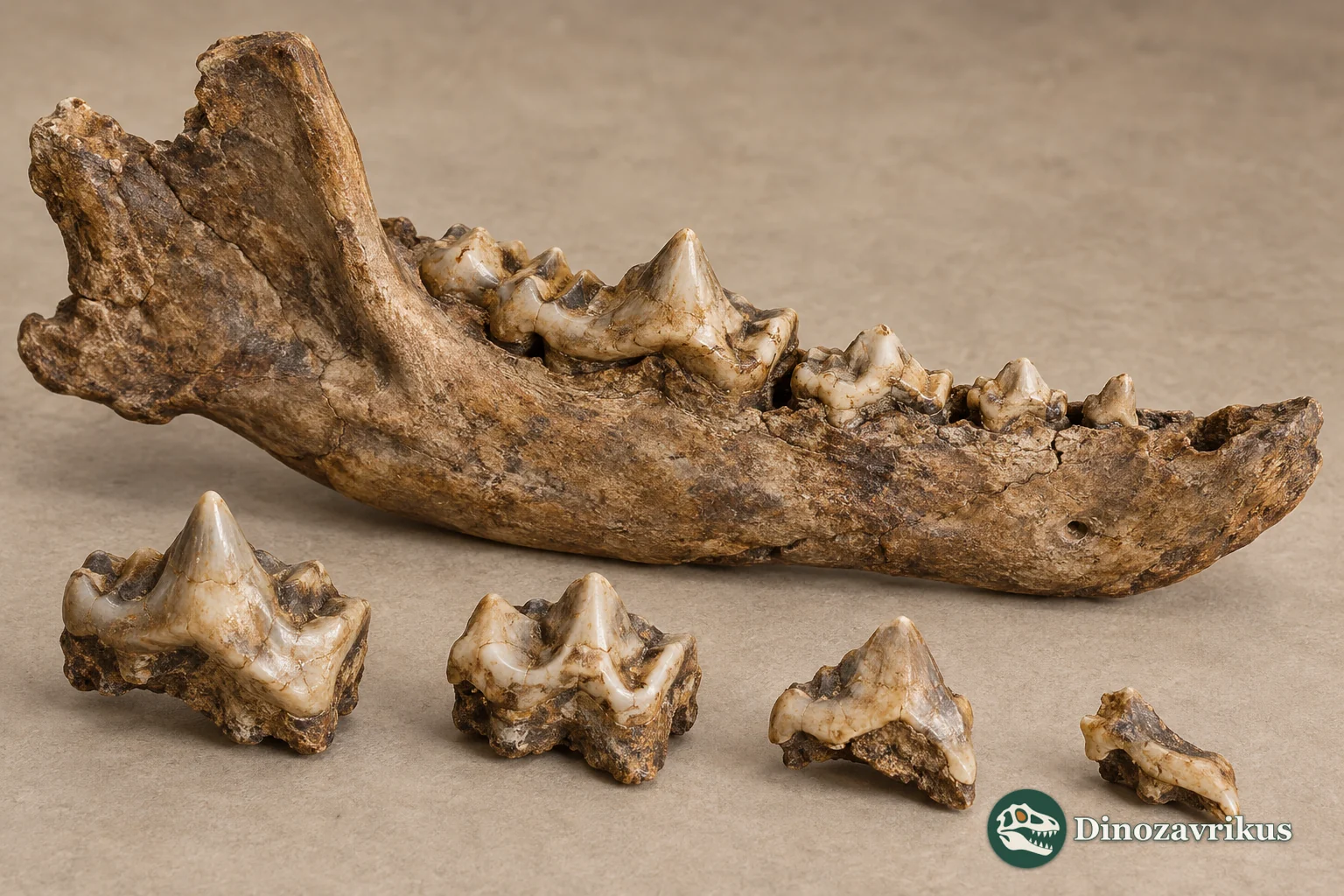
What the Dmanisi jaws show
Dentognathic remains from Dmanisi, Georgia, belong to a young adult attributed to Canis (Xenocyon) lycaonoides. The site is about 1.8 million years old. Reduction of the metaconid and entoconid on the lower carnassial helps distinguish its cutting teeth from those of less meat-specialized canids.
This anatomy supports a strongly carnivorous diet. It does not identify the prey at Dmanisi or prove that the fossil individual hunted with a pack. Such behavior is inferred through comparison with living canids and broader fossil evidence, and should remain distinct from the observed tooth features.

Range, body and unresolved kinship
Material assigned to this group occurs across parts of Europe and Asia. A preserved palate from Jinyuan Cave in northeastern China adds evidence for the species in the early middle Pleistocene. Comparisons suggest changes in jaw robustness and tooth proportions over time, though the pattern cannot be imposed on every population.
Researchers sometimes describe Xenocyon as wolf-sized or larger. That is a comparative body-size inference from incomplete remains, not a measured mass for the whole genus. Studies also disagree on whether it was a direct ancestor of the living African painted dog Lycaon pictus. Recent Chinese material has been used to support retaining Xenocyon as a separate genus, while another revision prefers a broader Lycaon.
The cover uses plausible canid proportions, but fur shade, ear shape and exact posture are artistic choices. Future associated skulls and limb bones could test current relationships more closely.
Frequently asked questions
Where are early Xenocyon fossils found?
Early jaw material has been described from Dmanisi in Georgia and the Gonghe Basin of Qinghai, China.
Why do papers write Canis (Xenocyon)?
The parentheses express a view that Xenocyon is a subgenus within Canis rather than a separate genus.
Does a carnassial prove pack hunting?
No. Tooth form supports meat consumption; pack hunting is a separate behavioral inference.
Was Xenocyon a direct ancestor of the African painted dog?
That remains disputed. Some revisions connect them directly, whereas others retain Xenocyon as a related distinct lineage.