

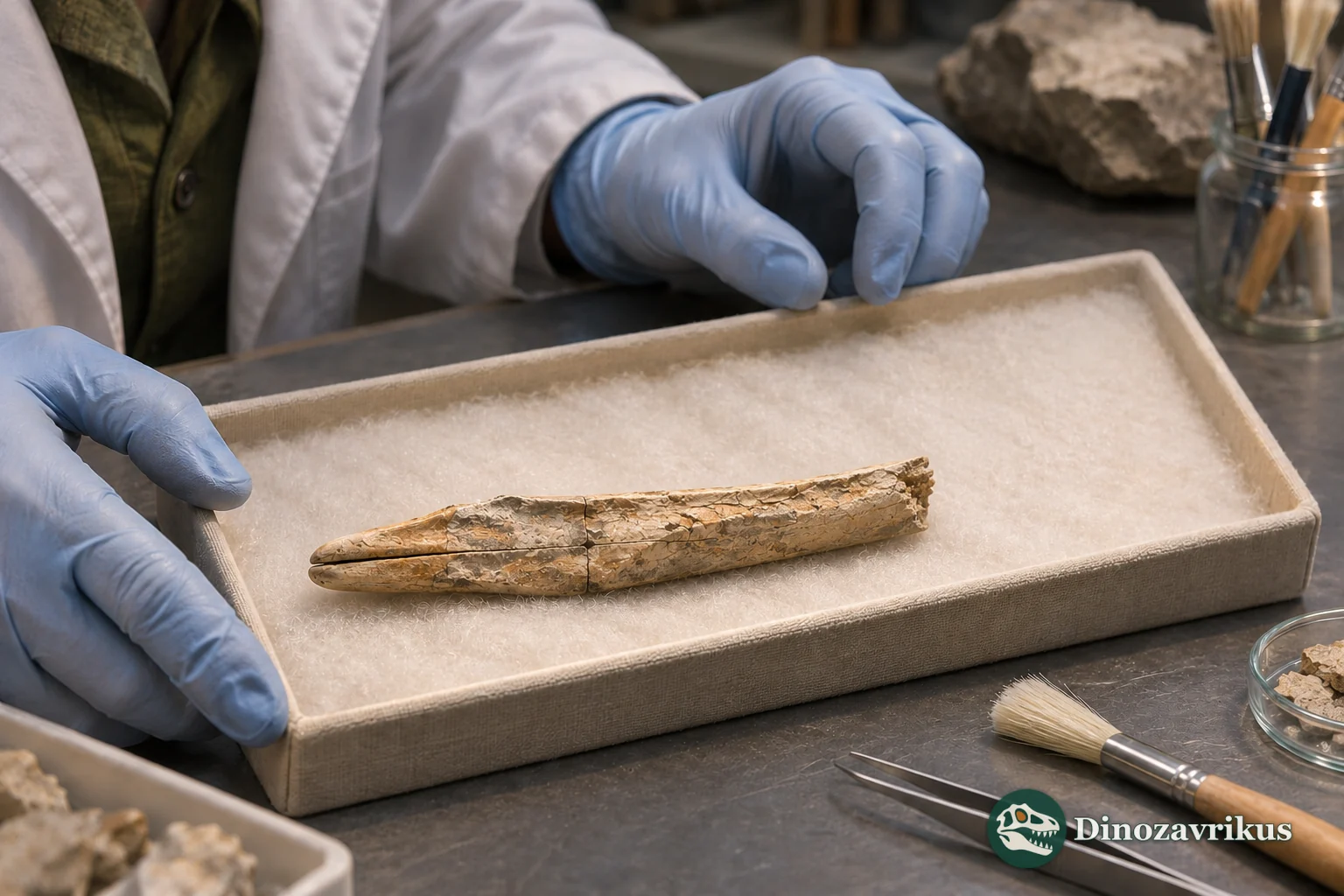
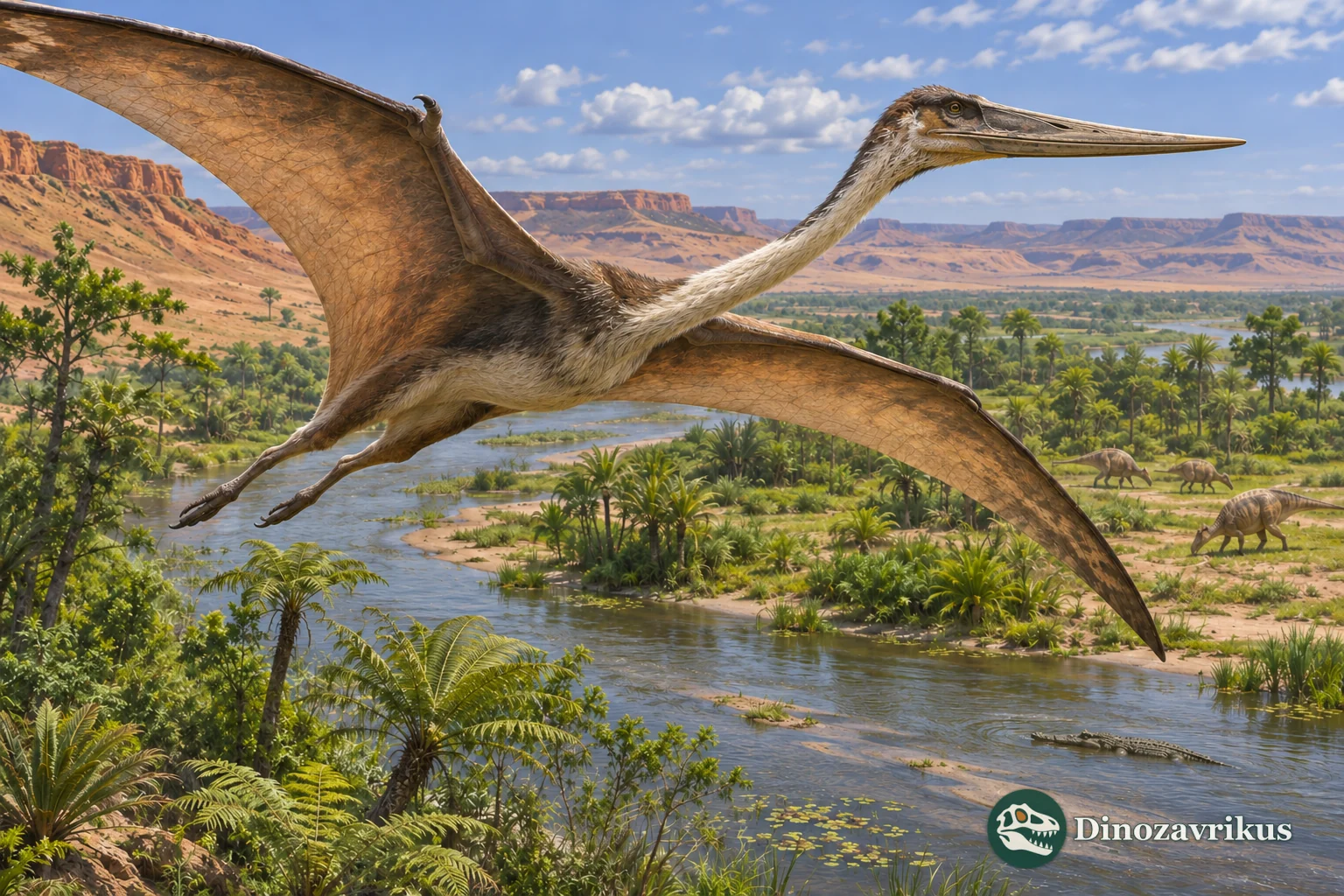
Xericeps curvirostris was named for the front of a lower jaw found in the Kem Kem beds of Morocco. The fossil is toothless, curves gently upward and carries distinctive grooves and ridges. It does not preserve the rest of the skull, wings or body. The complete animal on the cover is therefore a cautious artistic reconstruction.
Quick facts
| Named species | Xericeps curvirostris, Martill and colleagues, 2018 |
|---|---|
| Holotype | FSAC-KK 10700, anterior lower-jaw symphysis |
| Repository | Hassan II University collection, Casablanca |
| Locality | Aferdou N'Chaft near Hassi el Begaa, southeastern Morocco |
| Rock unit | Kem Kem beds; later assigned to the Ifezouane Formation |
| Age | Approximately Albian to Cenomanian |
| Group | Azhdarchoid; narrower placement remains uncertain |
| Wingspan | Unknown because no wing bone is preserved |
What can the fossils tell us?
FSAC-KK 10700 lacks the rear skull, neck, trunk and wings. Those parts in a full-animal illustration come from comparison with other pterosaurs.
The fragment lacks teeth and sockets. Grooves and paired ridges aid diagnosis, but they cannot identify an exact diet.
A later review discussed FSAC-KK 5203 in connection with Xericeps. It is not part of the holotype or a second piece of the same known skeleton.
A later stratigraphic review used the name Ifezouane Formation. The river scenery and complete animal are reconstructions, not a photograph of the discovery.
A single fragment from Kem Kem
David Martill and colleagues established Xericeps curvirostris from FSAC-KK 10700, found by local miners near Aferdou N'Chaft in southeastern Morocco. It is the fused front portion of the lower jaws, held in the Hassan II University collection in Casablanca. No associated upper skull, vertebra or wing belongs to the holotype.
The preserved jaw rises gently, and its surface has neither teeth nor tooth sockets. A central dorsal groove bordered by paired ridges toward the rear and a ventral midline groove form part of the diagnostic combination. The species name refers to curvature, but it does not reveal the entire missing beak or upper jaw.
Comparison without a full skull
The authors compared the mandibular symphysis with other toothless azhdarchoid pterosaurs. Alanqa is another Kem Kem taxon, but sharing a region does not make the fossils one species. A subsequent review discussed another fragment, FSAC-KK 5203, in relation to Xericeps. It remains separate material, not a continuation of the holotype.
A more precise position within azhdarchoids would benefit from more associated bones. The rear of the skull and neck cannot be restored confidently from the jaw front alone. There is no wing bone to measure, so a numerical wingspan for this species would be speculative.
Strata, setting and diet
The original description placed the jaw in the Kem Kem beds near the transition from Early to Late Cretaceous time. A later stratigraphic review refers the relevant beds to the Ifezouane Formation and gives an approximate Albian-Cenomanian range. The revised rock terminology does not add anatomical parts to the fossil.
Deposits in the area suggest a broad ancient river setting, but the actual place where this individual landed or fed is unknown. A toothless jaw section documents local anatomy rather than stomach contents or identified prey. Apatorhamphus offers another example of how fragmentary Kem Kem jaws require care when reconstructing whole pterosaurs.
What remains artistic
Body size, soft tissues, wing outline and colour cannot be determined for Xericeps from FSAC-KK 10700. The illustrations present one possible azhdarchoid appearance, with a restrained, nearly straight beak rather than exaggerating the gentle curvature visible in the preserved lower jaw.
Frequently asked questions
What is the Xericeps holotype?
FSAC-KK 10700 is the fused front portion of a toothless lower jaw; the rest of the skeleton was not found with it.
Did it have teeth?
No teeth or sockets are present on the preserved jaw fragment. Missing parts cannot be described with the same confidence.
Can its wingspan be measured?
No. The holotype includes no wing bones, so a complete wingspan would rely on uncertain comparisons.
Where was the fossil found?
It comes from the Kem Kem beds near Aferdou N'Chaft in southeastern Morocco, later assigned in a review to the Ifezouane Formation.