

Xiphodolamia is an extinct lamniform shark known chiefly from isolated teeth. Their forms differ enough that some were historically given separate species or genus names. Comparisons across larger collections suggest that tooth position within the jaw explains part of this variation. No complete skeleton is known to fix the shark's proportions, length or precise ecology.
Quick facts
| Type species | Xiphodolamia ensis Leidy, 1877 |
|---|---|
| Genus established | Joseph Leidy, 1877 |
| Classification | Lamniformes; family placement remains debated |
| Type locality | Eocene marls of New Jersey, USA |
| Known material | Isolated teeth; no associated skeleton |
| Genus range | Early to Late Eocene records |
| Recent name | X. maliki, described from Lutetian Turkey in 2025 |
| Body size and diet | Not established from isolated teeth |
What can the fossils tell us?
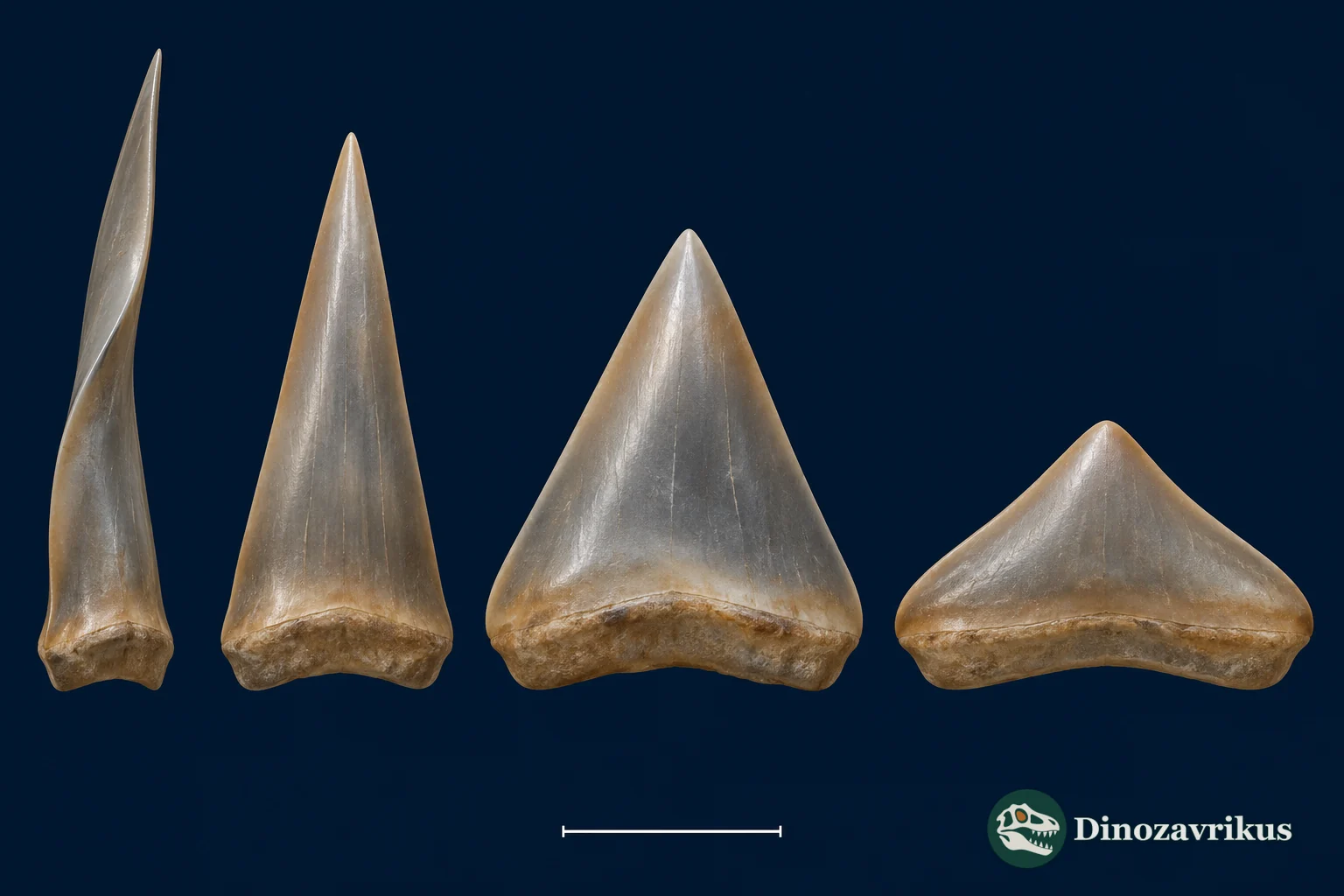
Collections show narrow, strongly compressed anterior teeth and broader lateral or posterior forms. A reconstructed tooth row is an interpretation; the isolated teeth are not an articulated jaw.
A 2009 review grouped many Early and Middle Eocene forms with X. ensis and recognised the serrated Late Eocene X. serrata. A new species, X. maliki, was described in 2025. These are successive taxonomic decisions, not a single timeless list.
The type species is based on New Jersey teeth; X. maliki comes from the Lutetian Soğucak Formation near Istanbul. Other records span Europe, Central Asia and the Tethyan region. They do not chart one population's migration route.
From New Jersey teeth to a named genus
Joseph Leidy established Xiphodolamia in 1877. Its type species, X. ensis, is based on teeth from Eocene marls in New Jersey. Similar-looking teeth later appeared under other names. For a time, several authors used Xenodolamia eocaena for material subsequently compared with Xiphodolamia, creating a history of shifting combinations and uncertain boundaries.
The naming history reflects a practical problem: isolated teeth may differ not only between species but also between positions in one jaw. A tooth set linked to a jaw can show that variation directly; most Xiphodolamia material is not preserved that way. A similar challenge occurs in other tooth-based sharks, including Macrorhizodus, whose fossils also require careful distinction between specimen evidence and reconstruction.
A varied tooth row reconstructed from collections
In 2009, Sylvain Adnet and colleagues compared old and newly collected teeth, including 92 intact specimens from Aktulagay in western Kazakhstan. They assigned the collection to the middle Ypresian, Early Eocene. Changes in crown height and root width led them to reconstruct several tooth positions and possible differences between young and adult individuals. The proposed arrangement was inferred from isolated teeth, not recovered as a complete jaw.
Some anterior teeth are strongly flattened from front to back and have a slightly sigmoid outline. Their cutting edge can twist across the crown face toward the tip. Lateral teeth are broader and angle backward, while posterior crowns are lower and more triangular. These forms help explain why specimens can look unlike each other without proving that every named form represents a separate species.
Species names through successive revisions
Adnet and colleagues treated X. ensis as the Early and Middle Eocene species, placing many teeth formerly called X. eocaena or X. barbadica in synonymy. They distinguished X. serrata by slight serrations along the cutting edges. They associated that form with Late Eocene deposits in Angola, Jordan and Iran, extending the published genus record later in the epoch.
In 2025, M. Levent Artüz and Mehmet Sakinç described X. maliki from the Lutetian Soğucak Formation at Küçükçekmece near Istanbul. They studied 44 teeth assigned to Xiphodolamia from a museum collection assembled by geologist Malik Sayar in 1954–1955. The new species has a narrow triangular crown with smooth surfaces and no lateral cusplets or serrations. Its designation adds a distinct interpretation to a genus whose names have long depended on tooth comparisons.
Eocene localities across several regions
Published Xiphodolamia teeth come from the Early and Middle Eocene in North America, Europe and Central Asia. Late Eocene records of X. serrata add localities around the Tethys and western Africa. The new species X. maliki adds a Lutetian occurrence from Turkey. Each site has its own stratigraphic context; the scattered records do not demonstrate an uninterrupted route followed by one population.
The age of an individual fossil is taken from the sedimentary unit and associated biostratigraphy, not from the crown's outline. Local marine deposits also do not reveal whether the living shark stayed near shore or ranged into deeper water. Palaeoenvironmental conclusions must be kept separate from the taxonomic identification of the tooth itself.
A lamniform with an unresolved family position
Xiphodolamia is placed in Lamniformes, the shark order that includes mackerel sharks. Its closer family-level position has been discussed. Adnet and colleagues in 2009 left the placement uncertain, citing a mix of dental characters. The 2025 description of X. maliki uses Xiphodolamiidae. This reflects different taxonomic treatments rather than different fossil evidence for the genus as a whole.
No complete skeleton establishes the head shape, fin proportions or total length of the shark. Isolated teeth do not preserve colour, speed, hunting behaviour or direct prey remains. The cover image is deliberately labelled as a generic artistic impression. More associated material would be needed to replace that broad outline with a species-specific reconstruction.
Frequently asked questions
When did Xiphodolamia live?
Published records range from the Early Eocene to Late Eocene, including the Lutetian species X. maliki and Late Eocene X. serrata. Ages apply to particular fossil horizons.
Why do Xiphodolamia teeth look so different?
Tooth form changes along a shark's jaw. The 2009 review interpreted several isolated crown forms as different positions, with possible growth variation; the fossils do not preserve a full tooth row.
How many Xiphodolamia species are recognised?
At least three species have been described by 2025: X. ensis, X. serrata and X. maliki. Some older names, including X. eocaena, have been treated as synonyms in particular revisions.
Do the teeth show the shark's size or diet?
No complete skeleton or directly associated meal establishes its total length or exact diet. Tooth shape provides evidence about crown form and probable position, not a complete ecological portrait.