

Acrolamna was a Cretaceous lamniform shark with flattened teeth and smooth cutting edges. The edge continues from the central cusp onto low shoulders. Eight teeth from the Orenburg region of Russia preserve differences in crown and root shape along the jaw.
Quick facts
| Order | Lamniformes |
|---|---|
| Fossils | Isolated teeth |
| Locality | Akkermanovka, Orenburg region |
| Locality age | Santonian to possibly Early Campanian |
| Anterior teeth | Up to 15 mm high in the Orenburg sample |
| Crown | Smooth cutting edge with low shoulders |
What can the fossils tell us?
The sample includes two anterior, three anterolateral and three lateral teeth. They were found separately.
Towards the corners of the mouth the root becomes more asymmetric and the notch becomes shallower.
The Orenburg assemblage indicates a Santonian to possibly Early Campanian age, supported by the lithology.
The Akkermanovka teeth
Eight mostly complete teeth of Acrolamna acuminata were described from Akkermanovka. The Museum of the World Ocean in Kaliningrad holds them as MMO 12260/1–8. Two were identified as anterior, three as anterolateral and three as lateral teeth. Front teeth in the sample reach 15 mm in height and 10 mm in width.
An anterior crown is sharp and nearly symmetrical. A lateral crown is wider and leans towards the corner of the mouth. The outer face is flat and the inner face convex. The smooth edge continues along the central cusp and both low shoulders. Paraisurus also had smooth cutting edges. The low shoulders and the outline of the root help identify Acrolamna.
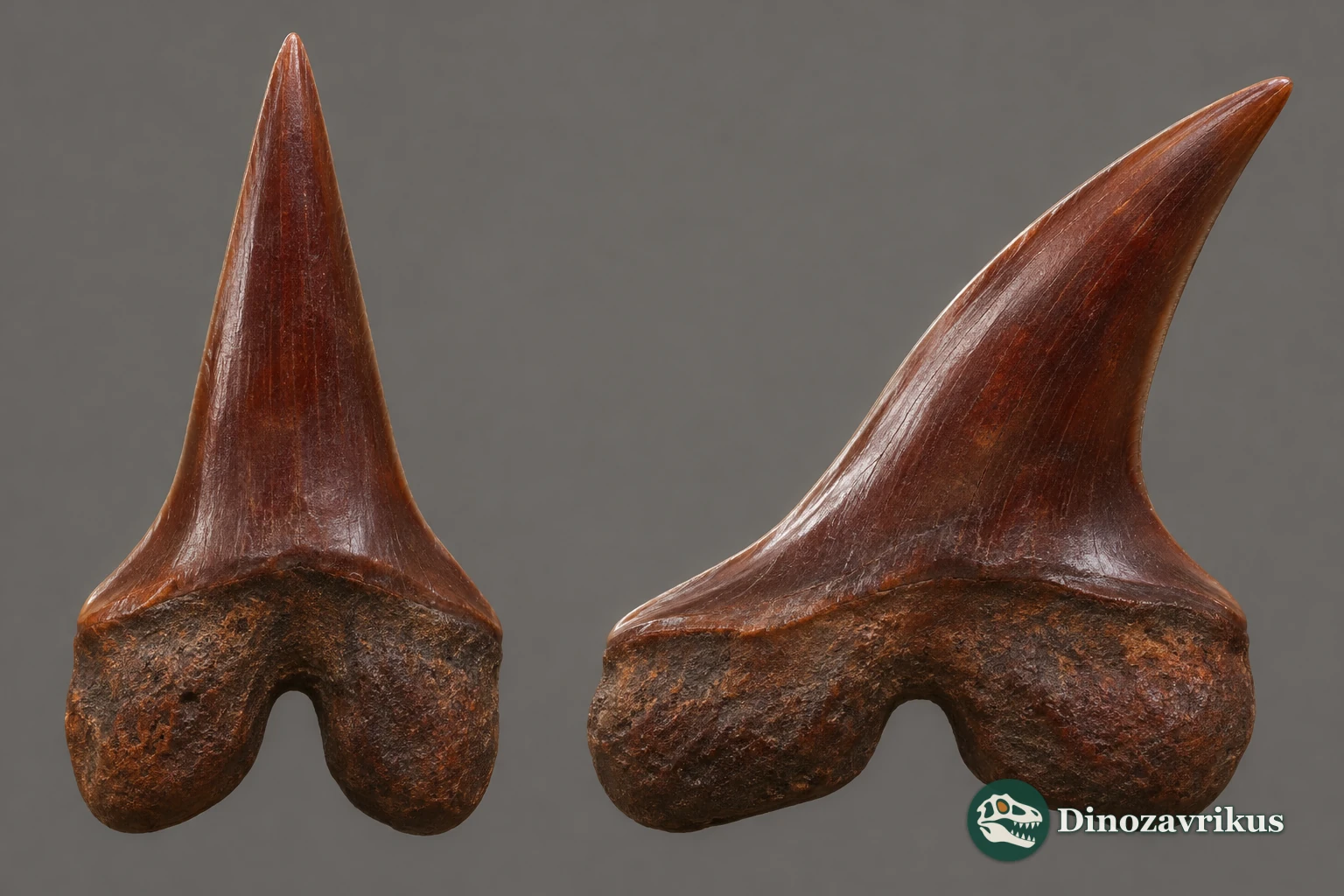
How the root changes along the jaw
The root lobes are almost symmetrical at the front, separated by a deep U-shaped notch. Farther back, one lobe broadens and the notch becomes shallower. The inner root has a single opening and lacks a nutritive groove. These features let researchers compare loose teeth when a whole set is absent.
The thin cutting edges could have sliced prey. The teeth cannot reveal its diet directly or establish its body length.
Records from Kazakhstan and Russia
Vladimir Zhelezko established the genus in 1990. The original type form comes from the lower Campanian of Terekty in western Kazakhstan. The Akkermanovka study also recognised A. crassicornis from Coniacian and Santonian deposits in Kazakhstan. Several additional named forms remain doubtful because their diagnostic features are poorly established.
The Orenburg fossils accumulated in a shallow sea that covered the Southern Urals. The vertebrate assemblage as a whole suggests a Santonian to possibly Early Campanian age. A tooth identified as Acrolamna has also been reported from the Kornevka River alluvium in the Kaliningrad region, where older fossils occur in reworked material derived from glacial till.
Frequently asked questions
How many teeth were described from Akkermanovka?
Eight, including anterior, anterolateral and lateral teeth.
Were the cutting edges serrated?
The observed edges are smooth and continue onto both shoulders.
Where is the Orenburg material held?
At the Museum of the World Ocean in Kaliningrad as specimens MMO 12260/1–8.
How did a Cretaceous tooth reach river deposits?
The river redeposited material derived from a moraine, including the tooth originally preserved in older rock.