

Paraisurus was a Cretaceous lamniform shark recognised by a single cutting cusp and a substantial root. Several of its teeth were found together near Trento. Tiny fossils in the surrounding rock helped resolve when they were deposited.
Quick facts
| Order | Lamniformes |
|---|---|
| Type species | Paraisurus macrorhizus |
| Age of the Trento material | Albian, Early Cretaceous |
| Fossils | Isolated and associated teeth |
| Crown | A cutting cusp without side cusplets |
| Body length | Undetermined |
What can the fossils tell us?
Calcareous nannofossils in the rock around the Italian teeth point to an Albian age.
The forms match two named species in Amalfitano’s small sample.
The combination of Paraisurus and Cretoxyrhina points to a Late Albian age for the sampled beds.
An Italian find with an uncertain age
Pictet and Campiche described the type species, now called Paraisurus macrorhizus, under Oxyrhina in 1858. Leonid Glickman established Paraisurus in 1957. Giuseppe D’Erasmo reported the teeth from a quarry near Trento in 1927. Their age remained unresolved when Giacomo Amalfitano revisited the material in 2021.
Amalfitano described both isolated and associated teeth. Calcareous nannofossils in the enclosing rock placed the find in the Albian, the last stage of the Early Cretaceous. The associated group allows the teeth to be compared even when each tooth’s position in the jaw is uncertain.
A single cutting cusp
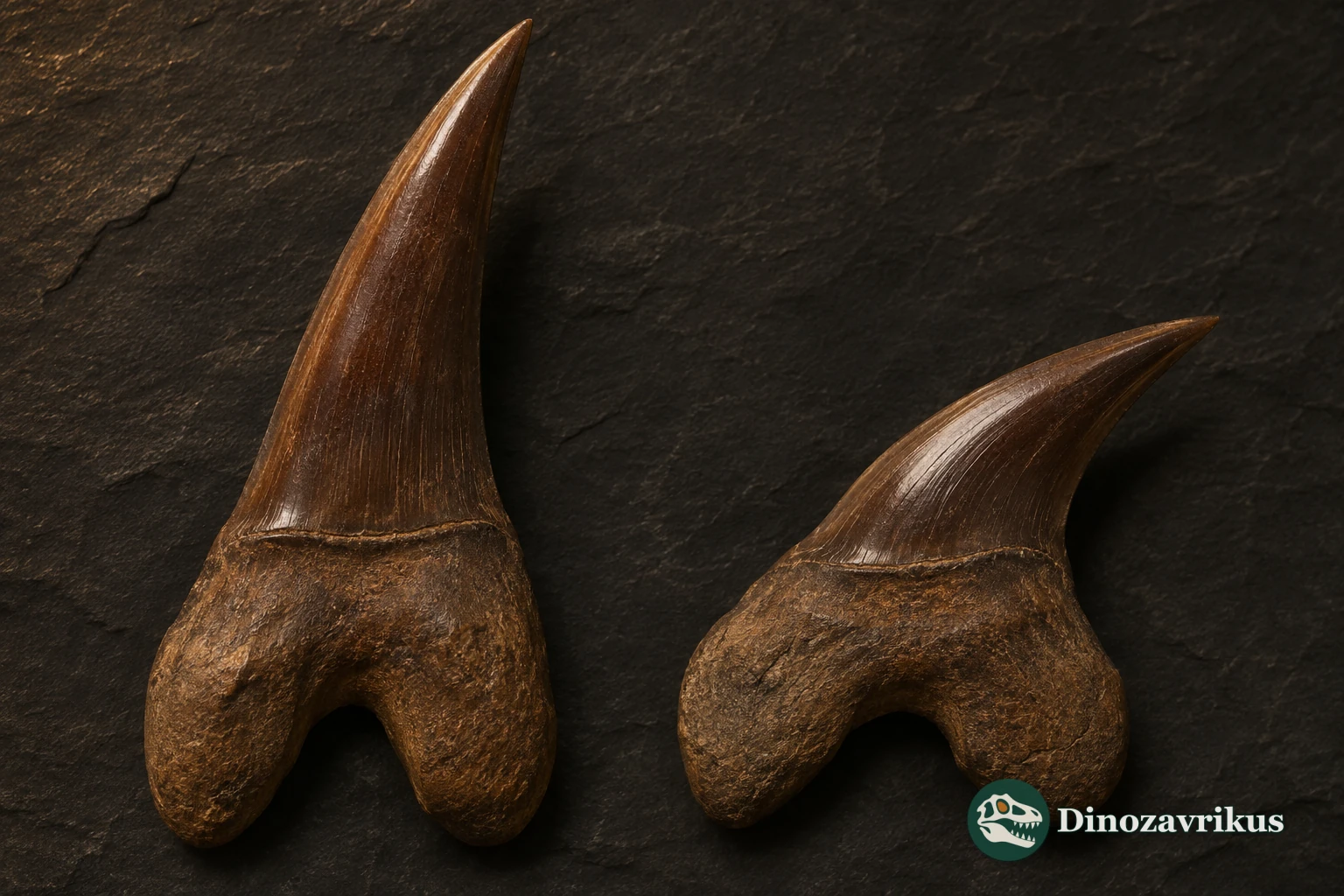
Two teeth from Melovatka-5 in the Volga region are approximately 15 mm high. Saratov State University holds them as specimens 155/39 and 155/40. Each has a substantial crown without side cusplets. Its outer face is nearly flat and its inner face strongly convex.
The smooth sharp edge could grip and cut prey. The fossils give no direct evidence of particular prey. In Cardabiodon, associated teeth allowed researchers to estimate the length of the lower dental arcade. Comparable evidence for a body length estimate is unavailable for Paraisurus.
Species and finds beyond Italy
Amalfitano’s statistical comparison of a small dataset recovered two groups corresponding to P. macrorhizus and P. compressus. Teeth named P. amudarjensis clustered with the second form, leading the author to propose treating that name as a junior synonym of P. compressus.
Near Kaniv, Tymofii Sokolskyi and Guillaume Guinot found P. macrorhizus alongside Cretoxyrhina vraconensis. Together the two species supported a Late Albian age for the sampled quartz and glauconite sands. Volga-region finds collected from Lower Cenomanian beds may have been eroded from older deposits and redeposited.
Frequently asked questions
What identifies a Paraisurus tooth?
A single smooth-edged cutting cusp with no lateral cusplets, supported by a substantial root.
How were the Italian teeth dated?
Calcareous nannofossils from the rock around them indicated an Albian age.
Why does the name amudarjensis appear in older accounts?
It was described as a separate species. Amalfitano’s comparison suggested that it belongs with P. compressus.
How long was the shark?
Known teeth provide crown measurements. They do not yield a reliable estimate of body length.