

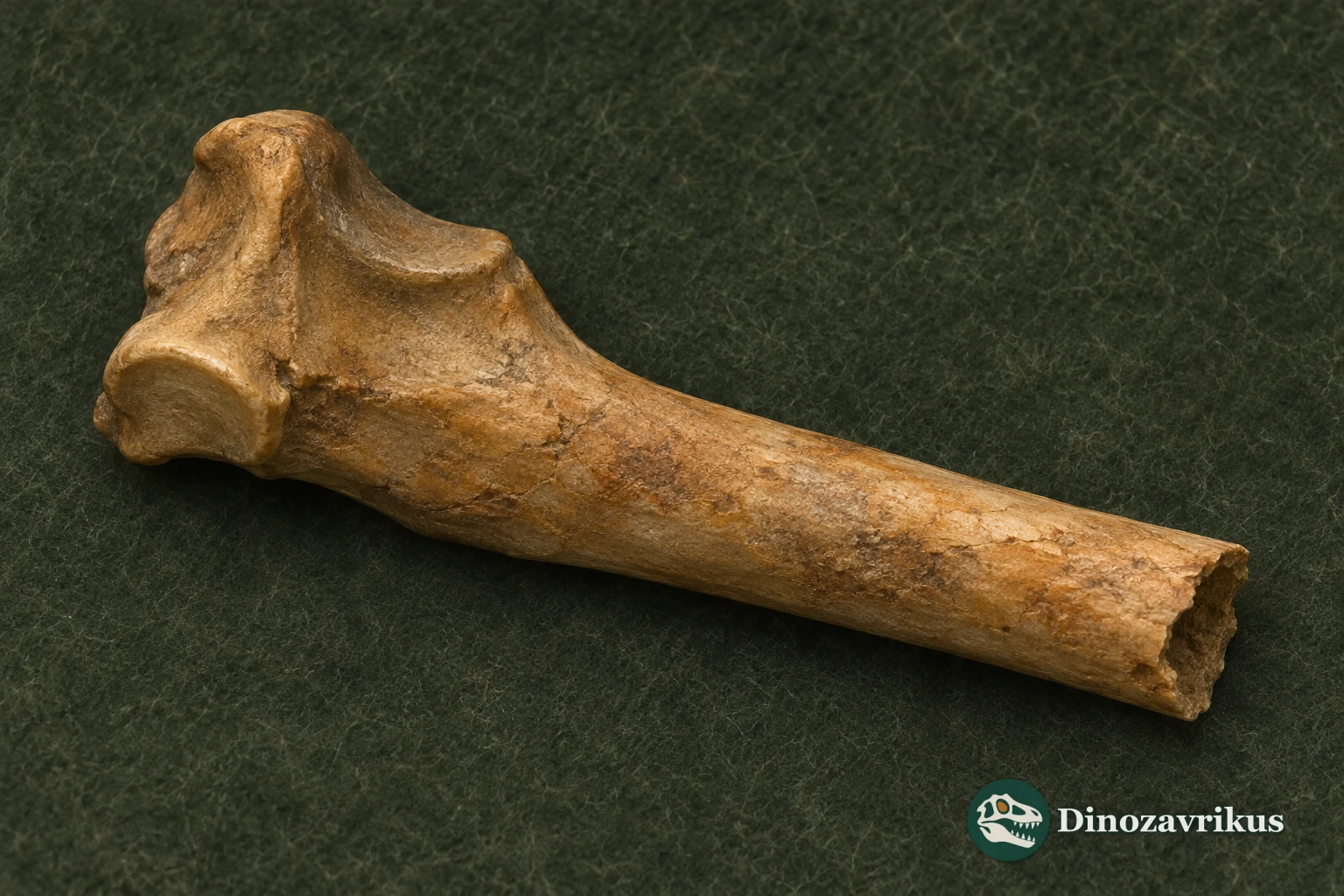
Actiornis anglicus was named for part of an elbow joint from the late Eocene of southern England. The bone was first assigned to the cormorant family and later compared with ibises. A revision of the original material challenged both identifications.
Quick facts
| Type species | Actiornis anglicus |
|---|---|
| Group | Bird of uncertain affinities |
| Age | Late Eocene |
| Locality | Hordle, Hampshire, England |
| Holotype | BMNH 30328 |
| Type material | Proximal end of right ulna |
What can the fossils tell us?
The fragment preserves joint surfaces and a bony projection for muscle attachment. Its total length is unknown.
One shoulder-to-elbow bone was originally described as Elornis anglicus. A 1976 revision assigned it to Actiornis.
Storrs Olson noted that the olecranon is less pronounced than in ibises. He also disagreed with the original cormorant identification.
A fragment from Hordle
Richard Lydekker described the species in 1891. The type, BMNH 30328, is held at London’s Natural History Museum. It comes from late Eocene strata of the Headon Hill Formation, where separate wing and shoulder bones preserve evidence of other birds, including the debated Petropluvialis.
From cormorant to possible ibis
In 1976 Colin Harrison and Cyril Walker referred two incomplete humeri and part of a tarsometatarsus to Actiornis. Lydekker had named one of those humeri Elornis anglicus and classified it with flamingos. The revision interpreted the two names as one species of ibis.
In 1981 Olson pointed to the relatively inconspicuous olecranon, a projection at the elbow. He agreed that the type was not from a cormorant but found no clear evidence that it belonged to an ibis. Without associated bones or a more complete skeleton, the size and feeding habits of this bird are uncertain.
Frequently asked questions
Where was Actiornis found?
At Hordle in Hampshire, England, in late Eocene rocks.
What fossil established the species?
BMNH 30328, the upper end of a right ulna.
Was it an ibis?
Harrison and Walker suggested that identification, but Olson found the type bone inconclusive.
What was Elornis anglicus?
Lydekker’s original name for an isolated humerus that was later referred to Actiornis.