

Christopher Duffin and David Ward described Agaleus in 1983 on the evidence of three teeth. Two came from fallen blocks at Lyme Regis in southern England. A thick main cusp, ridges around the base of the crown and a deep root also help identify this Early Jurassic shark at other European sites.
Quick facts
| Age | Early Jurassic |
|---|---|
| Material | Isolated teeth |
| Type locality | Lyme Regis, Dorset |
| Holotype | Tooth P.60788, London |
| Holotype height | 6.9 mm |
What can the fossils tell us?
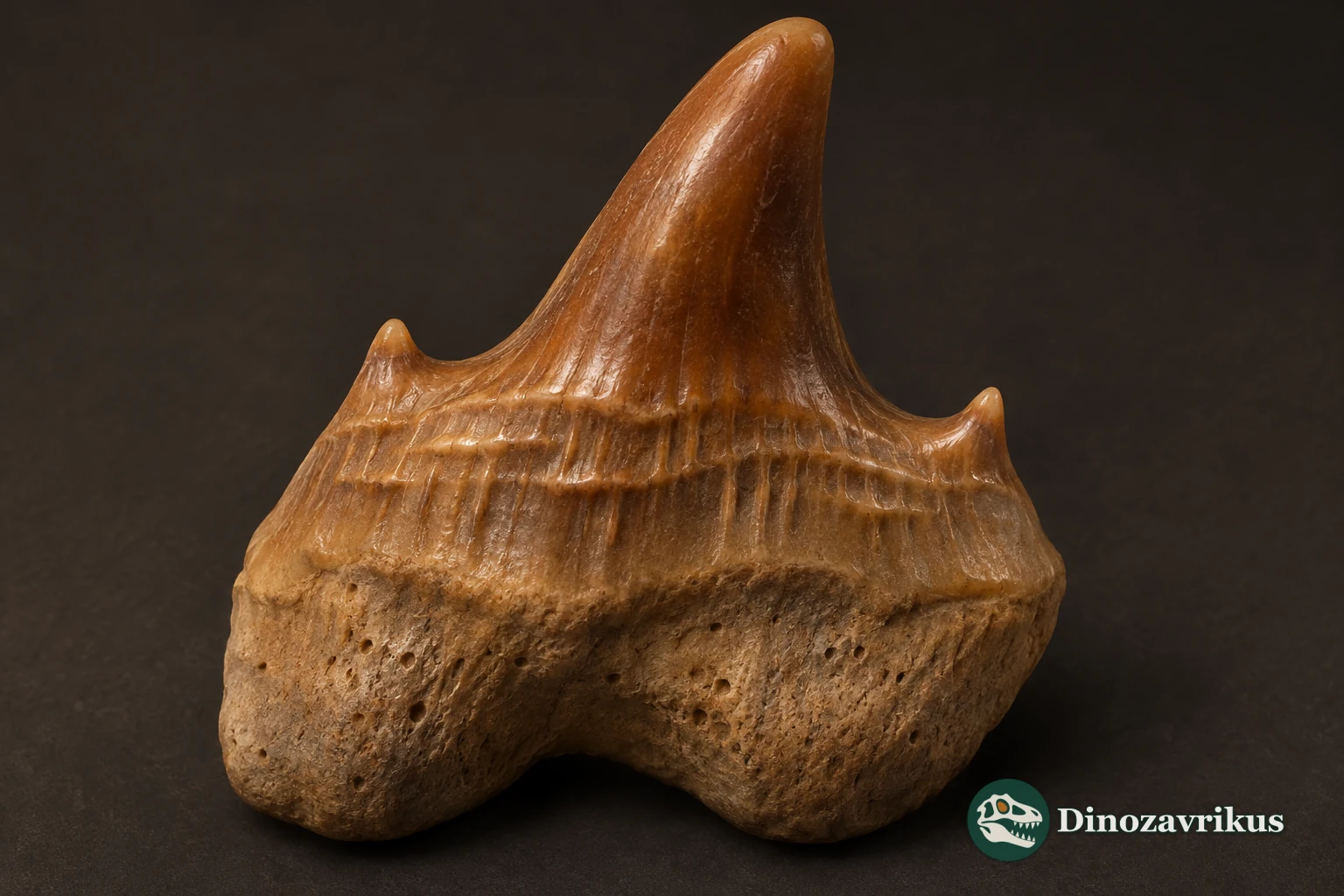
The tooth shows lateral cusplets, ridges on the crown and a V-shaped root base. Its main cusp preserves wear acquired during life.
Two incomplete teeth were described from the upper Pliensbachian at Grimmen. Their crowns and roots allowed comparison with the English type material.
Microscopy revealed three layers in the enameloid. The structure supports galeomorph affinities, while the precise position within that group remains uncertain.
Three teeth and two collectors
Andrew Gale found the holotype of Agaleus dorsetensis in a fallen block below Church Cliff. The genus honours Gale and the species name refers to Dorset. Tooth P.60788 is in the Natural History Museum, London. It is 6.9 millimetres high and measures 6.5 millimetres from its outer to inner face.
David Kemp found another crown, P.60789, in 1975 below the same cliff. Both specimens came from the Blue Lias, and the original authors considered them probably early Sinemurian. The label on the third specimen, GSM 117084, records only the Lower Lias. Its locality is unknown.
Ridges, cusplets and root
The main cusp inclines towards the tongue, with one small cusplet on either side. A crest runs through the tips to form cutting edges. Interrupted horizontal ridges run around the lower crown, some carrying short vertical folds. The deep root is V-shaped at its base, with openings for canals below and on its side faces.
Duffin and Ward noted wear acquired during life at the tip and on the outer face of the holotype. They proposed that Agaleus lived close to the seafloor and might have eaten hard-shelled prey. No direct record of its prey is known, and wear alone cannot identify a particular food.
Other shores of the Early Jurassic sea
The Pliensbachian Hasle Formation on the Danish island of Bornholm has yielded Agaleus teeth. In 2019, Sebastian Stumpf and Jürgen Kriwet described two incomplete teeth from later Pliensbachian deposits at Grimmen in north-eastern Germany. The same nearshore deposits preserve teeth of Palidiplospinax, an early shark from a different lineage.
The first description placed Agaleus among carpet sharks on dental grounds. Jan Rees later placed it in a family of its own. Microscopic study revealed three layers of enameloid, with a structure distinct from that of the Triassic sharks used for comparison. The results support the broader galeomorph grouping, but the teeth have yet to establish a precise order.
Frequently asked questions
Why is Agaleus named after Gale?
Andrew Gale collected the tooth on which the genus is based. The species name refers to the county of Dorset.
Does 6.9 mm refer to body length?
No. It is the measured height of the holotype tooth, from root base to cusp tip. The shark’s body length remains unknown.
Where is Agaleus known outside England?
Verified examples include Bornholm in Denmark and Grimmen in north-eastern Germany.
Was Agaleus a carpet shark?
Its first describers proposed that relationship. Later research placed it in a separate family of galeomorph sharks whose exact affinities remain open.