

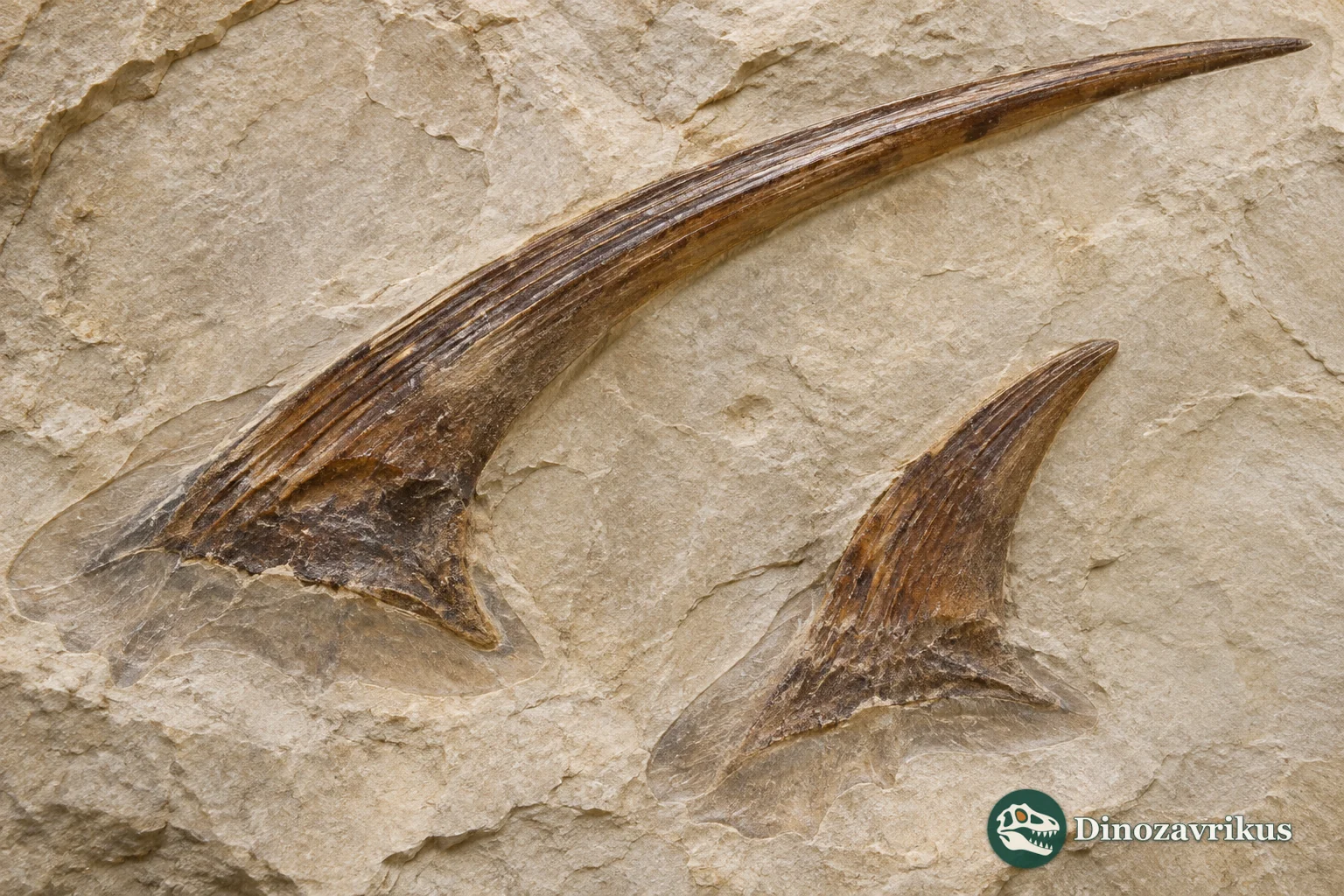
Palidiplospinax was a small extinct shark of Early Jurassic European seas. Unlike many fossil sharks, it is known from skeletal remains as well as isolated teeth. Stefanie Klug and Jürgen Kriwet established the genus in 2008 after revisiting specimens previously placed among other palaeospinacids. A spine before each of two dorsal fins proved especially informative.
Quick facts
| Type species | Palidiplospinax enniskilleni |
|---|---|
| Genus named | Klug and Kriwet, 2008 |
| Secure skeletal age | Early Jurassic |
| Key localities | Lyme Regis and southern Germany |
| Key character | Spines before both dorsal fins |
| Prey | Not directly identified |
What can the fossils tell us?
Early Jurassic English and German specimens preserve body parts including fins and dorsal spines. Species vary in completeness, so a feature observed in one cannot automatically be assigned to all.
Comparative skeletons show a spine before each of two dorsal fins, a different arrangement from related genera.
The central cusp, side cusplets and root shape add dental evidence, but a similar isolated tooth need not belong to a particular skeletal species.
Why the genus was established
Earlier workers placed similar Jurassic shark remains in Palaeospinax and Synechodus. Palaeospinacid teeth often resemble one another, while articulated skeletons were uncommon. Klug and Kriwet compared material from Lyme Regis in southern England and Holzmaden in southern Germany with later Jurassic sharks. Dental form together with dorsal-fin anatomy supported a separate genus.
The type species, P. enniskilleni, had originally been described as Synechodus enniskilleni. The revision also included P. occultidens and P. smithwoodwardi. These names identify different fossil species, not successive life stages of one shark. Later work has discussed additional German material, so species boundaries may continue to be refined.
What survived
Skeletal finds from Lyme Regis and Holzmaden allow study of heads, vertebral columns, fins and associated spines in individual specimens. Preservation differs among species. For example, the specimen referred to P. smithwoodwardi retains a vertebral column and appendages but lacks a skull; its own head cannot be directly measured from that specimen.
This is a richer kind of evidence than teeth alone. Palaeobates preserves a partial jaw and fin material, whereas Cretomanta is known from tiny teeth. Those contrasts concern fossil preservation, not a demonstrated close relationship among the three.
Fin spines and teeth
The studied Early Jurassic palaeospinacids have spines before both dorsal fins. The compared Synechodus bears two dorsal fins without such spines, while Paraorthacodus has a different fin arrangement. The diagnosis rests on several characters rather than a single detached spine.
Teeth carry a principal cusp and side cusplets. Researchers compare cusp shape, symmetry, the decline in cusplet height and root form to distinguish related species. An isolated similar tooth cannot always be linked confidently to a particular skeletal species. The younger Odontorhytis has a different dental record and taxonomic history.
Age, habitat and reconstruction
The main skeletal records come from Early Jurassic marine strata in England and Germany. Later Jurassic skeletons used in the 2008 comparison belonged to other genera; they do not by themselves extend the age of Palidiplospinax into the Late Jurassic.
The fossils support two dorsal fins with spines and a general body outline. The cover's colour and living pose are artistic. No direct stomach contents establish a particular prey animal; teeth permit feeding comparisons but do not replace that missing evidence.
Frequently asked questions
How does Palidiplospinax differ from similar sharks?
Studied skeletons show a spine before each of two dorsal fins; tooth characters add further distinctions.
Is a complete skeleton known?
Skeletal remains preserve several body regions, but completeness varies by species and specimen.
When did the genus live?
Secure skeletal finds come from the Early Jurassic of Europe.
What did it eat?
Specific prey is not identified by direct stomach contents or equivalent evidence.