

Odontorhytis is an extinct shark identified from distinctive isolated teeth. Böhm named its type species, O. pappenheimi, in 1926. Later finds clarified dental anatomy and widened its known range, but no complete body has been found. The cover is a cautious artistic reconstruction, not a portrait of a preserved specimen.
Quick facts
| Type species | Odontorhytis pappenheimi |
|---|---|
| Named | Böhm, 1926 |
| Age | Paleogene; well-studied Eocene teeth |
| Tunisian sample | More than 300 isolated teeth |
| Crown height in Tunisia | 5–14 mm |
| Body length | Not established from the teeth |
What can the fossils tell us?
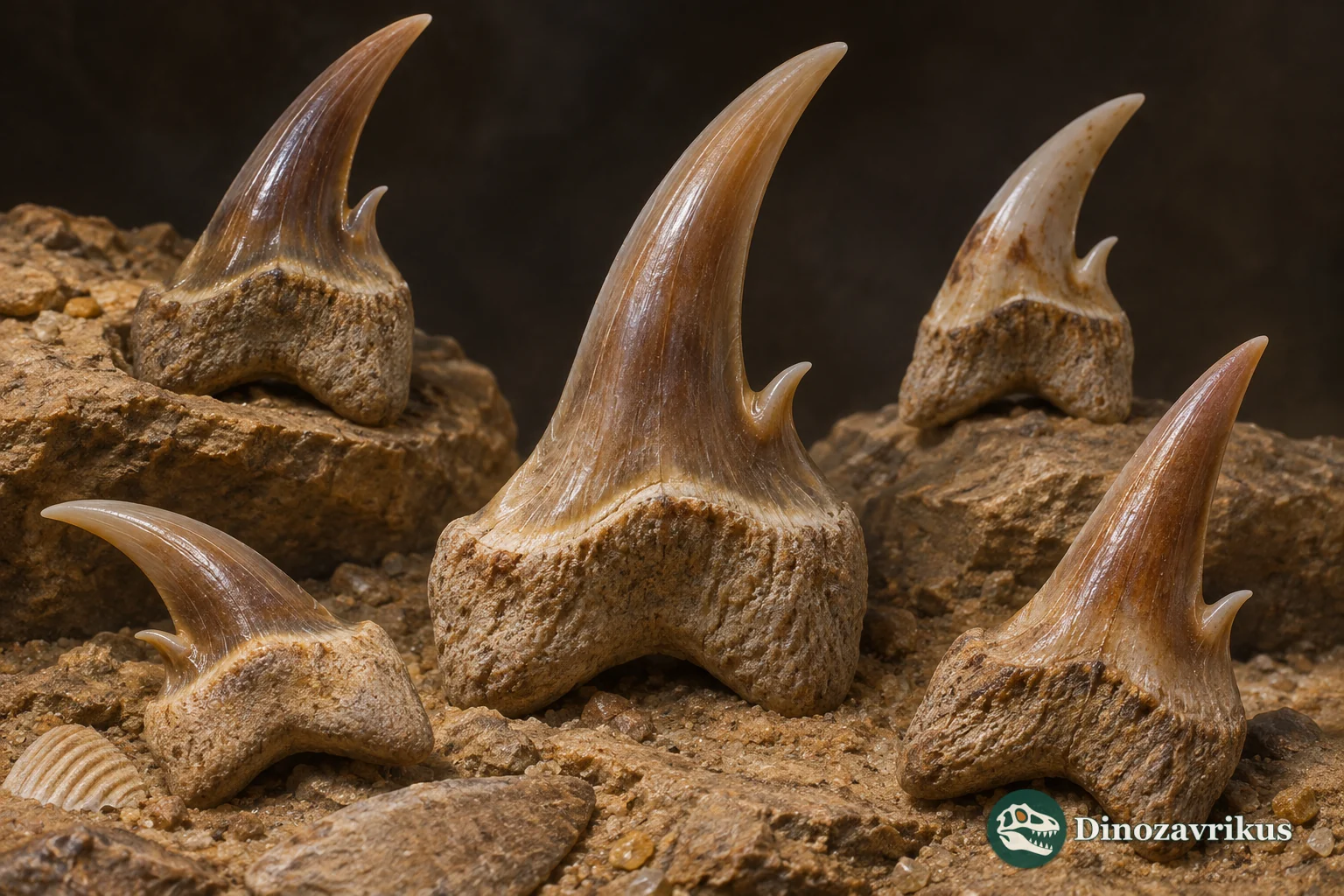
Teeth carry a high inward-slanting cusp with a small hooklike barb. The Tunisian sample contains over 300 separate teeth, not one complete jaw.
The type species came from Namibia. Comparable teeth occur in Tunisia, Egypt and Pakistan; Indian teeth were referred to the genus with a qualification.
Researchers leave the shark's exact order uncertain. No preserved skeleton verifies its body length, silhouette or colour.
Naming and discovery
The type species was named from Namibian fossil material. Paleontologists recognize Odontorhytis through a combination of dental characters, especially a tall pointed main cusp slanting toward the inside of the jaw and a small hooklike projection on its inner side.
A large sample from KEB-1 at Djebel el Kébar in central Tunisia yielded more than 300 teeth referred to O. pappenheimi. The researchers cautioned that several undescribed species may be hidden under that historical name. Hundreds of shed teeth do not count hundreds of individual sharks.
What the teeth show
Crown heights in the Tunisian sample range from 5 to 14 mm. The teeth are nearly symmetrical and compressed along the jaw. Their chief cusp is tall, sharp and tilted inward, with a barb visible from the side. Crown enameloid is largely smooth, though fine folds can occur near the inner base. The relatively high, thick root has a grooved projection.
Teeth interpreted as anterior have more slender cusps; presumed lateral teeth tend to have shorter, more massive cusps. These positions were inferred by comparing isolated shapes, not observed in an intact tooth row. Crown height cannot by itself establish the length of the shark.
Eocene waters and occurrences
The Tunisian series comes from lagoonal Eocene deposits of the Souar and Fortuna formations. Similar finds are reported from Egypt and Pakistan. Indian material from the Bandah Formation was called close to O. pappenheimi, with a qualification based on differences in morphology; that identification should not be treated as certain species-level proof.
Other Paleogene sharks include Striatolamia, Physogaleus and Parotodus. Their presence in related marine records illustrates diversity, not a demonstrated close relationship. Sediment indicates coastal and lagoonal settings, but the exact depth of an individual Odontorhytis is not known.
Classification and reconstruction limits
The Tunisian study lists the genus among sharks of uncertain order. Dental anatomy identifies its fossils, but without a skull and fin skeleton its position among shark lineages remains difficult to resolve. The Egyptian species O. bahariensis was named separately, although authors have discussed whether some differences could reflect age rather than species. Isolated crowns alone have not settled the question.
There are no stomach contents or direct prey traces assigned to this shark. Pointed teeth are compatible with grasping relatively soft prey, but do not identify a particular animal. The cover's colour, body proportions and swimming pose are artistic choices.
Frequently asked questions
What fossils identify Odontorhytis?
Mainly isolated teeth. More than 300 were studied from Eocene locality KEB-1 in Tunisia.
What is unusual about its teeth?
They have a tall sharp cusp leaning inward and a small barb on its inner side.
Do we know its body length?
No. The studied Tunisian crown heights are 5–14 mm, but they do not yield a reliable total length.
Why is its classification uncertain?
Isolated teeth provide limited characters, and a diagnostic skull or more complete skeleton has not been found.