

Cretomanta is a Cretaceous cartilaginous fish known from minute isolated teeth. Case, Tokaryk and Baird named its type species, C. canadensis, in 1990 from Saskatchewan. The manta-like name does not prove that it looked like a living manta. Even its precise placement among rays remains debated.
Quick facts
| Type species | Cretomanta canadensis |
|---|---|
| Named | Case, Tokaryk and Baird, 1990 |
| Main evidence | Isolated teeth up to 1.5 mm high |
| Locality | Saskatchewan, Canada |
| Studied sample age | Cenomanian, Late Cretaceous |
| Body length | Unknown |
What can the fossils tell us?
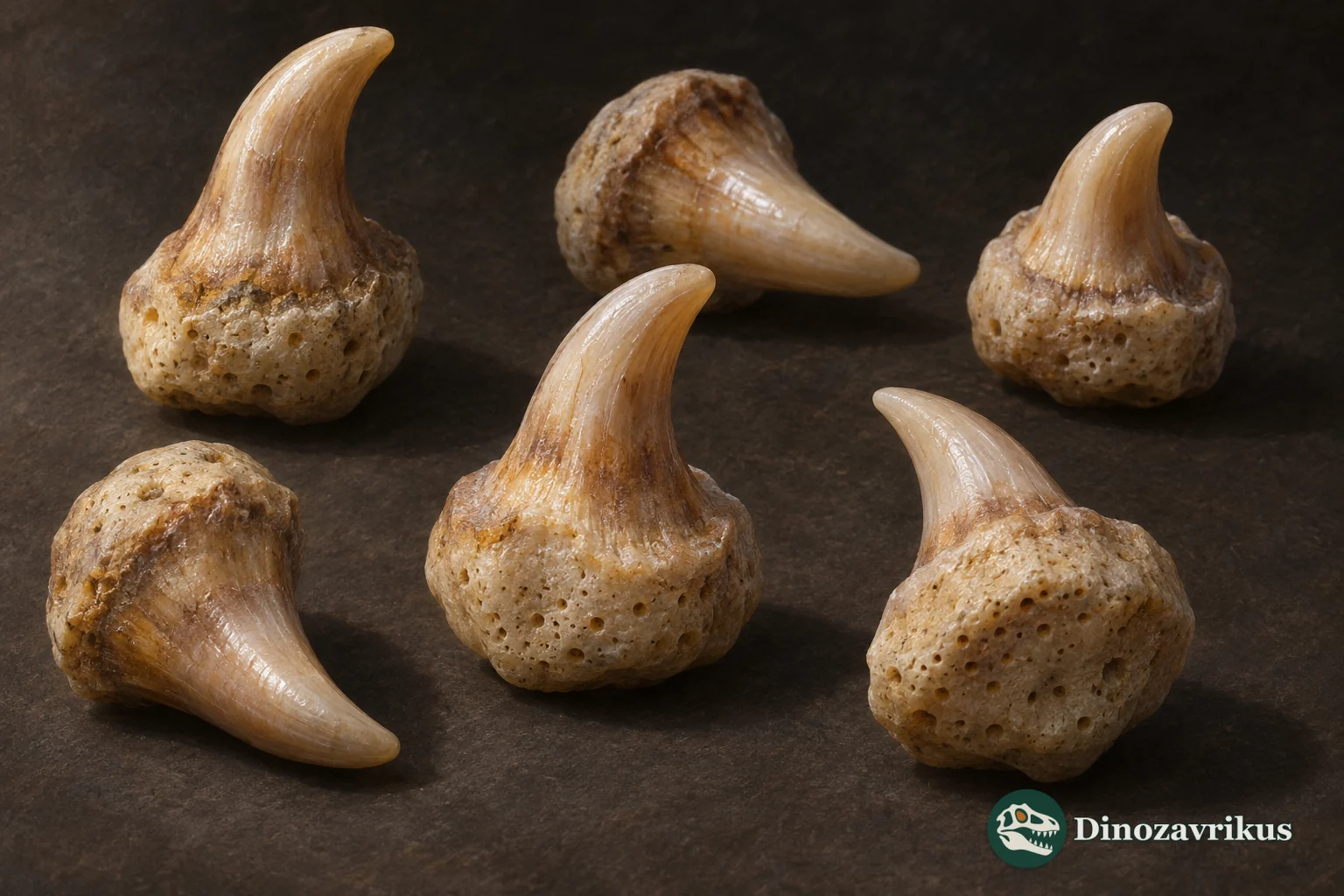
A Cenomanian sample contains 47 isolated teeth up to 1.5 mm high. Most have one narrow cusp and a rounded root.
The original Coniacian assignment of the type material was revised to basal Turonian; a separate, well-described sample is Cenomanian.
Possible ray affinities and plankton filtering are inferred from teeth. No skeleton, stomach contents or measured total length is known.
Discovery and age
The original account placed the type material in the Niobrara Formation near the Carrot River in Saskatchewan and regarded it as Coniacian. Underwood and Cumbaa later revised the type horizon to basal Turonian. The change matters because older accounts retain the original age.
Their 2010 study examined 47 isolated teeth from a Cenomanian bonebed at the Bainbridge River. Several preserve the crown and root better than the type material. Similar teeth reported from multiple Cretaceous horizons need not all belong to one species.
What the teeth reveal
The studied teeth reach only about 1.5 mm in height. Most carry one narrow, erect or slightly leaning cusp with a strong inward curve and no cutting edge; one has a double cusp. The rounded roots bear small vascular openings and a relatively narrow pulp cavity.
Most teeth are similar in form, but none was preserved in a jaw. Tooth-row position and growth changes cannot be read directly from them. Tooth size alone does not supply a reliable body-length estimate.
Possible relationships and feeding
Underwood and Cumbaa found the root vascular pattern difficult to reconcile with a lamniform shark. They compared the teeth with rays, including plankton feeders, but warned that similar dental forms can arise independently. Exact batoid relationships and a direct connection to modern mantas are therefore unproved.
Plankton feeding is a proposal based on tooth form, not preserved gut contents or a filtering apparatus. The jaw-bearing Palaeobates and tooth-based Polyacrodus illustrate different kinds of evidence for extinct cartilaginous fishes; neither is a demonstrated close relative of Cretomanta.
Marine setting and reconstruction
The Bainbridge River bonebed accumulated in a nutrient-rich marine setting and includes small bony fishes and other vertebrates. The deposit records where teeth were buried, not the exact travels of an individual animal.
No complete body, fin outline, colour or measured size is known. The cover is a speculative ray-like reconstruction. Odontorhytis is another tooth-based animal whose body must likewise be illustrated with caution.
Frequently asked questions
Why is Cretomanta compared with rays?
Its dental structure has been compared with batoids and does not strongly fit a lamniform shark, but precise placement remains uncertain.
How small were the teeth?
The well-described Saskatchewan series has teeth up to about 1.5 mm high; this is not a body-size estimate.
Did it filter plankton?
Possibly, according to tooth comparisons, but neither gut contents nor a filtering apparatus has been found.
Do we know its appearance?
No. Isolated teeth do not establish its body outline, colour or total length.