

Albertellina was a small trilobite from the middle Cambrian of Nevada. Its head shield had long flattened spines pointing backwards. The tail shield had a smooth rim with a slight inward curve at the rear.
Quick facts
| Group | Trilobites, family Zacanthoididae |
|---|---|
| Age | Middle Cambrian |
| Region | North America: Nevada, United States |
| Diet | Unknown |
| Type species | Albertellina aspinosa |
| Holotype | USNM 208121 |
What can the fossils tell us?
The Desert Range material includes cranidia, free cheeks, a hypostome and tail shields.
The original description estimates that the largest individuals represented by these fragments were about 30 mm long.
The material in the original description leaves the number of segments between the head and tail shields unknown.
Fossils from Nevada
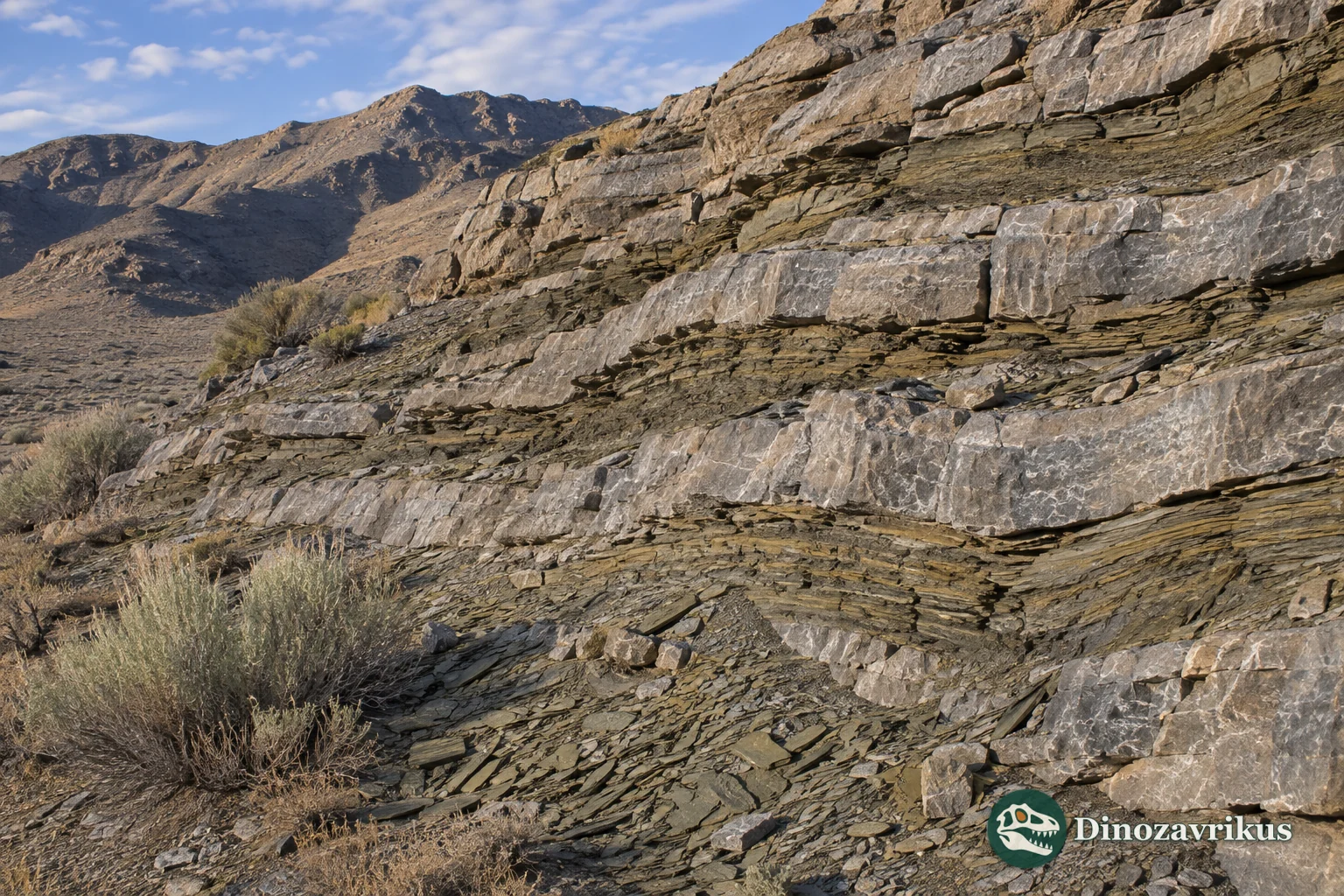
Allison Palmer established Albertellina in a study published with Robert Halley in 1979. The holotype of A. aspinosa comes from the Pahrump Hills Shale Member of the Carrara Formation in Nye County. The holotype is a tail shield held at the Smithsonian National Museum of Natural History.
Collections from the Desert Range also yielded free cheeks, a hypostome from the underside near the mouth and separate tail shields. Two tail shields attributed to the same species came from the Spectre Range. The known parts led Palmer and Halley to estimate that the largest individuals were about three centimetres long.
The head and tail look quite different
The glabella, the raised midline of the head shield, was long and widened towards its blunt front end. Narrow, curved eye lobes lay alongside its rear half. Long flattened cheek spines pointed backwards from the rear corners of the head shield.
The tail shield resembled a trapezoid with rounded corners. Its raised axis narrowed towards the rear. In the original description, the absence of spines on the tail rim helped distinguish the genus from Albertelloides and Paralbertella.
A name for part of a rock sequence
In southeastern Nevada, A. aspinosa names the lowest subzone of the larger Albertella Biozone in the Pioche Shale. The two genera have similar names, and each plays a different role in recognizing the sequence. Correlating beds calls for identifying the species and checking the rest of the trilobite assemblage.
Frequently asked questions
Which part is the holotype?
The holotype is a tail shield, or pygidium, catalogued as USNM 208121.
Where were the spines?
The long flat spines extended from the corners of the head shield. The tail shield had a spineless rim.
How large did Albertellina grow?
The original authors estimated a length of about 30 mm for the largest known individuals from separated parts.
What does the Albertellina subzone identify?
It marks the lower part of the Albertella Biozone in the middle Cambrian Pioche Shale.