

Albertonectes vanderveldei is a Late Cretaceous elasmosaurid from Alberta, Canada. Its holotype preserves a nearly complete postcranial skeleton, including an exceptionally long neck, but the skull is missing. The original description counted 76 cervical vertebrae; a later study interpreted the cervical–pectoral boundary differently and counted 75. Both counts describe the same fossil and the difference is anatomical classification, not a second specimen.
Quick facts
| Type species | Albertonectes vanderveldei |
|---|---|
| Group | Plesiosaur; elasmosaurid |
| Age | Late Campanian, Late Cretaceous |
| Formation | Bearpaw Formation |
| Locality | Near the St. Mary River, southern Alberta, Canada |
| Holotype | TMP 2007.011.0001, Royal Tyrrell Museum of Palaeontology |
| Preserved material | Nearly complete postcranial skeleton; skull missing |
| Cervicals | 76 in the original description; 75 under a later boundary interpretation |
| Length estimate | About 11.2 m for the reconstructed postcranial skeleton |
Evidence guide
The holotype preserves an articulated vertebral series, most ribs, girdle elements and nearly complete limbs. The skull, left forelimb and some distal hindlimb bones are missing; a display reconstruction fills those gaps.
Kubo and colleagues counted 76 cervical vertebrae in 2012. Sachs, Kear and Everhart later treated the last vertebra in that count as part of the pectoral series and recognized 75 cervicals. The disagreement concerns anatomical interpretation of one transition vertebra.
The chert stones occur in the trunk region. Their shape was used to suggest that many may have been collected near a beach, but gastroliths do not reveal a precise diet or hunting strategy. Some were lost when an excavator struck the fossil.
The description reports a tooth-marked coracoid, two shed Squalicorax teeth and local skeletal disruption. Together these observations support scavenging, but they do not show that a shark killed the plesiosaur.
Discovery in an ammolite mine
The skeleton was uncovered in 2007 during open-pit mining for gem-quality ammonite shells, or ammolite, south of Lethbridge. An excavator bucket unexpectedly struck the fossil. Workers at Korite International preserved exposed material, and the Royal Tyrrell Museum team helped recover and prepare it. The holotype is catalogued as TMP 2007.011.0001. The species name honours René Vandervelde, associated with the mining company where the discovery was made.
The fossil comes from the Late Campanian Bearpaw Formation, deposited in the Western Interior Seaway. The rock unit provides the geological age and marine setting; the bones themselves do not carry a calendar date. Part of the trunk was damaged by the excavator before recovery, including ribs and an unknown number of gastroliths.
What the skeleton preserves
Vertebrae extend from the atlas-axis complex to the end of the tail. Most of the axial skeleton and ribs were found in articulation, although the long neck had broken into four sections. The specimen also preserves parts of the shoulder girdle, an incomplete pelvis and nearly complete fore- and hind limbs. The skull is absent, as are the left forelimb and some distal bones of the hind limbs.
This combination makes the specimen useful for comparing vertebral, girdle and limb proportions among elasmosaurs. Muraenosaurus also had a long neck, but its skeleton shows a different arrangement and proportions. Such comparisons describe diversity within plesiosaurs; they do not imply that one genus descended from the other.
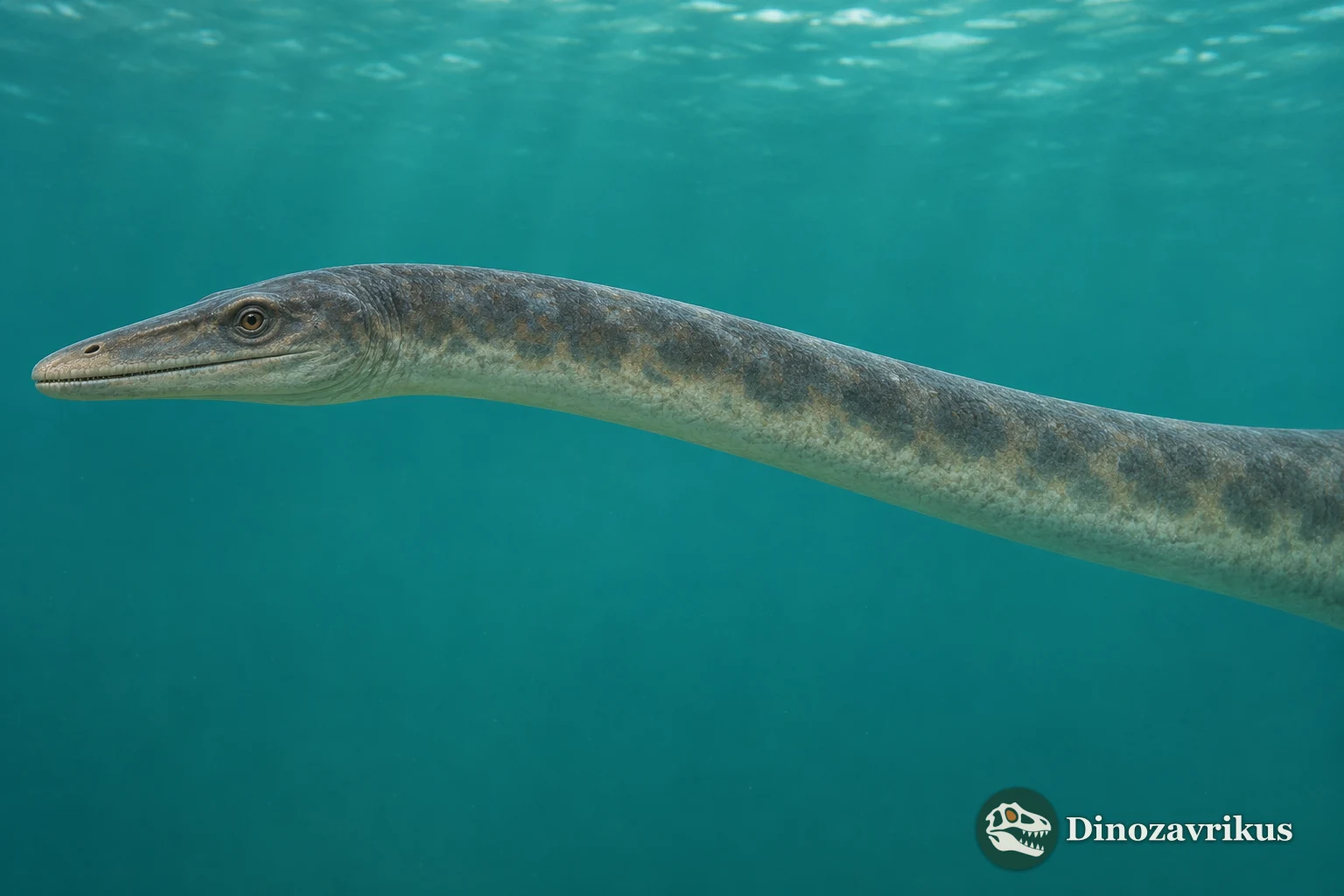
A neck with 75 or 76 vertebrae
The 2012 description counted 76 cervicals, including the atlas and axis. In 2013, Sachs, Kear and Everhart revisited where the neck ends and the pectoral region begins in plesiosaurs. They argued that the last vertebra counted as cervical in Albertonectes already belongs to the transition into the shoulder region. Their interpretation yields 75 cervical vertebrae.
The difference is not a disagreement about how many bones were present. It reflects how the rib articulations and other anatomical features are used to define a boundary. Under either count, the neck remains among the longest known for a plesiosaur. The original study estimated it at roughly seven metres. Thalassomedon offers another example of a long-necked elasmosaurid, with a different fossil record.
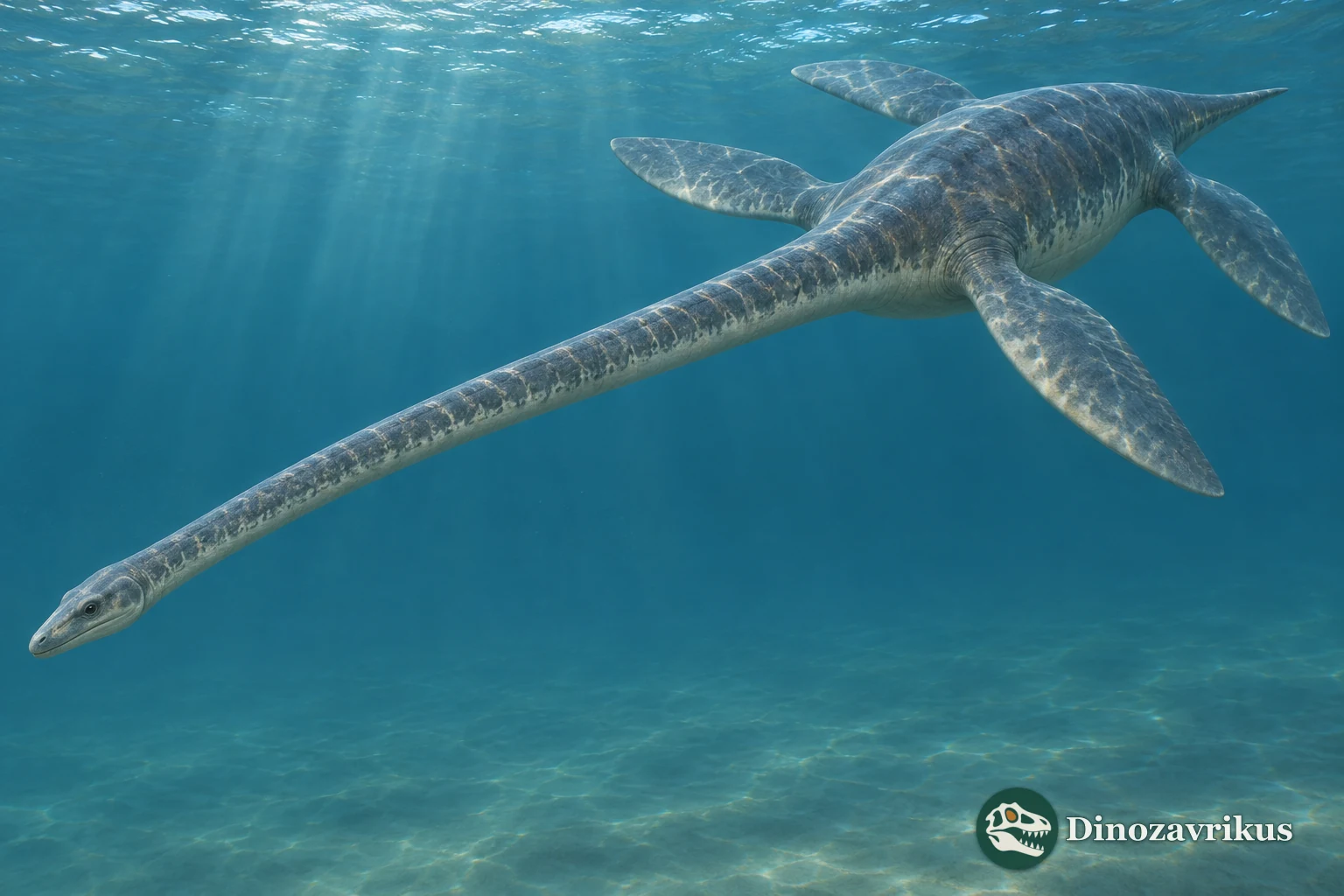
Length and the missing skull
The published reconstruction gives about 11.2 m for the postcranial skeleton, with roughly seven metres assigned to the neck. This is not a measurement of a complete animal from snout to tail: the skull is missing, and the total living length depends on how that absent part is restored. The 11.2 m figure should therefore be tied to the reconstructed postcranial skeleton rather than treated as a precise body-length measurement.
The diagnosis of Albertonectes does not rest on neck length alone. The original authors described a distinctive combination of vertebral features, a relatively broad clavicular arch, coracoid and pubic projections, fused posterior caudals and a relatively slender humerus. With no skull, the postcranial combination is central to identifying the taxon.
Gastroliths and shark traces
Ninety-seven gastroliths, or stomach stones, were recovered with the skeleton. Their diameters range from less than one centimetre to 13.5 cm in the original description. Shape analysis led the authors to suggest that many had been ingested near a beach. Later work revisited how incomplete and damaged gastrolith assemblages affect interpretation. Their presence does not establish a specific menu or explain exactly how the animal used them.
A tooth mark on a coracoid, two shed teeth of the shark Squalicorax and local skeletal disruption are consistent with scavenging after death. They do not establish that a shark caused the animal's death. The fossil records traces and associations, not the full sequence of events on the seabed.
What remains unknown
The articulated skeleton establishes a large marine plesiosaur with an unusually long neck and four paddle-like limbs. It does not preserve colour, skin, soft-tissue outlines, swimming speed or the animal's ordinary neck posture. There is only one known individual, so variation within the species, growth through life and reproduction cannot be assessed from the current sample.
The scenes on this page are palaeoart based on the skeleton and comparative anatomy. In particular, the reconstructed head is not known from the holotype. These images illustrate one plausible body plan; they are not photographs or a measured tracing of TMP 2007.011.0001.
Frequently asked questions
Where was Albertonectes found?
Its only known skeleton was discovered in 2007 during ammolite mining south of Lethbridge, Alberta, Canada. It comes from the Late Campanian Bearpaw Formation.
How many neck vertebrae did it have?
The original description counted 76 cervical vertebrae. A 2013 reassessment treated the last vertebra in that count as pectoral and recognized 75 cervicals.
How long was Albertonectes?
The published reconstruction estimates about 11.2 m for the postcranial skeleton and roughly seven metres for the neck. The skull is missing, so total body length depends on reconstruction.
Do the gastroliths prove what it ate?
No. Ninety-seven stones were found with the skeleton, and their shape supported a hypothesis about where some may have been swallowed. They do not establish a specific diet or hunting method.