

Allgoviachen tortonica was a member of the duck family that lived in what is now Bavaria about 11.44 million years ago. Its left leg is known almost in its entirety. The lower leg and foot were still joined when they were uncovered in river deposits at Hammerschmiede.
Quick facts
| Type species | Allgoviachen tortonica |
|---|---|
| Family | Anatidae |
| Age | Earliest Late Miocene, about 11.44 million years ago |
| Locality | Hammerschmiede, Bavaria, Germany |
| Holotype | SNSB-BSPG 2020 XCIV 1058 |
| Measured bones | Tibiotarsus 125.8 mm and tarsometatarsus 74.1 mm |
What can the fossils tell us?
The type specimen comprises the lower end of the femur, the tibiotarsus, the tarsometatarsus and most toe bones. There are no bones of the skull or wing.
Several modern ducks that spend time on land or perch have similarly curved claw bones. The comparison suggests possible perching but cannot demonstrate it.
The short articulation for the second toe and the absence of a particular depression for the first metatarsal support placement in Anatidae. Subfamily relationships remain open.
An articulated specimen from a Bavarian clay pit
Gerald Mayr, Thomas Lechner and Madelaine Böhme published the description online in 2022. The name combines Allgovia, the Latin name for the Allgäu region, with the Greek for goose. The species name refers to the Tortonian age of the deposit.
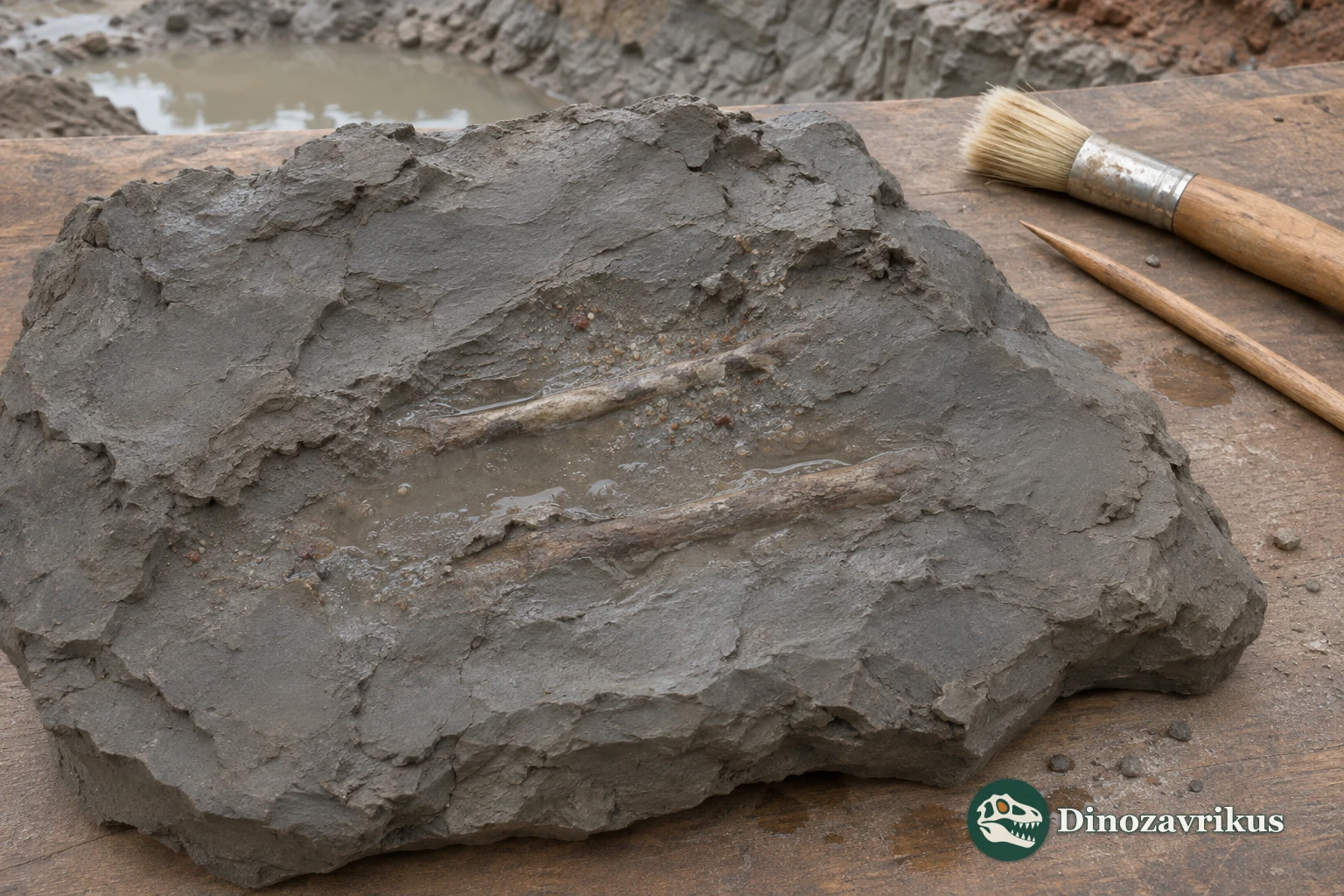
The type comes from bed HAM 4 in the clay pit near Pforzen. Its tibiotarsus is 125.8 mm long and its tarsometatarsus 74.1 mm. The leg is comparable in scale to a shelduck’s, though a whole-body length cannot be read directly from these bones. A fragmentary lower end of a left tarsometatarsus from bed HAM 5 was also referred to the species.
Feet suited to life on land?
The joint for the second toe is short, as in anatids, but the top of the tarsometatarsus has an unusually deep hollow on its front face. The describers considered that Allgoviachen might be an early side branch of the duck family. Missing parts of the skeleton limit the comparison. The much older European bird Romainvillia illustrates how the fossil record samples early duck relatives at different times.
The end bones of the claws are curved and have a prominent attachment for the flexor tendon. Their shape resembles that of some whistling ducks and shelducks more than the straighter claws of many strongly aquatic ducks. This led the authors to suggest a more terrestrial lifestyle. Perching, proposed by analogy with some living ducks, remains a possibility. There is no direct evidence of diet.
What kept the leg together
Burial probably took place fairly quickly, before the toes and lower leg separated. At this site, river flow scattered the bones of other birds. The authors considered that the isolated leg, missing the upper part of the femur, might have been left by a predator or scavenger. The fossil does not identify an animal responsible for the loss.
Frequently asked questions
How large was Allgoviachen?
The bones of the known leg are comparable to those of a modern shelduck. A complete body length is not known.
Where was it discovered?
The holotype came from bed HAM 4 in the Hammerschmiede clay pit near Pforzen, in the Allgäu region of Bavaria.
Were its toes webbed?
The fossil preserves the bones of the toes, not their skin or webbing.
Do the claws prove that it perched?
No. The resemblance to the claws of some perching ducks is consistent with that interpretation, but it does not show the behaviour directly.