

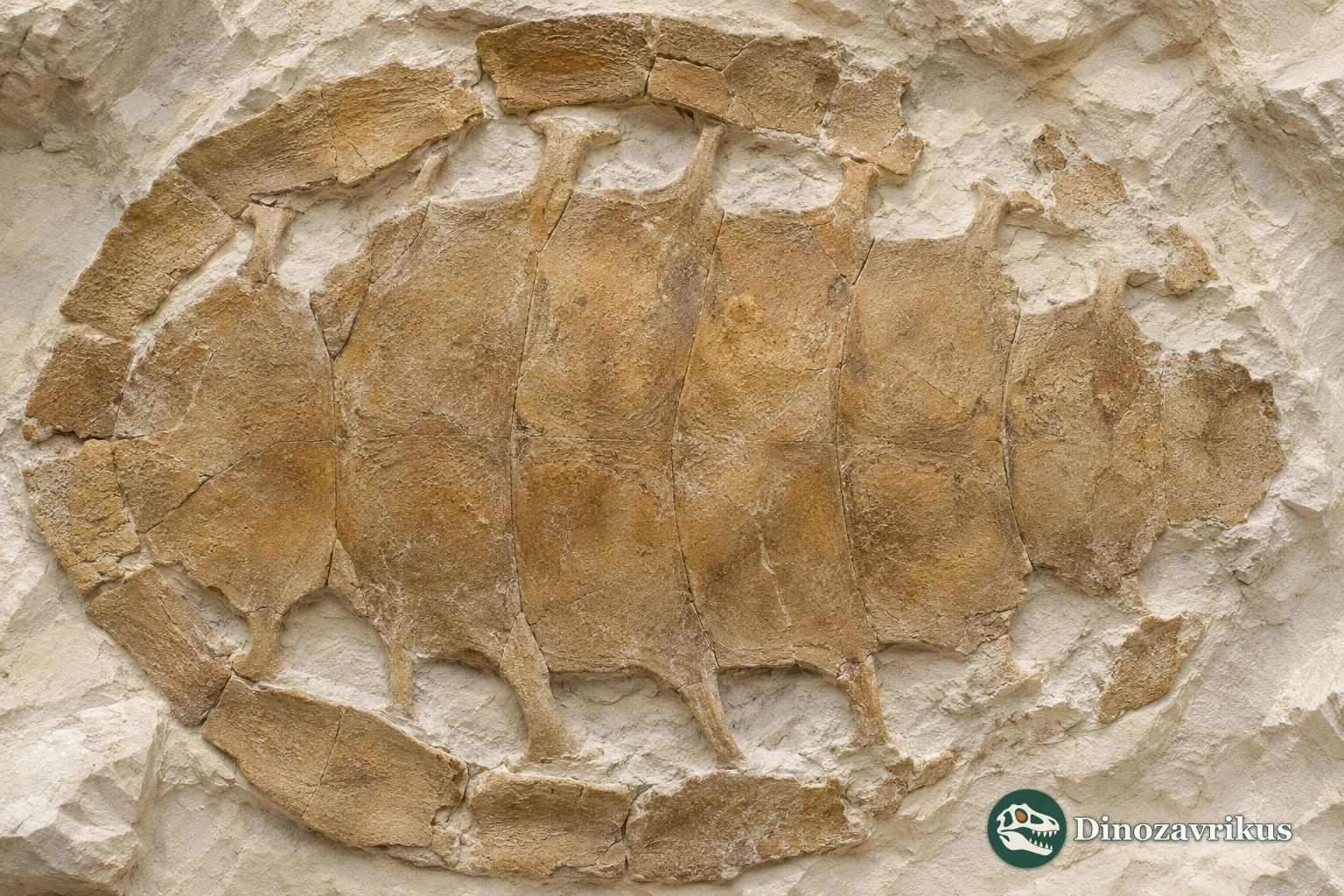
Allopleuron was a large sea turtle in the seas of latest Cretaceous Europe. The central part of its upper shell was narrow, with broad gaps towards the bony rim. Fossils from the Maastricht area are mostly from adults. That imbalance has prompted studies of both the habitat and the fossil record itself.
Quick facts
| Group | Turtles, sea turtles (Chelonioidea) |
|---|---|
| Age | Late Cretaceous (late Maastrichtian for the type species) |
| Region | Europe (the Netherlands and Belgium) |
| Type species | Allopleuron hofmanni |
| Museum specimen | NHMM 000001, skeleton from the Maastricht area |
| Scientific name | Allopleuron |
| Diet | Exact diet unknown |
| Carapace length | About 1.4 m on average |
What can the fossils tell us?
The rib-bearing plates end well short of the marginal bones in adult material. The fossils preserve the bony framework of the shell.
Most individuals in the 2011 museum survey had an estimated carapace length greater than a metre. The sample size distribution alone cannot establish where juveniles lived.
Carbon isotopes from shell bone are compatible with an animal-based diet. Several assumptions about local food sources affect the interpretation.
A name from the Maastricht chalk
Petrus Camper described large marine turtle remains from the Maastricht area in the eighteenth century. John Edward Gray introduced Chelonia hofmanni in 1831, honouring the fossil collector Jean-Léonard Hoffmann. The single f in the original spelling is retained. Georg Baur erected Allopleuron in 1888.
NHMM 000001, a substantial skeleton found in 1862, is now at the Maastricht Natural History Museum. Gray based his name on references to earlier illustrations rather than selecting a single specimen. Later discussion has proposed the Brussels specimen IRScNB 3901 to anchor its usage.
What the bony shell preserves
The name refers to the unusual costal plates. These rib-bearing bones are very short, leaving wide gaps towards the outer band of marginal bones. The gaps persist in large individuals. The margin and central framework can be traced from the fossils, while the tissues that covered them are lost.
Sea turtles in several branches evolved reduced bony shells. Cretaceous Protostega provides another example with its own pattern of reduction. Analyses of the wider skeleton have disagreed on the position of Allopleuron, placing it either on the cheloniid stem or closer to the leatherback branch.
An uneven record of growth stages
In 2011, R. Janssen, R. van Baal and A. Schulp surveyed public collections from the type Maastrichtian area in the Netherlands and Belgium. They estimated carapace lengths from dimensions of partial specimens where possible. Most exceeded a metre, and the species has a reported average near 1.4 metres. Bones of the shell, shoulder girdle, skull and lower jaw were particularly well represented.
One explanation for the scarcity of young turtles is that they lived in different waters. Preservation and collection can also favour larger fossils. Bones from these deposits leave the locations of breeding and nursery grounds open.
Limits of the ecological and geological record
Carbon isotope measurements support the possibility of an animal-based diet, with room for other interpretations depending on local food sources. The bones cannot identify particular prey.
Some younger fossils were assigned to Allopleuron. A turtle from the Middle Eocene of Kazakhstan was named A. qazaqstanense. A subsequent study of additional material argued that it lies outside the genus, with the similarities reflecting a parallel shift towards life in open water. That referral is therefore disputed.
Frequently asked questions
How long was the carapace?
Most individuals in the Maastricht museum sample exceeded one metre. The published average is about 1.4 metres.
Were there gaps in the shell of adults?
Yes. The reduced bony plates left spaces towards the rim even in mature individuals.
Do the fossils reveal what it ate?
The isotope values allow an animal-based diet, but the exact food remains uncertain.
Why is hofmanni spelled with one f?
It preserves Gray’s original spelling of 1831. The collector he honoured spelled his surname Hoffmann.