

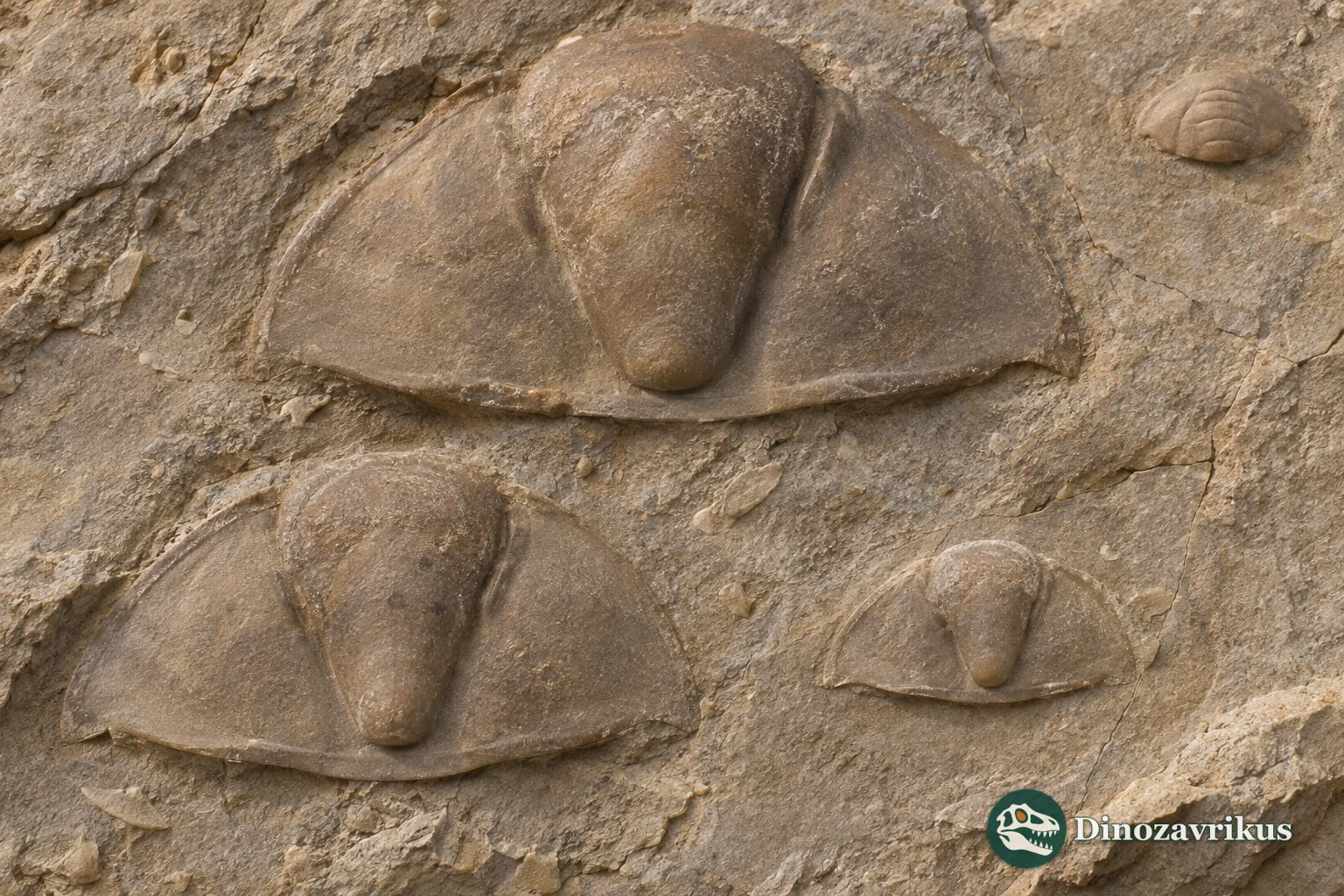
Alokistocare was a Middle Cambrian trilobite genus. Measurements of head shields show that some parts grew faster than others. Measurements of the tail shields give a different result: their proportions stayed roughly constant as they increased in size.
Quick facts
| Group | Trilobites |
|---|---|
| Age | Middle Cambrian, Miaolingian |
| Region | North America (United States) |
| Diet | Unknown |
| Type species | Alokistocare subcoronatum |
| Genus named by | T. Lorenz, 1906 |
What can the fossils tell us?
James Hall and Robert Whitfield described the Bear River Range material in 1877.
Several proportions continued to change after the trilobite acquired its adult number of thoracic segments.
The parts of the pygidium scaled together as the shield grew. This sets its growth pattern apart from the cranidium.
From the Ute Limestone to later collections
James Hall and Robert Whitfield described the type species from the Ute Limestone in Utah’s Bear River Range. In 1906, Lorenz made it the type of Alokistocare. The head shield has broad fixed cheeks and a low frontal area. Its central lobe, or glabella, tapers forwards.
In 1999, Frederick Sundberg redescribed A. subcoronatum from collections in the Ehmaniella Biozone. The material included cranidia, free cheeks, plates from the underside of the head, thoracic segments and tail shields. This combination gave him more characters to compare with those of other genera.
Growth and the limits of the genus
Some parts of the cranidium grew faster relative to its overall length, while others grew more slowly. The measured tail shields did not show the same pattern. Sundberg also found small but significant differences among samples of cranidia. An isolated fragment is therefore best compared with material of a similar growth stage and with the range within each collection.
The redescription proposed treating Pseudoalokistocare as a junior synonym of Alokistocare. Sundberg placed earlier species with superficially similar heads in a separate lineage of Amecephalus. Comparing several parts of the armour made the distinctions easier to trace.
Frequently asked questions
Which species defines Alokistocare?
A. subcoronatum, originally described from the Ute Limestone in North America.
Where did proportions change most during growth?
The central part of the head shield showed several changes. The measured parts of the tail shield increased in proportion to one another.
Do fossils preserve the underside of the head?
Collections include detached plates from the underside, including hypostomes. They were compared with the rest of the armour by shape and occurrence.
Why was Pseudoalokistocare combined with Alokistocare?
Sundberg’s 1999 character analysis supported putting the material in a single genus. Alokistocare is the earlier name.