

Anachronornis anhimops lived in what is now Wyoming near the end of the Palaeocene, about 56 million years ago. Its short, deep bill resembles that of a modern screamer. A skeleton preserving much of the skull, wings and body lets researchers compare this bird with both screamers and other early relatives of waterfowl.
Quick facts
| Type species | Anachronornis anhimops |
|---|---|
| Group | Early waterfowl relative |
| Age | Latest Palaeocene, about 56 million years ago |
| Locality | Willwood Formation, Wyoming, United States |
| Holotype | USNM 496700 |
| Estimated skull length | 75–80 mm |
What can the fossils tell us?
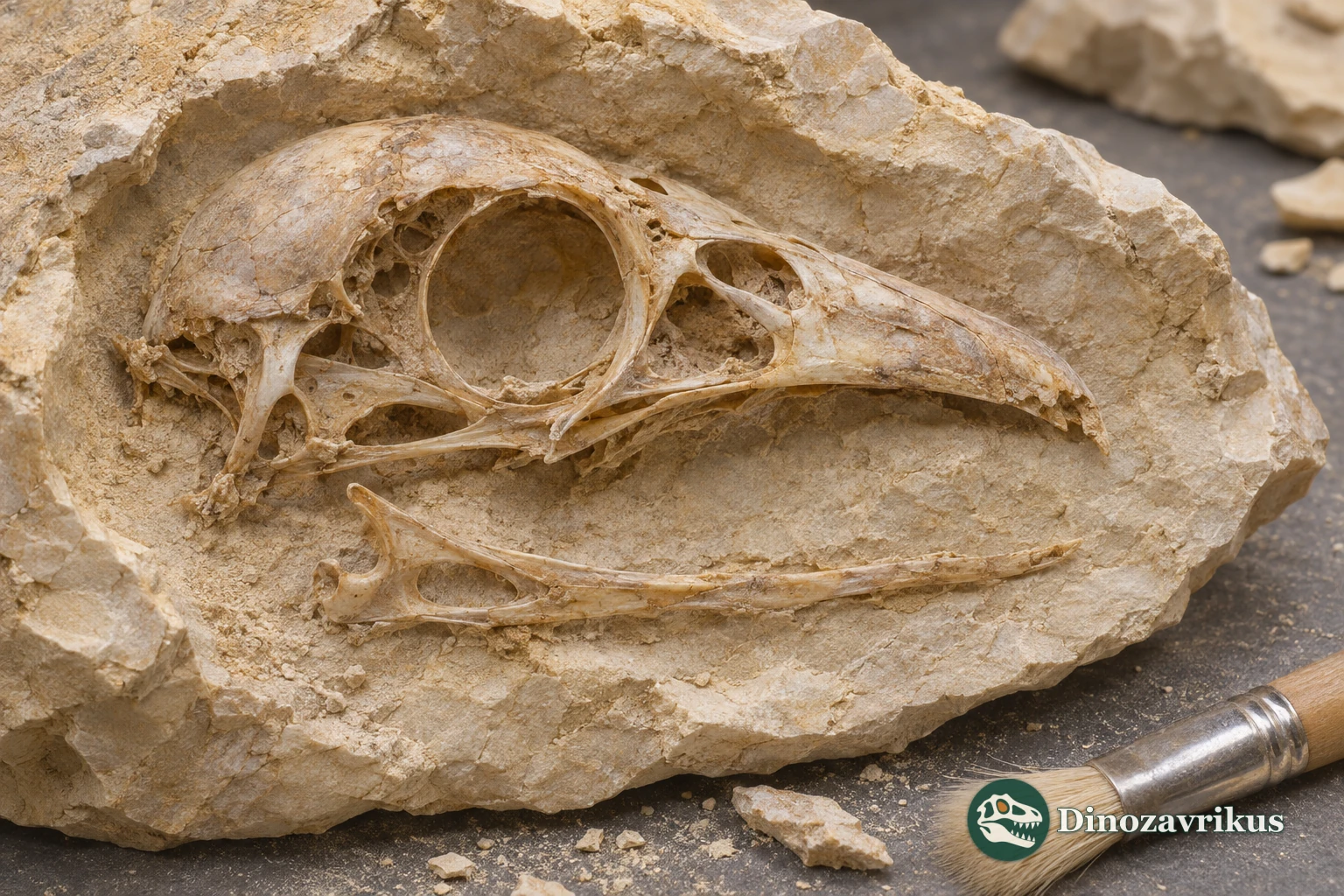
The bony bill is taller than it is wide. Few openings for nerves and vessels are visible, so there is limited support for a highly sensitive duck-like bill.
The left humerus and ulna are both 80.5 mm long. The pelvis and limb bones do not show a clear suite of adaptations for underwater propulsion.
The fossil combines characters of screamers and other waterfowl. Its placement depends on the dataset and method, and those analyses do not identify it as the direct ancestor of living waterfowl.
One skeleton from the Willwood Formation
Peter Houde, Meig Dickson and Dakota Camarena named the bird in 2023. Anachronornis refers to a bird that appears out of its expected time. The authors saw features that could have been present before the living waterfowl lineages diverged. The species name refers to the resemblance of the head to that of a horned screamer.
The type specimen, USNM 496700, is housed in the Smithsonian’s National Museum of Natural History. It comes from Park County in the Clarks Fork Basin. The authors gave its horizon an estimated age range of 56.22–55.80 million years. The fossil includes the skull and mandible, vertebrae, part of the breastbone, wing bones, pelvis and parts of both legs.
Anatomy preserved in the bone
The skull is estimated at 75–80 mm long. The mandible measures 65 mm. The bony upper bill is narrow and vaulted, with a slightly downturned tip. Its few small neurovascular openings suggest there was less sensory equipment at the tip than in many ducks that feel for food with their bills.
The left humerus and ulna both measure 80.5 mm. The preserved hand bone lacks the spurs found on the wings of living screamers. The thigh bones are long and slender, but the bones below the knee are incomplete. That prevents a full reconstruction of hindlimb proportions.
Near the roots of waterfowl
The nodule that held the skeleton also preserved traces of other vertebrates, including land or tree-dwelling animals. The shape of the pelvis and front of the knee suggested to the authors a comparison with active walkers in wet or shallow habitats. A diet like that of living screamers, which eat vegetation, was one possibility. No food is directly associated with the skeleton.
Houde and colleagues interpreted the bird as close to the early branching of waterfowl. Testing different sets of fossils and characters led to several positions on the tree. Subsequent analyses likewise left the exact relationship unresolved. Telmabates, from the Eocene of South America, shows a different combination of limb features in an early member of the wider group.
Frequently asked questions
What made its head look like a screamer’s?
The bony bill was comparatively narrow and deep, with a gently downcurved tip. That combination is more reminiscent of a screamer than a broad-billed duck.
How many skeletons are known?
The species was described from a single skeleton, USNM 496700. Other isolated waterfowl-like bones from the same deposits have not been securely assigned to it.
Was Anachronornis a diving bird?
The known bones lack clear signs of specialised diving. The possibility of surface swimming or feeding in shallow water remains open.
Was it the ancestor of modern ducks?
That has not been established. Analyses support a connection with early waterfowl, but its exact branch varies with the selection of fossils and characters.