

Anatosuchus minor was a small notosuchian from Early Cretaceous Niger. Its flattened snout was wider than the back of its head. Skulls of different ages show that this shape became more pronounced as the animal matured. CT scans also helped refine the account of its teeth.
Quick facts
| Species | Anatosuchus minor |
|---|---|
| Age | Aptian–Albian, Early Cretaceous |
| Locality | Gadoufaoua, Niger |
| Formation | Elrhaz Formation |
| Holotype | MNN GAD603, immature skull and jaws |
| Adult skull length | About 14 cm |
What can the fossils tell us?
The adult skull and lower jaw are wider at the front relative to the back of the head. Erosion affected the edges of the young specimen, which limits the precision of a direct size comparison.
A CT scan and exposed teeth show six premaxillary teeth on each side. Front teeth missing from the type originally made the count appear lower.
Part of the adult skeleton preserves the position of the armour relative to the spine. The missing tail prevents a direct measurement of total body length.
A young skull and an adult skeleton
Paul Sereno and colleagues described Anatosuchus in 2003 from the skull and jaws of an immature individual. The specimen, now MNN GAD603 and originally numbered GDF603, was found in a hematitic concretion. Weathering had removed exposed parts of the skull, including along the front of the snout.
In 2009 Sereno and Hans Larsson described the nearly complete adult skull MNN GAD17 with its lower jaws and part of the articulated skeleton. The new specimen preserved more of the snout, as well as vertebrae and plates of armour. The two skulls show both changes that went with growth and features obscured by weathering in the type.
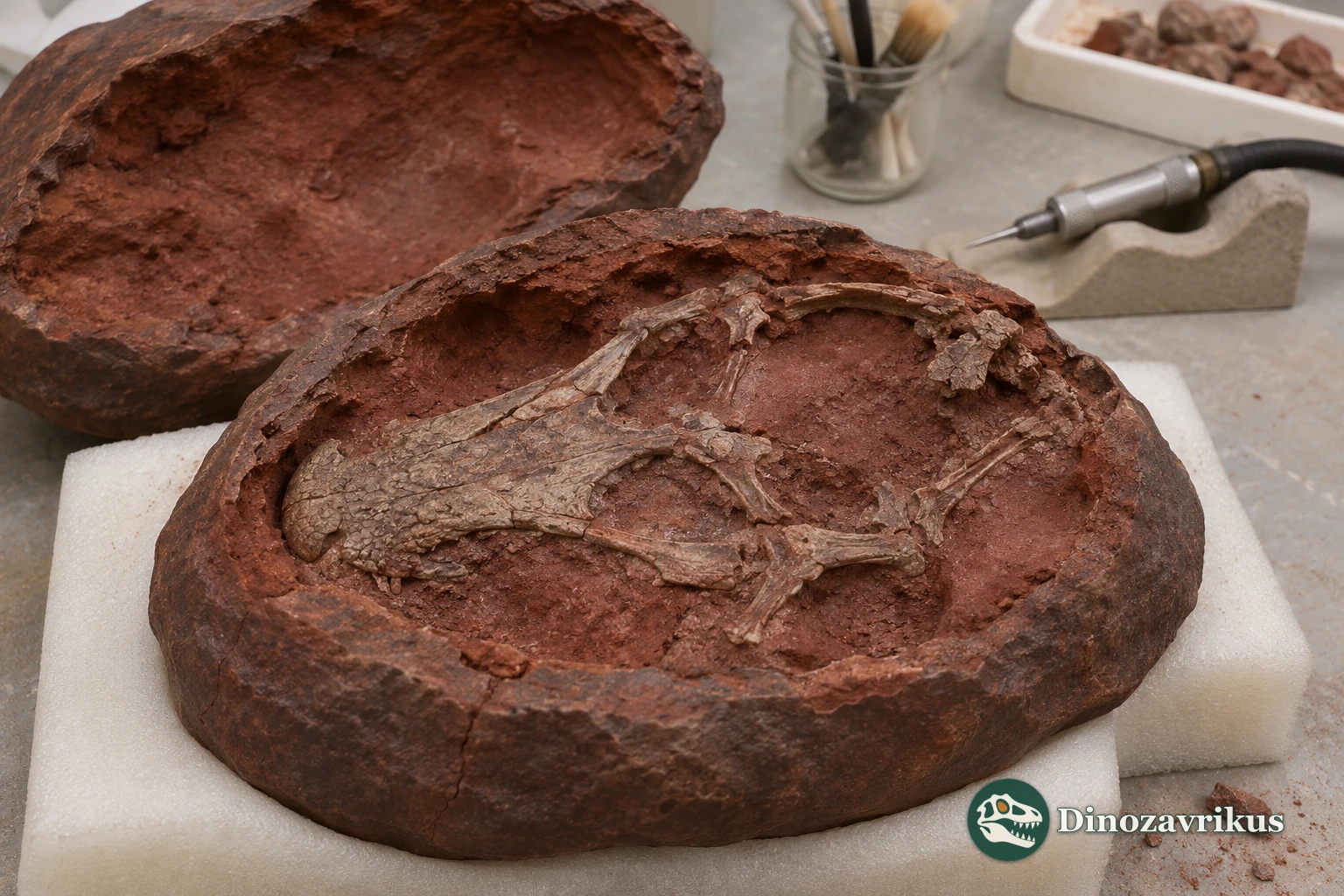
How the shape and tooth count changed
The adult skull measures 142.4 mm in maximum length and 94.2 mm across the widest part of the snout. The younger skull preserves 97 mm of length and 50.3 mm of snout width. Its damaged edges complicate exact comparison, but the jaw outlines also show the proportionally broader adult snout.
The tooth row turns around the corners of the broad snout. Visible teeth and the CT scan of MNN GAD17 document six premaxillary teeth on each side. A gap between the upper tooth rows of the young specimen turned out to be erosion. That removed one of the features originally cited to link Anatosuchus closely with the South American Comahuesuchus.
Armour and the Gadoufaoua fauna
Paired plates survived in position over parts of the neck and trunk. The researchers left these bones in place and used CT imaging to examine areas still hidden in rock. The skeleton lacks the tail. The redescription estimated the animal at under one metre long.
The river deposits of Gadoufaoua also yielded the slender-snouted Stolokrosuchus. Anatosuchus had small inward-curving teeth and numerous openings for nerves and vessels around its flattened snout. Catching small animals in shallow water is one interpretation of this anatomy, with no preserved meals to identify its prey.
Frequently asked questions
Why is it nicknamed DuckCroc?
Its broad, flat snout has rounded corners and a low profile reminiscent of a duck’s bill. The fossil has rows of teeth along that outline.
What did the adult skull reveal?
It showed the mature proportions of the snout and helped establish six premaxillary teeth per side.
How large was Anatosuchus?
The adult skull was about 14 cm long. The 2009 redescription estimated total length at less than one metre.
Which bones survived with the adult skull?
The lower jaws, many vertebrae, several limb bones and some of the armour are preserved. Parts of the armour still lie over the vertebrae.