

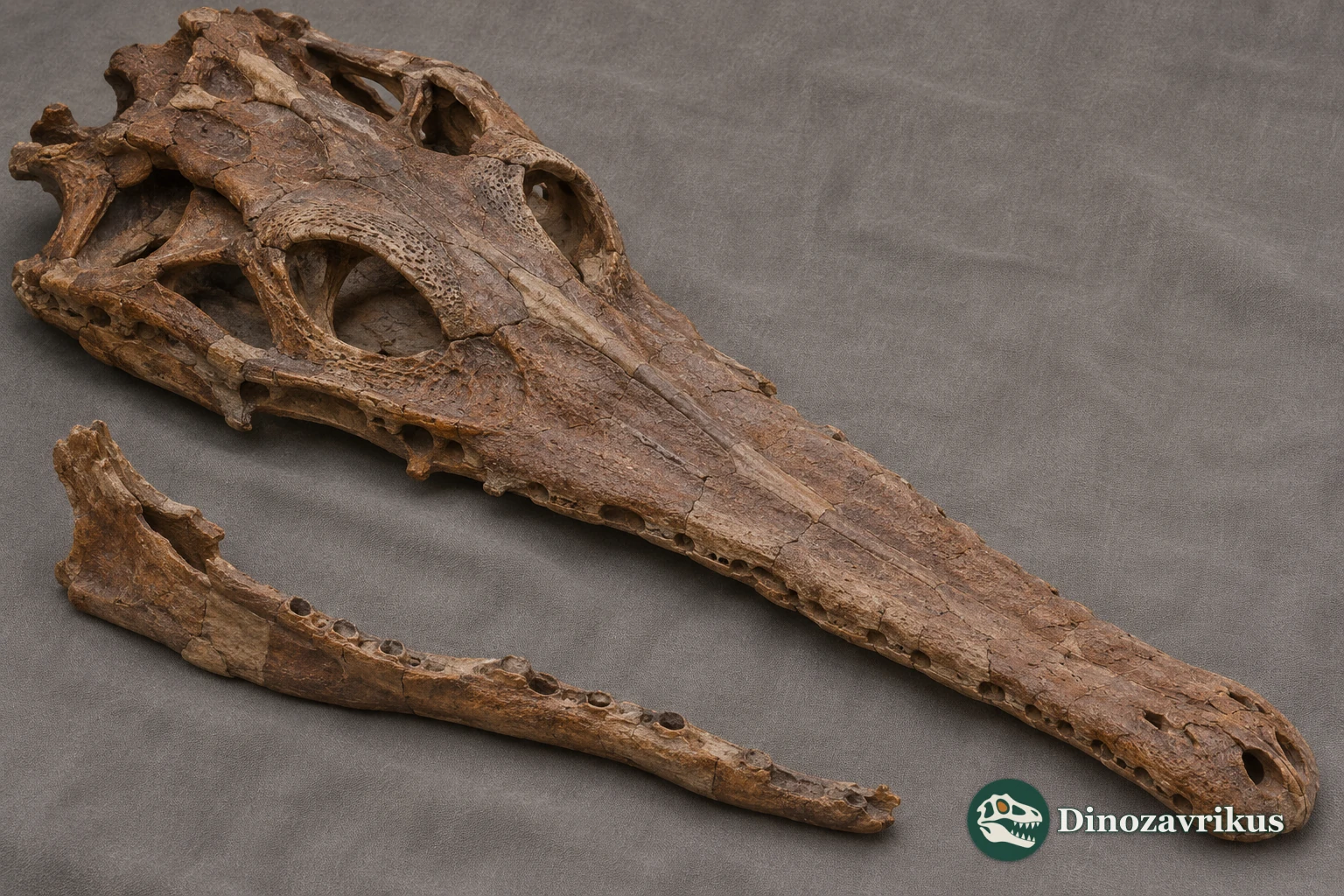
Stolokrosuchus lapparenti was a long-snouted crocodyliform from the Early Cretaceous of Niger. Its nearly complete skull shows the shape of the snout and gives a basis for estimating body length. Researchers agree on much of its anatomy, while different analyses place it in different parts of the family tree.
Quick facts
| Species | Stolokrosuchus lapparenti |
|---|---|
| Age | Early Cretaceous, Aptian type material |
| Locality | Gadoufaoua, Niger |
| Formation | Elrhaz Formation |
| Holotype | MNN GDF 600, nearly complete skull |
| Estimated length | About 2.4 m from skull proportions |
What can the fossils tell us?
The preserved bones constrain the outline of the head. The animal’s limbs and much of the rest of the body remain unknown.
The model gave a length of about 2.4 m. Its uncertainty reflects the proportions and relationships of the species used for comparison.
Several teeth from Gadoufaoua were attributed to Stolokrosuchus. Crown form adds evidence about the teeth, while the diet remains uncertain.
Gadoufaoua and the original skull
Hans Larsson and Boubacar Gado described the species in 2000 from the nearly complete skull MNN GDF 600. Lower jaw fragments are also known from the area. The species name honours Albert-Félix de Lapparent, who studied Cretaceous vertebrates in Africa.
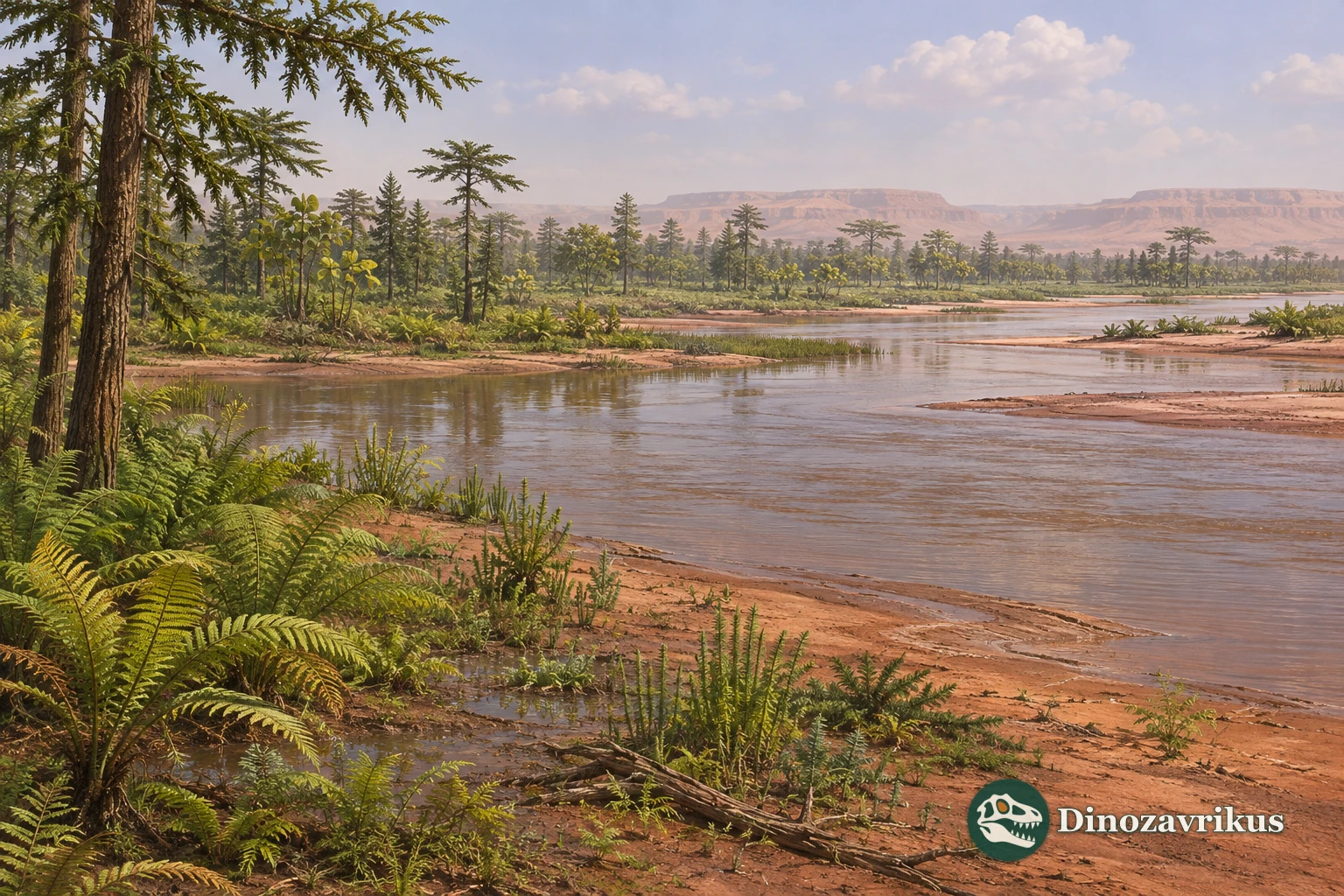
The type comes from Aptian beds. The Elrhaz Formation as a whole is commonly assigned to a broader Aptian to Albian interval. Fish and freshwater turtles from Gadoufaoua provide evidence of the waterways in which many of the local fossils accumulated.
A narrow snout and competing relationships
The long upper jaws have a relatively straight lower outline. A groove runs along the lower jaw near its tooth row, also seen in Hamadasuchus and several other crocodyliforms. Isolated crowns from Gadoufaoua were later attributed to Stolokrosuchus on dental evidence.
The original description placed the animal close to peirosaurids. A later analysis included it within Itasuchidae. One analysis published in 2026 placed it among early neosuchians, while other results left its position unresolved. The long snout is shared across several lineages and has limited value on its own for settling the question.
Estimating the size of the animal
A 2026 study used a dorsal skull length of 490 mm in a statistical model that incorporates evolutionary relationships. The predicted total length was about 2.39 m, with a reported 75% interval of about 1.9 to 3.0 m. No complete skeleton provides a direct measurement.
The slender jaws could have helped seize small, mobile prey. Fish are a plausible possibility. No stomach contents or other direct dietary evidence have established what this animal usually ate.
Frequently asked questions
Where was the type skull found?
At Gadoufaoua in Niger, in the Elrhaz Formation.
Who is named in the species epithet?
The palaeontologist Albert-Félix de Lapparent.
How was its length estimated?
Researchers used skull length and relationships among crocodyliforms to model total body length.
Why is its classification still debated?
Different analyses have linked it to itasuchids or early neosuchians, or left its position unresolved.