

Anguanax zignoi is a Middle to Late Jurassic plesiosaur from the Kaberlaba locality in Veneto, northern Italy. Its type specimen, MPPL 18797, preserves more than 75 bones and teeth from one individual, including parts of the skull and limbs. The skeleton is incomplete, so its published body-length estimate is comparative rather than a measurement from snout to tail.
Quick facts
| Species | Anguanax zignoi |
|---|---|
| Group | Plesiosaur; basal pliosaurid |
| Age | Uppermost Callovian to middle Oxfordian, Jurassic |
| Formation | Rosso Ammonitico Veronese Formation, middle unit, lithozone 5 |
| Locality | Kaberlaba quarry, near Asiago, Veneto, Italy |
| Type specimen | MPPL 18797, Museo Paleontologico e della Preistoria Pietro Leonardi, Ferrara |
| Preserved material | More than 75 bones and teeth from one individual; partial skull, jaw, vertebrae and limb bones |
| Estimated length | About 3–4 m in a comparative estimate; not directly measured |
Evidence guide
MPPL 18797 includes parts of a skull and mandible, isolated teeth, vertebrae, shoulder-girdle material and limb bones. The elements are associated, but the skeleton is incomplete and several regions cannot be reconstructed from the fossil itself.
The specimen came from lithozone 5 in the middle unit of the Rosso Ammonitico Veronese Formation. The unit spans the uppermost Callovian to middle Oxfordian; the bones have not been given a direct radiometric date.
The large partial skull relative to the preserved limb bones, together with cranial and vertebral features, was used to place the animal among basal pliosaurids. The conclusion depends on a combination of characters, not a complete skeleton.
Cau and Fanti compared MPPL 18797 with better-preserved plesiosaur skeletons to estimate a body length of about 3–4 m. Because the skull, vertebral column and limbs are incomplete, this remains a comparative estimate.
A quarry specimen from Kaberlaba
The fossil was collected in the 1980s from an active quarry at Kaberlaba, near Asiago in the Veneto region. It was removed from a cherty interval in the middle unit of the Rosso Ammonitico Veronese Formation and transferred to the Museo Paleontologico e della Preistoria Pietro Leonardi in Ferrara, where it is catalogued as MPPL 18797.
The specimen was notable because articulated plesiosaur remains are uncommon in southern Europe. Many bones had shifted little or moderately before burial, and parts of the skull, shoulder region and tail remained associated. This preserved context made the fossil more informative than isolated bones, while still leaving major gaps in the animal's anatomy.
From an unnamed pliosaur to Anguanax
Cau and Fanti first described MPPL 18797 in 2014 as an indeterminate pliosaurid. They considered the preserved material informative but did not yet assign it a genus and species. In a later study, the authors named Anguanax zignoi and analysed its position among plesiosaurs. The change records a taxonomic reassessment of the same fossil, not the discovery of a second skeleton.
The later phylogenetic analysis placed Anguanax among basal pliosaurids, close to the branch that includes Marmornectes and Thalassophonea. A position on an evolutionary tree expresses a proposed pattern of shared ancestry. It does not show that any named genus was the direct ancestor of another. The Jurassic forms Hauffiopteryx and Muraenosaurus offer useful anatomical comparisons, not a family chain leading directly to Anguanax.
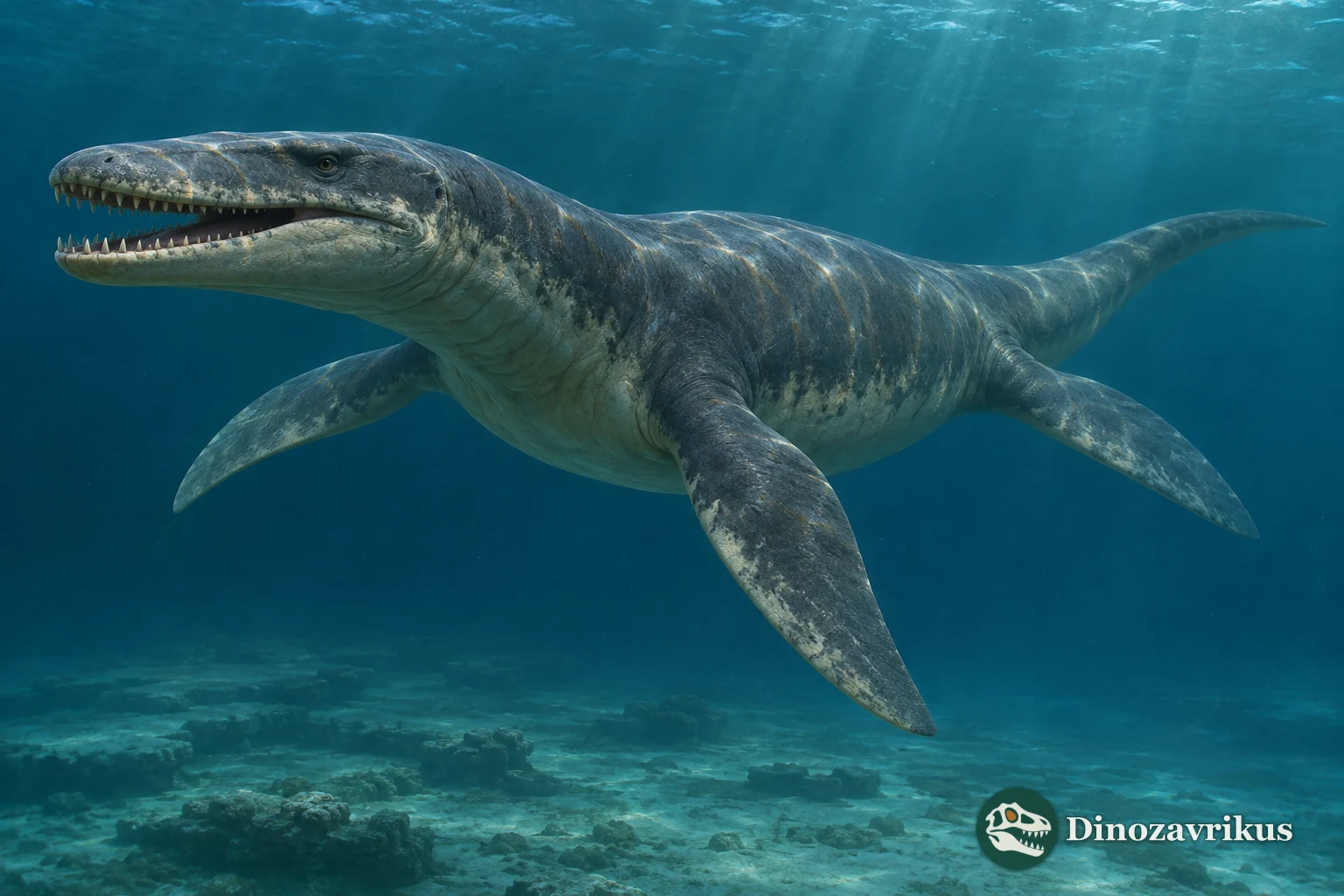
What the type specimen preserves
The inventory lists more than 75 bone and tooth elements from one individual. These include a partial skull and mandible, 32 isolated teeth, cervical, dorsal and caudal vertebrae, a right scapulocoracoid, a femur, two lower-leg bones and separate hand or foot elements. No more than ten presacral vertebrae are preserved, so the neck and trunk lengths cannot be measured directly.
The front of the skull and the anterior end of the lower jaw are missing, and most of the skull roof was not recovered. The maxilla is incomplete, some skull surfaces are compressed or eroded, and many vertebral regions are absent. The evidence supports a partial anatomical description; it does not preserve a full outline of the living animal.
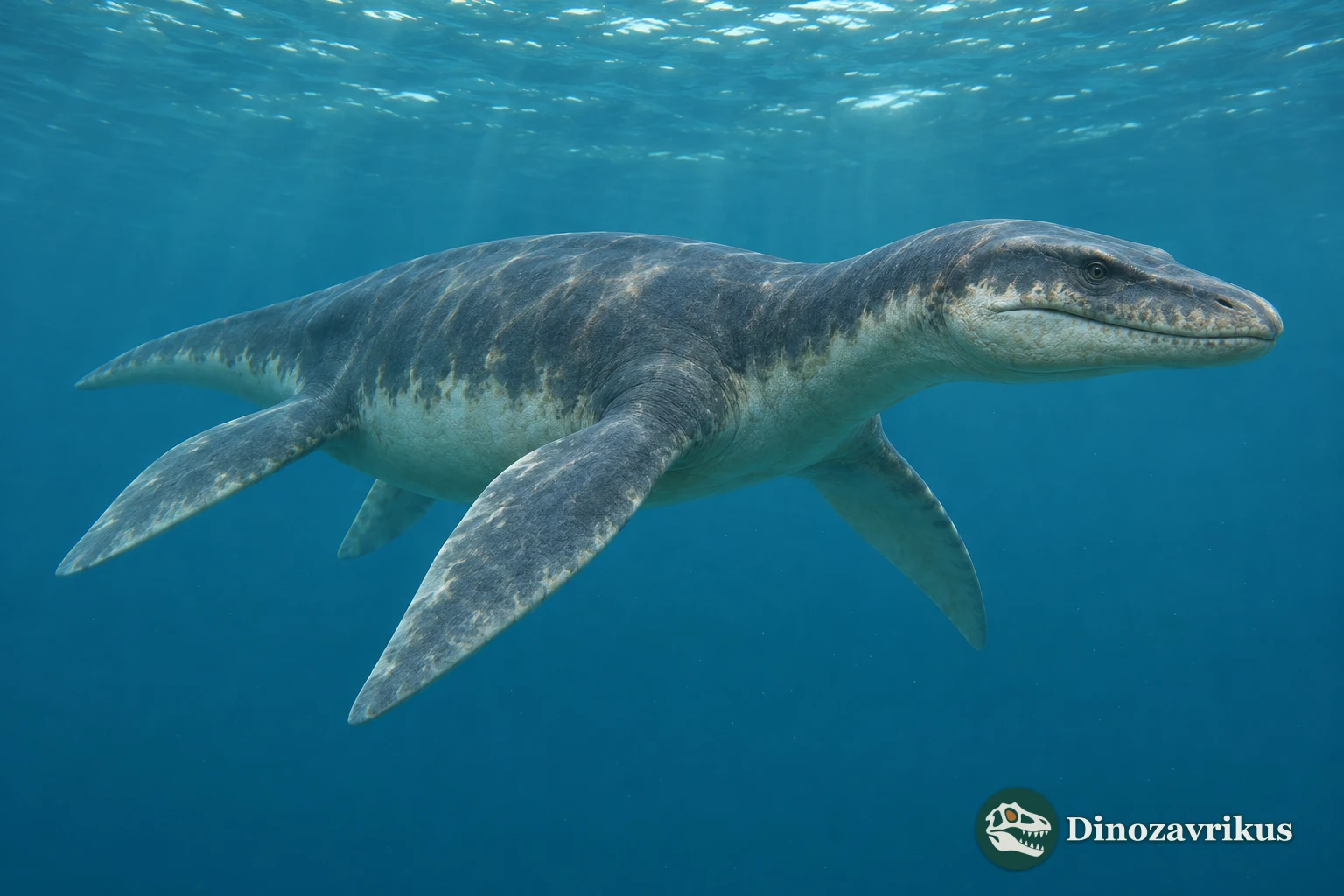
A large skull and a comparative length estimate
The preserved skull is more than 520 mm long, but it is incomplete. The original description compared its size with the limb bones and with better-preserved plesiosaur skeletons. From those comparisons, the authors estimated a total body length of about 3–4 m. This is a published estimate, not a direct measurement of a complete Anguanax skeleton.
A relatively large skull, an elongate lower jaw and the proportions of the few preserved vertebrae were interpreted as consistent with a comparatively short neck and deep body. Those proportions are inferred from anatomical relationships across plesiosaurs; the missing neck and trunk bones prevent a precise reconstruction. The figures on this page therefore show comparative palaeoart rather than a measured tracing of MPPL 18797.
Teeth, possible prey and the marine setting
The isolated crowns are slender, slightly recurved and bear weak enamel ridges. They were found near the skull rather than preserved in their sockets, so their exact positions in the tooth row are uncertain. Cau and Fanti interpreted the small, slender teeth and other cranial features as consistent with predation on small or soft-bodied prey in well-lit upper waters. That is an ecological hypothesis based on anatomy; no stomach contents identify a meal.
The surrounding limestones contain radiolarians, sponge spicules and other marine evidence. The authors placed the Kaberlaba area on the Trento Plateau within the Tethyan realm. Small isolated shark teeth were also recovered in the quarry, but they were not embedded in the Anguanax skeleton and do not prove an attack on a living animal. The fossil records a marine reptile and its burial context, not a witnessed hunting scene.
What remains uncertain
The type specimen supports a pliosaurid identification and a comparative body-length estimate, but it cannot establish the species' full range of variation, growth stages, colour, skin, swimming speed or exact diet. With one associated skeleton and substantial missing anatomy, several details of the whole-body reconstruction remain provisional.
A 2020 discussion of the regional fossil record continued to treat Anguanax zignoi as a species based on the incomplete, partly articulated pliosaurid MPPL 18797. New associated remains could test its anatomical interpretation. For now, the distinction between preserved bones and inferred appearance is essential when reading either the fossil description or a full-body illustration.
Frequently asked questions
Where was Anguanax found?
The type specimen was collected in the 1980s from Kaberlaba quarry near Asiago in Veneto, northern Italy. It came from lithozone 5 of the middle unit of the Rosso Ammonitico Veronese Formation.
What bones are known?
MPPL 18797 includes more than 75 elements from one individual: parts of the skull and mandible, isolated teeth, vertebrae, shoulder-girdle material and limb bones. The skeleton is incomplete.
How long was Anguanax?
The 2014 description estimated about 3–4 m by comparison with better-preserved plesiosaurs. The fossil is too incomplete for a direct measurement of total body length.
What did Anguanax eat?
Its slender, slightly recurved teeth and cranial anatomy led the describing authors to suggest small or soft-bodied prey. No gut contents or associated prey establish a specific diet.