

Annakacygna was a flightless swan that lived in the seas around what is now central Japan roughly 11.5 million years ago. A partial skeleton reveals reduced forearms and an unusually large lower jaw. A second species is named from the end of a much larger shin bone.
Quick facts
| Type species | Annakacygna hajimei |
|---|---|
| Group | Anatidae, swans |
| Age | Late Miocene, about 11.5 million years ago |
| Locality | Haraichi Formation, Gunma, Japan |
| Holotype of type species | GMNH-PV-678, associated adult skeleton |
| Estimated length | About 1.5 m for the type species |
What can the fossils tell us?
The right humerus of the type is 220 mm long and the ulna 125 mm. These proportions and a reduced keel support the inference of flightlessness.
The jaw led the authors to propose a filter-feeding mechanism. Neither the upper bill nor any filtering lamellae are preserved.
The type species was reconstructed at about 1.5 m from parts of the skeleton. A length near 1.95 m for the other species comes from scaling a single bone and is less certain.
Two fossils from river beds in Gunma
Hajime Nakajima discovered the type skeleton on the floor of the Usui River in Annaka. The other fossil, the end of a right tibiotarsus, was collected by Toshimasa Moridaira at the Kabura River near Yoshii. The Gunma Museum of Natural History holds the two type specimens as GMNH-PV-678 and GMNH-PV-1685.
Hiroshige Matsuoka and Yoshikazu Hasegawa named Annakacygna in 2022, combining Annaka with a word for swan. They honoured Nakajima in the name A. hajimei and the district of Yoshii in A. yoshiiensis. The larger fossil is similar in shape to the matching bone in the type species. The measured joint is about 1.3 times as wide.
Short wings with pronounced muscle attachments
The forearm and hand were strongly shortened relative to the humerus. The shape of the wrist, especially the enlarged radial carpal bone, appears to have limited how far the wing could unfold. The breastbone has a reduced keel. Together these features indicate a flightless bird whose wings could still be used for other movements.
The authors suggested that the folded wings and movable tail may have helped confine chicks on a swimming adult’s back. They based this on the fit of the wing joints and their comparison with living swans. The specimens preserve no young birds or direct evidence of the behaviour. Early accounts compared the skull and limb material with the Californian bird Megalodytes. Differences between the limb bones subsequently helped distinguish the Japanese genus.
Feeding in a marine setting
The Haraichi Formation contains marine deposits and has also yielded fossils of marine mammals. Annakacygna hajimei had thick-walled limb bones and a long, robust lower jaw. The form of the jaw joints and muscle attachment areas suggested that its bill could move through an unusually large range.
The describers proposed that the animal filtered small food particles at the surface. In their reconstruction, soft lamellae inside the bill would have retained the food. Those structures and the upper bill are missing, so the diet and precise feeding action remain inferences.

A longer reconstruction of the neck
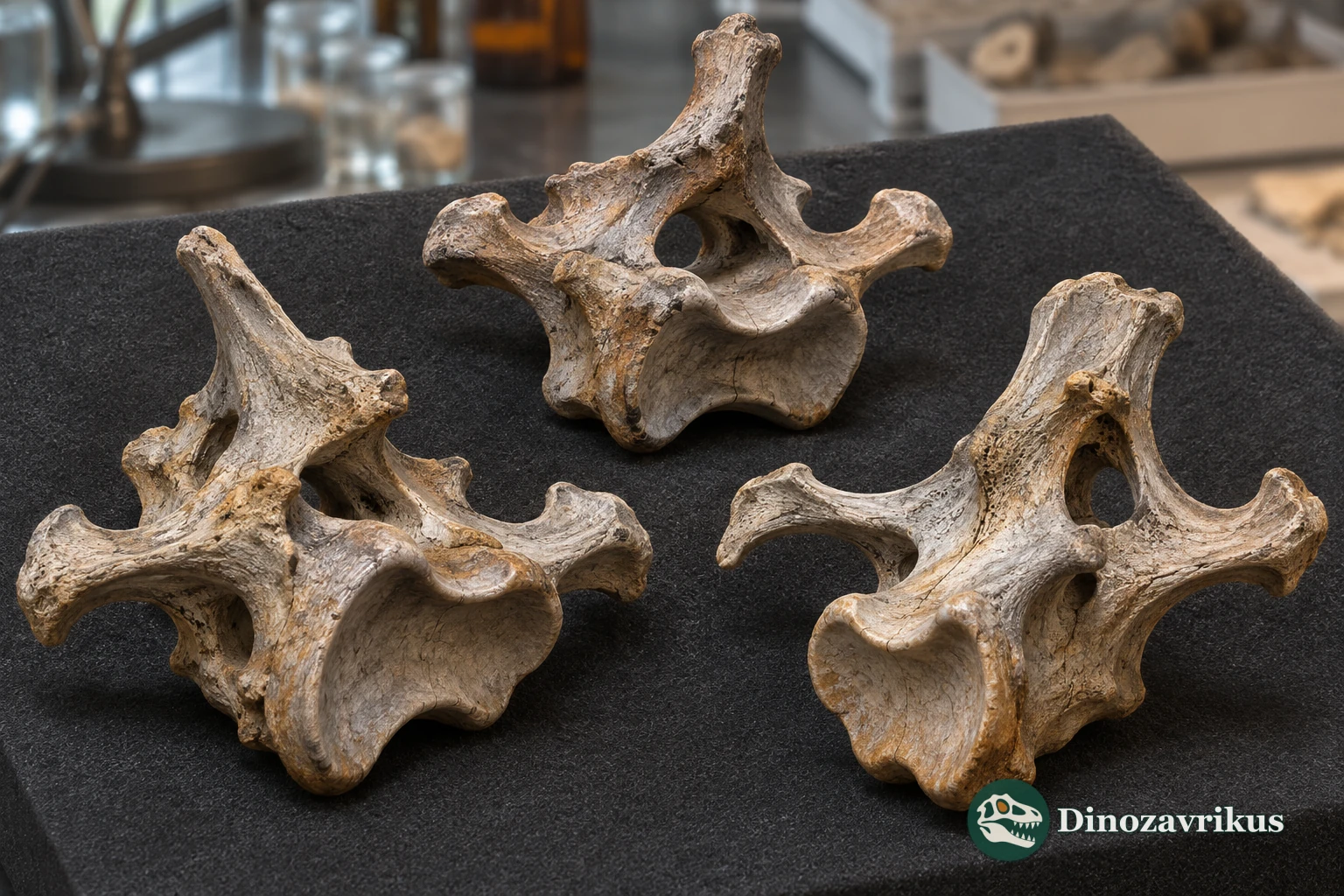
In 2024 Matsuoka, Riko Seoka and Hasegawa re-examined 12 cervical and five thoracic vertebrae. They reconstructed a neck with 23 vertebrae and estimated a bill-to-tail length of about 150 cm for A. hajimei. That superseded the original estimate of roughly 120–130 cm based on comparison with the black swan.
For A. yoshiiensis, the authors multiplied the length of the type species by the relative size of the end of the shin bone. This gave about 195 cm, conditional on the two species having broadly similar proportions.
Frequently asked questions
What shows that Annakacygna was a swan?
The anatomy of the pelvis and the long neck, reconstructed with 23 cervical vertebrae, support its placement among swans.
Could either species fly?
The well-known species had a reduced breastbone keel and shorter distal wing bones. The larger species is known from a leg fragment, so its wing proportions cannot be checked directly.
Did the bird eat plankton?
Planktonic food was proposed from the jaw reconstruction. Neither preserved food nor the filtering structures are known.
How was the larger species estimated at nearly two metres?
Researchers scaled the body length of the type species using the relative width of the shin-bone joint. That estimate depends on similar body proportions.