

Annea was a Jurassic carpet shark known from isolated teeth. Their outer crowns often bear a prominent central ridge. The ridge and the structure of the root helped link teeth from Belgium to a genus previously known from Germany.
Quick facts
| Order | Carpet sharks |
|---|---|
| Type species | Annea carinata |
| Fossils | Isolated oral teeth |
| Principal ages | Toarcian, Aalenian and Early Bajocian |
| Type species holotype | Tooth SMF 7144, 0.85 mm wide |
| Repository | Senckenberg Museum, Frankfurt |
What can the fossils tell us?
The type tooth of Annea carinata came from the Upper Aalenian at Moorberg near Hanover.
The Toarcian teeth are older than the German holotype. Their crowns and roots supported a separate species.
Some ray teeth share a similar outer ridge, but the vascular structures of the root differ.
A tooth 0.85 mm wide
Detlev Thies described Annea carinata in 1983 from a tooth 0.85 mm wide. It came from Upper Aalenian deposits at Moorberg near Hanover. The Senckenberg Museum in Frankfurt holds the holotype as SMF 7144. Thies later described an Early Bajocian tooth from Emmerke near Hildesheim.
A ridge runs down the outer surface of the main cusp towards the projecting base of the crown. The shape of the crown and the arrangement of openings and grooves in the root both contribute to identification. Studies place Annea among carpet sharks but leave its family uncertain.
Older teeth from Belgium
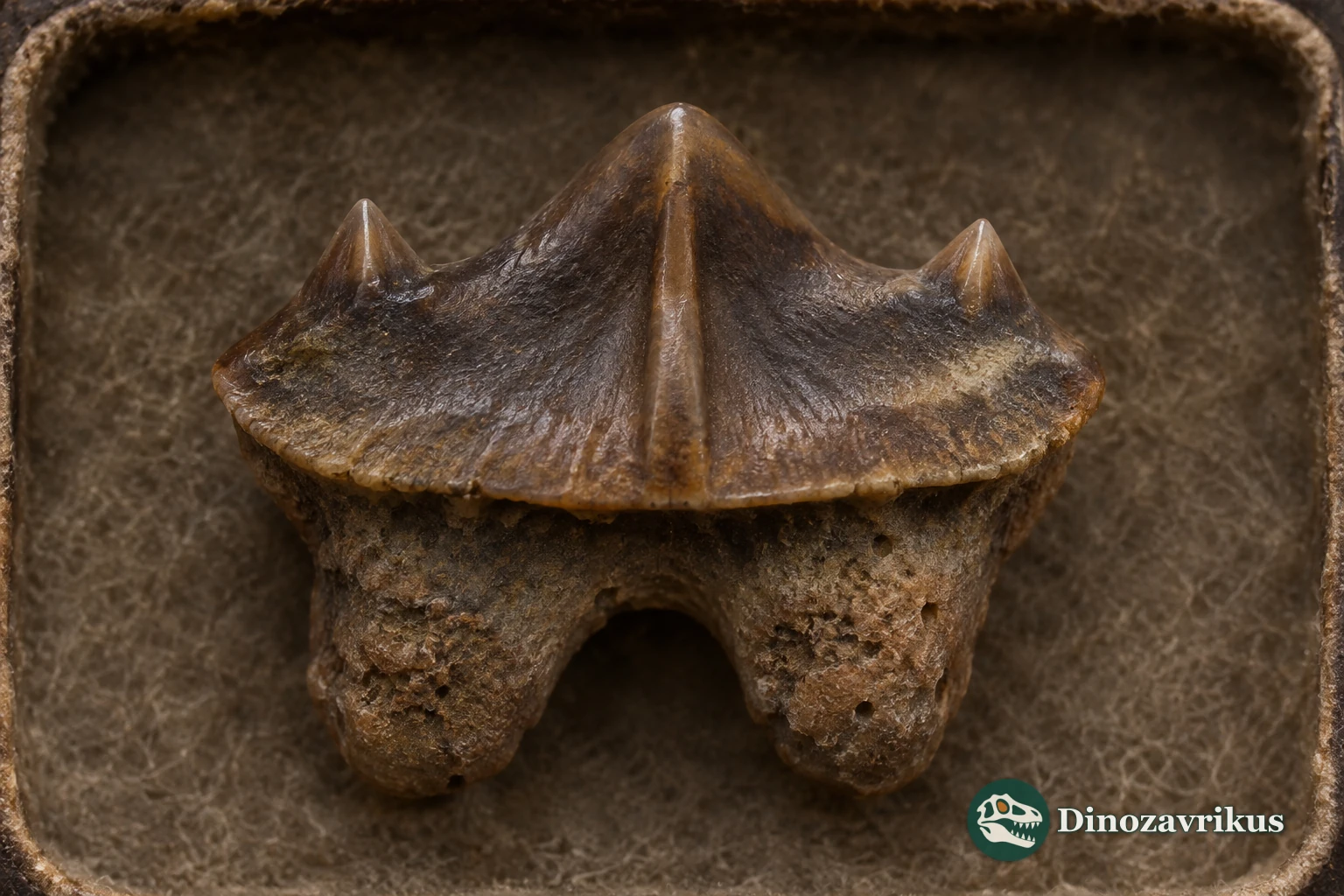
Dominique Delsate and Detlev Thies described Annea maubeugei in 1995 from Halanzy. The Royal Belgian Institute of Natural Sciences holds the holotype, IRSNB P6238. Ammonites in the phosphatic marl place the material near the top of the Bifrons Zone and in the Variabilis Zone. The same beds yield teeth of the early ray Toarcibatis.
The Belgian species has a single pair of pyramidal side cusplets. The German species can have one or two pairs of more slender cusplets. On the inner side of the Belgian crown, a narrow, flat projection contrasts with the bulkier, rounded projection of the German teeth.
Variation in the Belgian teeth
The authors compared teeth from the Belgian sample above and below a crown height of about 0.8 mm. In the smaller group the ridge often continues onto the apron at the front of the crown. In larger teeth the ridge tends to stop higher. The authors suggested a change with age, although an isolated tooth does not establish an individual's age.
These fossils document differences across the sample and between species. They cannot establish total body length, fin outlines or diet.
Frequently asked questions
Where was the tooth used to name Annea found?
At Moorberg in north-western Germany, in Upper Aalenian deposits.
Which species was described from Belgium?
Annea maubeugei, named in honour of Pierre-Louis Maubeuge for his studies of the Jurassic of Lorraine.
Do all Annea teeth have one pair of cusplets?
The Belgian species has one pair. The German species can have one or two.
How was the Belgian fossil bed dated?
Ammonites from the phosphatic marl indicate a Toarcian age.