

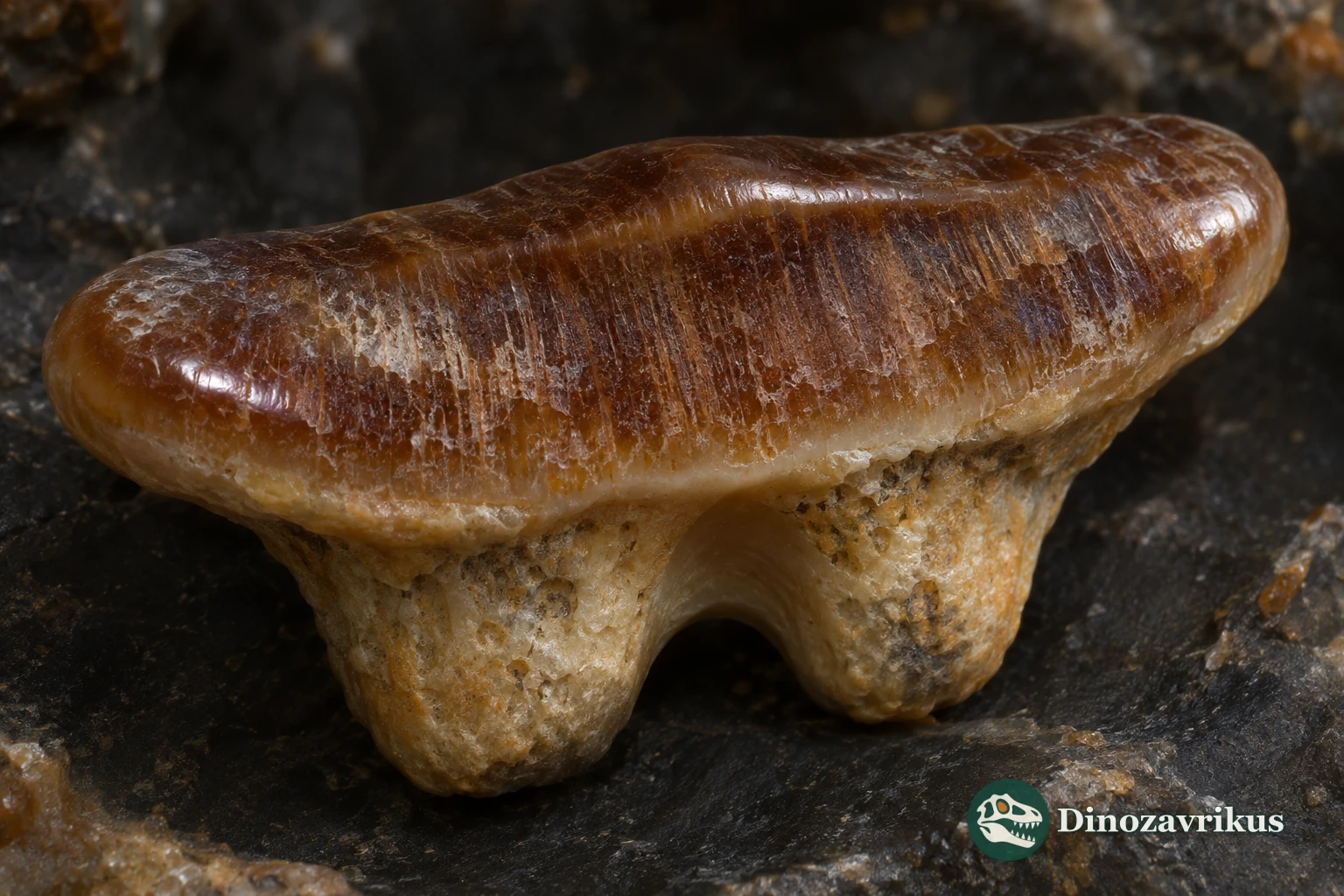
Toarcibatis is an early ray known from isolated teeth. The tooth used to name its type species measures only 1.2 mm along the jaw. Under magnification it shows a low, elongated crown and a deep groove between the root lobes.
Quick facts
| Group | Rays |
|---|---|
| Age | Toarcian, Early Jurassic |
| Type species | Toarcibatis elongata |
| Type locality | Halanzy, Belgium |
| Holotype | Tooth Hlz113, 1.2 mm wide |
| Fossils | Isolated teeth |
What can the fossils tell us?
Tooth Hlz113 came from the Crassum beds towards the top of the Bifrons ammonite Zone.
A hollow between the two helps separate these teeth from similar teeth of Cristabatis.
The 2026 study describes samples from Halanzy and Dudelange–Zoufftgen. Those counts are for teeth.
The millimetre-wide holotype
Dominique Delsate and Laurent Candoni established the genus in 2001. The holotype of Toarcibatis elongata, tooth Hlz113, came from the Crassum beds in southern Belgium at Halanzy, towards the top of the Bifrons ammonite Zone. Another tooth in the type series had previously been assigned to Protospinax. Comparison of the crown and root led to its recognition as material of an early ray.
The same study named several other forms. For example, T. multicristata from the Chassillé area has conspicuous ridges and occurs in the earlier Tenuicostatum Zone. In 2022 Toarcibatidae replaced Archaeobatidae, which did not meet the requirements for an available family name.
Recognising the crown in profile
Viewed from above, the crown of the type species is a long rhombus. A short tongue-like projection extends on the side that faced into the mouth. The crown overhangs that projection. In Cristabatis the inner face continues into the projection with almost no hollow. The comparable hollow is also less distinct in Belemnobatis.
A groove with a central opening separates the two root lobes. Delsate and Candoni described rear teeth as more elongated along the jaw than teeth farther forward. The low crown is useful for comparison, though it does not identify a particular prey animal.
Samples from Belgium and Luxembourg
In 2026 Delsate described 80 teeth of the type species from Halanzy and 18 from the Dudelange–Zoufftgen section. Belgian specimen TM588 measures 1.6 mm in width. Luxembourg specimen TM589 measures 0.8 mm. Without a jaw or an associated dentition, that difference cannot be converted into the relative body lengths of two rays.
The Luxembourg specimens came from several levels in the Variabilis and Thouarsense ammonite zones. Washing and sorting sediment made it possible to recover teeth of this size. The records document occurrence in several horizons. The outline of the body and tail remains unknown.
Frequently asked questions
Where did the holotype come from?
The Toarcian Crassum beds at Halanzy, southern Belgium.
How wide is the holotype tooth?
Hlz113 measures 1.2 mm along the jaw axis.
What separates it from Cristabatis?
Seen in profile, the crown overhangs a distinct hollow above the inner projection.
Has a skeleton been found?
The described material consists of isolated teeth. It does not establish the proportions of the ray.