

Belemnobatis was an extinct ray known from several well-preserved skeletons as well as isolated teeth. Its best-documented species, Belemnobatis sismondae, comes from Cerin in southeastern France. The skeletons show a broad, nearly circular pectoral disc, a short blunt snout and a long tail. That record supports a more confident body reconstruction than fossils made up only of detached teeth.
Quick facts
| Name | Belemnobatis Thiollière, 1852 |
|---|---|
| Type species | Belemnobatis sismondae |
| Group | Batomorphs, the cartilaginous-fish group that includes rays |
| Best material | Near-complete skeleton MDC 20015305 and other Cerin specimens |
| Age of type species | Late Jurassic, Upper Kimmeridgian |
| Length | About 105 cm in large measured B. sismondae specimens |
| Diet and colour | Not established by the known fossils |
What can the fossils tell us?
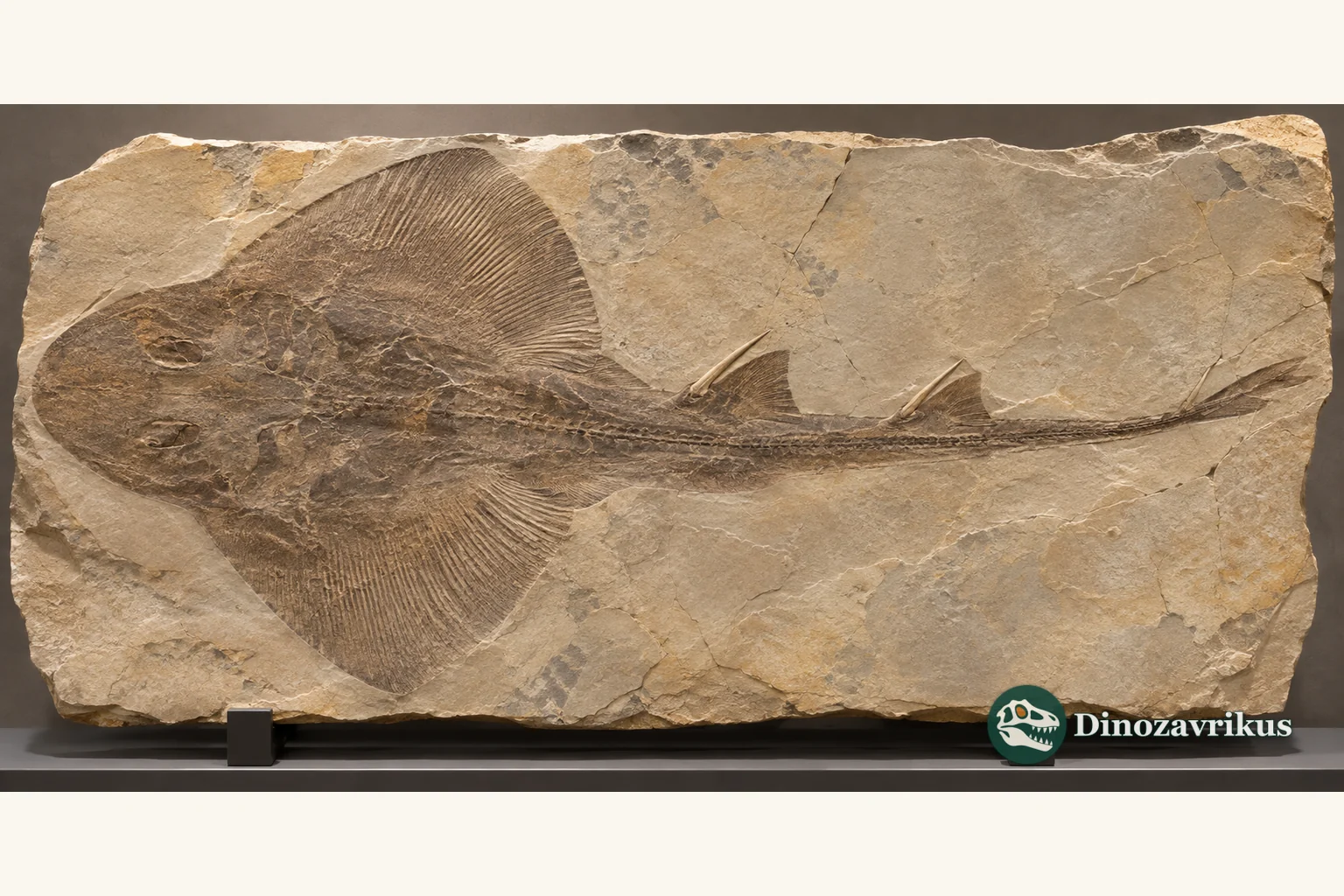
The holotype MDC 20015305 is almost complete, although part of its tail is missing. A 2024 revision also lists other complete and partial specimens. Skeletons show the disc and fins in place; isolated teeth cannot provide the same reconstruction.
In B. sismondae, the pectoral fins joined the head to form a disc whose length and width were similar. Both measured about 45 percent of total length in the analysed specimens. These are published measurements of the studied fossils, not a fixed template for every species in the genus.
Teeth assigned to Belemnobatis have been reported from several European and Asian deposits, but isolated dental material is harder to connect securely to a body-bearing species. Recent revisions distinguish diagnostic skeletons from older tooth-based identifications, so extreme dates in compilations do not carry equal evidential weight.
A name tied to Cerin
The French geologist Victor Thiollière established the genus in 1852. The name combines Greek roots for ‘spear’ and ‘ray’; the first element may refer to the conspicuous fin spines. The species name sismondae honours the Italian geologist Angelo Sismonda.
The type species is best documented at Cerin, in the Ain department of southeastern France. Its fossils come from the Upper Kimmeridgian, late in the Jurassic Period. The holotype, catalogue number MDC 20015305, is nearly complete but lacks part of the tail. Museum collections contain additional individuals: some are almost entire, while others preserve only the head, pectoral girdle, pelvic fins or tail vertebrae. These are separately collected specimens, not pieces of one composite skeleton.
A rounded disc and long tail
The pectoral fins joined the front of the body and head, producing a broad disc. In B. sismondae it was almost round: disc length and width each averaged about 45 percent of total body length in the measured sample. Its leading edge ended in a short, blunt snout without a separate elongated rostral appendage. That combination helps distinguish it from other Jurassic rays with a more extended front margin.
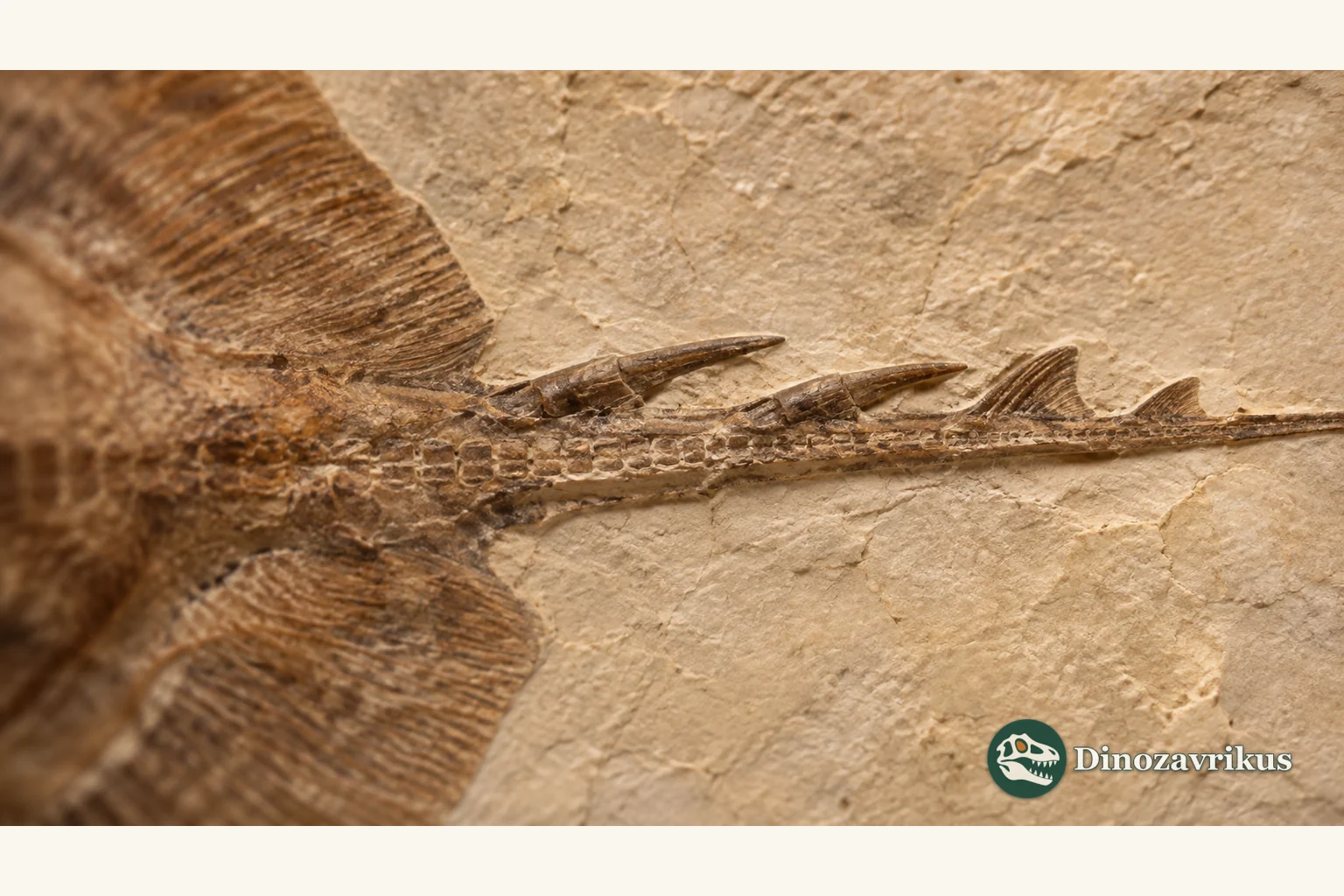
A 2024 redescription estimated that large specimens reached roughly 105 centimetres in total length. This is an estimate for the preserved sample, not a demonstrated maximum for every species or every period in which the genus may have existed. The tail made up about three fifths of total length in the measured fossils. Two conspicuous spines were associated with the dorsal fins; they were larger than those described in several other related Jurassic rays.
The skeletons also preserve details hidden by a simple outline. The pectoral skeleton contains 40–43 radial elements. Low, transversely expanded teeth have a weak or absent central cusp, while small skin denticles carry thickened, smooth crowns. Larger denticles occur especially along the midline. These features come from fossils in which the relevant parts are preserved together.
What isolated teeth can tell us
The genus name appears in studies of teeth from multiple localities. A 2008 report described teeth assigned to Belemnobatis from the Early Cretaceous Cherves-de-Cognac site in France and from Middle Jurassic deposits in Thailand. Cherves-de-Cognac includes lagoonal sediments of reduced salinity rather than an exclusively open-marine fauna. The authors noted that the taxonomy of Jurassic and Early Cretaceous rays was still being revised.
These reports should be kept separate from the skeleton-based record of B. sismondae. Tooth crowns and roots help researchers compare specimens, but similar shapes may occur in different rays, and a detached tooth rarely identifies an entire body with equal confidence. A tooth resembling Belemnobatis therefore does not automatically extend the measured body proportions, age or ecology of the Cerin species to another locality.
Movement, feeding and unknowns
The large pectoral disc and flattened outline identify a ray-like body plan. They do not preserve a swimming path or the precise posture used while feeding. Comparisons with living bottom-dwelling rays can suggest life near the seafloor, but that remains an ecological inference rather than direct observation. The better-known Jurassic ray Spathobatis offers a useful comparison of fossil body outlines without implying that the two genera were identical.
Tooth form also does not identify a particular prey. A low, transversely expanded crown may inform hypotheses about feeding mechanics, but no known gut contents establish a named diet. Skin colour, soft tissues, growth rate, lifespan and reproductive behaviour are not preserved. Claspers identify male individuals in some specimens, yet that evidence does not reveal the full life cycle.
A genus revised through its skeletons
A 2024 comparison of rostral and body proportions supported the distinct identity of B. sismondae and separated some similar Late Jurassic rays previously grouped too broadly. The revised diagnosis places the well-supported species in the Upper Kimmeridgian at Cerin. Older papers assigned teeth from Middle Jurassic, Late Jurassic and Early Cretaceous deposits to various species of Belemnobatis; those records are useful hypotheses, but they do not form a uniformly secure timeline for the whole genus.
For a particular fossil, the age of the rock, its exact position in the layer and the diagnostic anatomy matter more than a combined range copied from a catalogue. The Late Jurassic Cerin ray remains the clearest basis for reconstructing the animal. Tooth-only records from other regions need renewed comparison with better-preserved material before they can carry the same confidence.
Frequently asked questions
Was Belemnobatis a shark?
No. It was a batomorph, the cartilaginous-fish group that includes rays and their close relatives. Its broad pectoral fins joined the front of the body.
Where was the best-preserved skeleton found?
The type species Belemnobatis sismondae is best documented at Cerin in the Ain department of France. Its holotype is nearly complete but is missing part of the tail; other skeletons are known from the same locality.
How large was Belemnobatis?
Large measured specimens of B. sismondae are estimated at about 105 centimetres long. The estimate should not be transferred automatically to every species or tooth record assigned to the genus.
What did it eat?
Its exact diet is unknown. Tooth shape can inform hypotheses about feeding mechanics, but the known fossils do not establish particular prey.