

Spathobatis was a Jurassic batoid, or ray, with a broad pectoral disc and an elongated rostrum. Articulated skeletons from Cerin in eastern France preserve enough of the body to show its outline directly. They also provide a firmer basis for comparison than isolated teeth, which may look similar in unrelated rays.
Quick facts
| Name | Spathobatis Thiollière, 1848 |
|---|---|
| Type species | Spathobatis bugesiaca; older papers use S. bugesiacus |
| Fossil evidence | Articulated skeletons; the holotype is nearly complete but lacks its tail |
| Best-supported locality | Cerin, Ain, eastern France |
| Age | Late Jurassic, Kimmeridgian |
| Approximate length | About 60 cm for published specimens; not a demonstrated genus-wide maximum |
| Diet and colour | Not established by the known skeletons |
What can the fossils tell us?
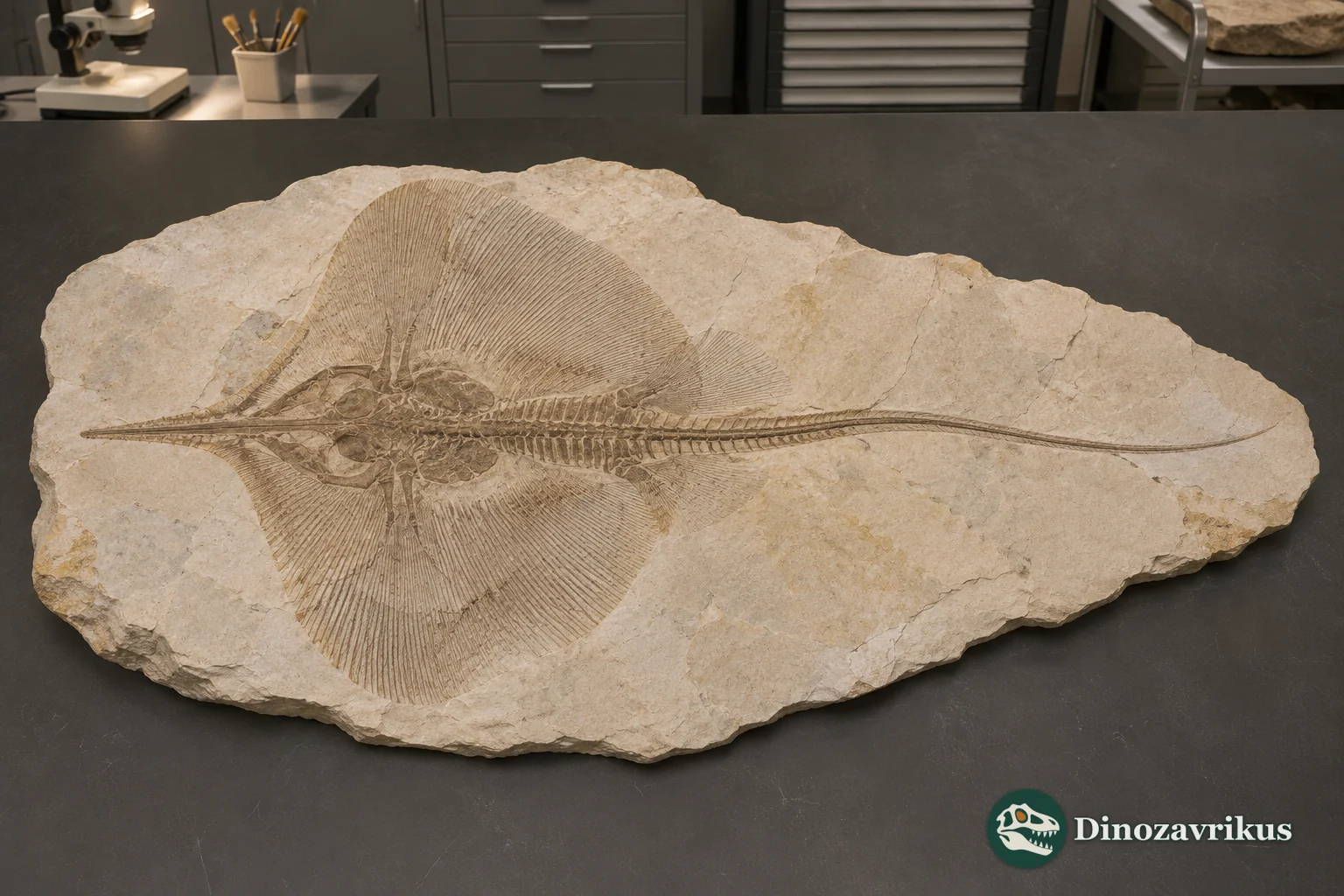
The holotype MDC 20015307 is nearly complete but lacks the tail. A second specimen, MDC 20015303, is more complete. These fossils allow the disc and fins to be compared in place instead of inferred from detached dental remains.
The pectoral fins join the sides of the head to form a flattened disc, with a narrow, spatula-like rostral extension at the front. In measured specimens the disc width is about 39 percent of total length and its length about 46 percent. Those values describe the measured fossils, not every member of the genus.
A 2024 comparison of rostral and body shape separated several Jurassic batoids formerly grouped together. The type species is most securely tied to Cerin; lookalike skeletons from other deposits need to be tested against the revised diagnosis. A 2025 nomenclatural note also corrected the feminine spelling bugesiaca and the family-name priority of Asterodermatidae.
A name tied to the Bugey region
The French geologist Victor Thiollière introduced the genus name in 1848. Its type species was later named for Bugey, the historical region that includes Cerin. Older literature usually prints the specific epithet as Spathobatis bugesiacus. In 2025, a nomenclatural note explained that the genus name is feminine and the ending should agree: Spathobatis bugesiaca. This is a spelling correction under zoological nomenclature, not a newly discovered fossil or a new species.
The holotype, catalogued as MDC 20015307, preserves almost the entire skeleton except for the tail. Specimen MDC 20015303 provides a more complete comparison. Catalogue numbers identify individual fossils; they should not be mistaken for a count of animals recovered from one bed. The surviving material is exceptional because the rays are articulated rather than represented only by teeth or isolated cartilage impressions.
Cerin and the changing fossil record
Cerin lies in the Ain department of eastern France. Its fossil-bearing beds are Kimmeridgian in age, within the Late Jurassic. The most secure skeletal occurrence of S. bugesiaca is from this locality. Older studies also applied the name Spathobatis to rays from other European deposits, including the Solnhofen area, on the basis of broad resemblance.
A 2024 reassessment compared rostral geometry and body proportions across a sample of 52 articulated batoids. Several forms once treated as unusually large or variable Spathobatis proved distinct; a large form was named Aellopobatis. That revision changes how locality lists should be read. A record in an older catalogue may reflect an earlier identification rather than a confirmed range under the newer diagnosis.
A ray with a long, spatula-ended snout
The skeleton shows the familiar ray arrangement: the pectoral fins broaden and join the head, making a flattened disc ahead of the narrower trunk and tail. The front of the head extends into a long rostrum that ends in a spatula-like outline. It is a widened projection, not a sharp beak or the tooth-bearing snout of a typical shark.
The measured pectoral disc is broad relative to the body. Its width reaches roughly 39 percent of total length, and its front-to-back length roughly 46 percent in the specimens reported by the study. The holotype has no tail, so any complete-length estimate for that individual involves reconstruction. About 60 centimetres is a useful published estimate for the known material, not proof of the largest size the genus could attain.
Fin skeleton and sexual maturity
Researchers described 38 to 40 pectoral radials, the internal supports that spread through the disc. Their segmented arrangement is visible in the fossils and helps distinguish the anatomy from a simple outline drawing. Small spines are associated with the dorsal fins in some specimens. As with other fossil rays, the number and preservation of visible elements vary from slab to slab.
Males preserve elongated pelvic claspers, the paired structures used in internal fertilisation by living sharks and rays. Their shape can identify sex and indicate that an individual had reached sexual maturity. The fossils do not preserve courtship, egg development, birth or the timing of reproduction, so those parts of its life history remain unknown.
What the skeleton cannot establish
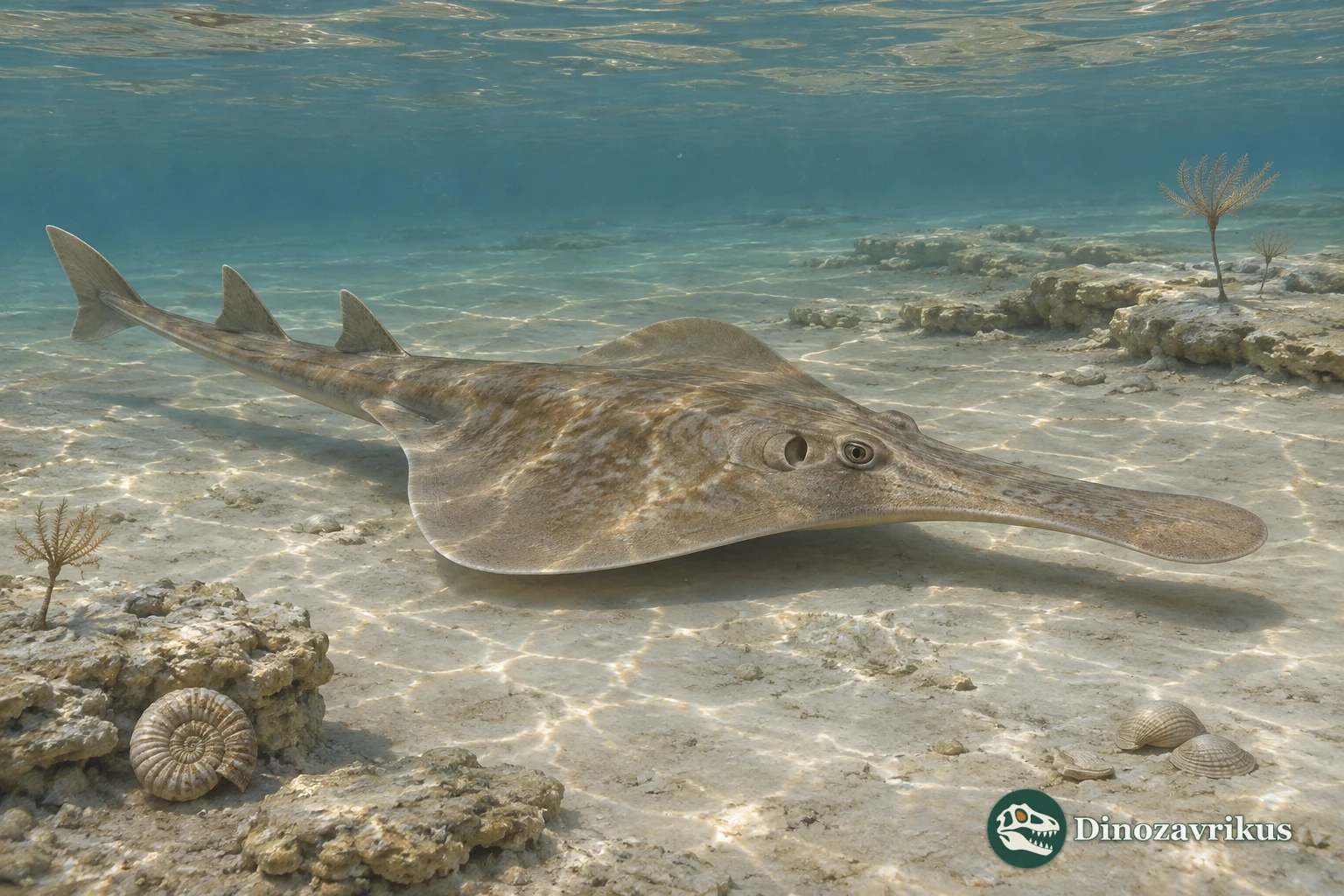
Broad pectoral fins indicate a different swimming mechanism from the side-to-side body undulation of a narrow-bodied shark. The segmented radials supported a flexible disc that could be moved in strokes. This anatomical comparison makes a ray-like mode of propulsion plausible, but it does not measure speed, turning performance or the animal's usual position in the water.
No stomach contents or prey held between the jaws identify a meal. A flattened ray may have searched near the bottom, yet the fossil does not prove a particular prey list. Soft tissues, skin pattern, colour, sound, growth rate and seasonal behaviour are also absent. The body reconstruction therefore follows the fossil outline while leaving unsupported details open. For another fossil batoid with a different dental record, see Ptychotrygon; for a shark known mainly from teeth, compare Parasquatina.
Frequently asked questions
Was Spathobatis a shark or a ray?
It was a ray, a batoid within the cartilaginous fishes. Its pectoral fins join the head to form a broad disc.
Where are the most secure skeletons from?
Cerin in eastern France. Articulated fossils from there anchor the identification of the type species.
How large was it?
Published estimates put known specimens at about 60 cm. The holotype lacks its tail, so the exact full length of that individual is not directly preserved.
Do fossils reveal what it ate?
No specific prey is established. The body plan may be consistent with near-bottom life, but that alone does not identify a diet.