

Parasquatina is a fossil genus of cartilaginous fish known mainly from isolated teeth in Late Cretaceous marine deposits of Europe. It is notable for a shifting classification: researchers first compared its teeth with angel sharks, then assigned the genus to a different major shark group. No fossil yet shows the whole animal.
Quick facts
| Name | Parasquatina Herman, 1982 |
|---|---|
| Type species | Parasquatina cappettai, based on an incomplete tooth from Hemmoor |
| Fossil evidence | Isolated teeth from different jaw positions; no associated skeleton |
| Range | Middle Turonian to Maastrichtian records, with a separate Danian report from Denmark |
| Localities | France, England, Germany and Denmark |
| Placement | Moved from a tentative angel-shark affinity to Orectolobiformes in a 2014 study |
| Body size | Unknown from the available teeth |
What can the fossils tell us?
Herman erected Parasquatina from a single incomplete tooth in Maastrichtian chalk at Hemmoor, north-west Germany. Later records add more teeth, but the original name was not based on an articulated skeleton.
The Middle Turonian P. justinensis was based on 24 teeth; the Late Santonian P. jarvisi on 15 teeth from four sites. These samples reveal variation in crowns and roots, not the connection of the jaws to the body.
A 2012 study tentatively considered a squatinid affinity and discussed competing resemblances. A 2014 paper moved the genus to Orectolobiformes. Neither interpretation is a direct observation of the complete animal.
A genus first recognized from one tooth
Günter Herman established Parasquatina in 1982 from one incomplete tooth in Maastrichtian chalk at Hemmoor, Lower Saxony. The type species is P. cappettai. Herman tentatively compared the fossil with angel sharks but also noted features resembling some carpet sharks and catsharks. The initial assignment was therefore cautious from the beginning.
A 2012 review revisited the genus while describing additional Late Cretaceous material from France and southern England. Its authors still regarded a squatinid relationship as possible, but emphasized that the evidence was provisional until skeletal remains with teeth in place could be found. The published discussion does not supply a verified collection number for the original Hemmoor tooth, so a museum number should not be inferred from a later specimen.
What the teeth preserve
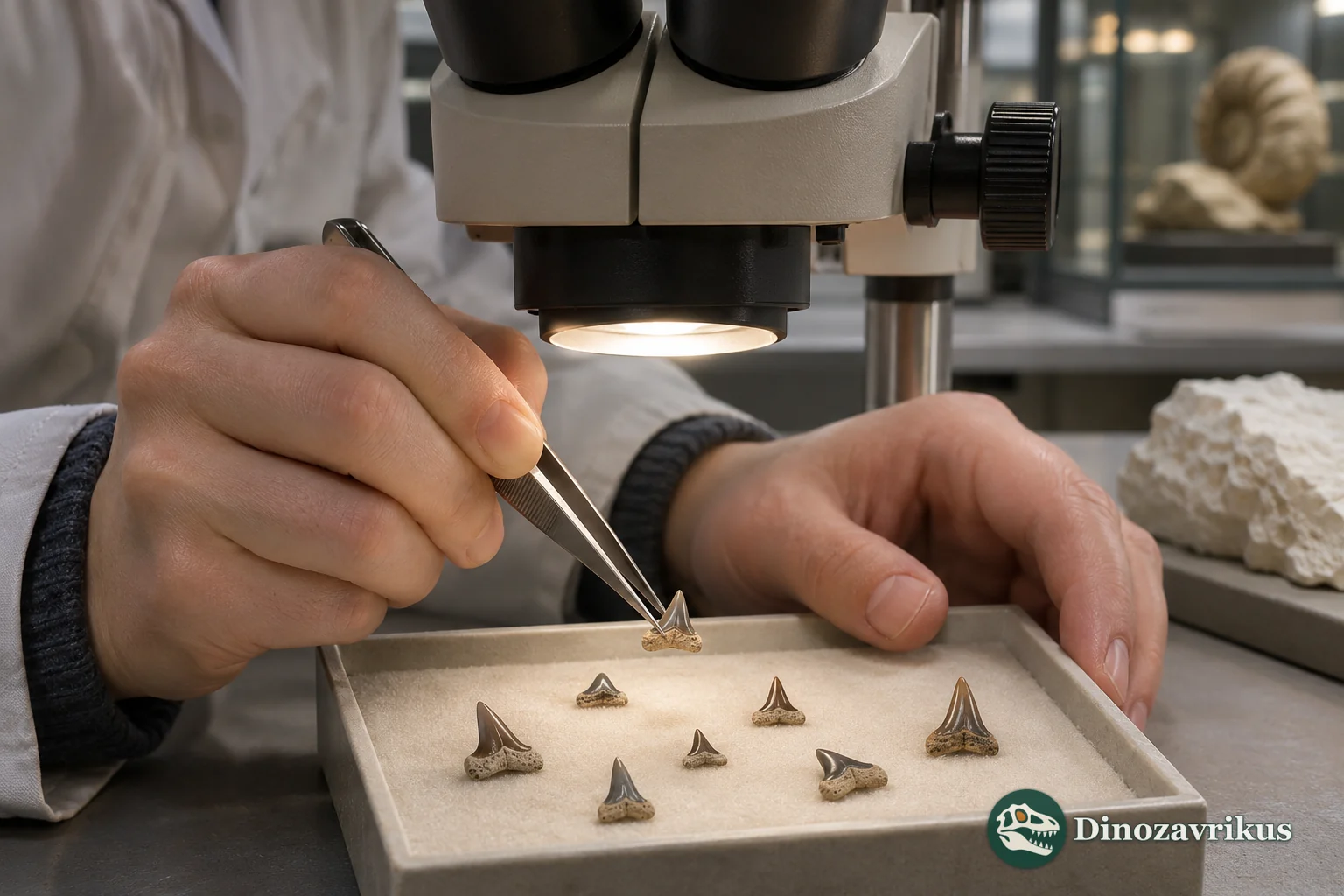
The teeth are small, usually with a single triangular central cusp and a low root divided into branches. Cutting edges can continue from the cusp onto the shoulders. Crown width, root shape, the labial apron and small surface ridges vary among species and between positions along a jaw.
In P. justinensis, most teeth are wider than high and have a smooth crown with little or no developed labial apron. The Middle Turonian type locality, Justine-Herbigny in France, yielded 24 teeth; JUH1-4 is the holotype. The sample includes anterior, anterolateral and lateral positions, which helps show that a jaw did not carry one uniform tooth shape.
The Late Santonian species P. jarvisi was described from 15 teeth across four sites. Its holotype, P. 66885, came from the lower horizon at Winterbourne. The species has a more prominent apron over the root and a vertical ridge on the labial face of some crowns, particularly in anterior teeth. Those features provide a basis for comparison, while the teeth remain isolated fossils rather than a mounted jaw.
Classification changed with new comparisons
The 2012 paper placed Parasquatina tentatively among Squatinidae, the family of angel sharks. The authors also discussed similarities to orectolobiform and scyliorhinid sharks. Crown shape alone did not settle the question; the form of the root, apron and lingual protuberance had to be weighed together.
In 2014, Jürgen Pollerspöck and Bernhard Beaury described P. zitteli from the Maastrichtian Gerhartsreiter beds near Siegsdorf in Bavaria. Its teeth lack the labial apron seen in some other species. In the same study, the authors withdrew the earlier placement in Squatiniformes and assigned the genus to Orectolobiformes. This illustrates how an anatomical comparison can change a taxonomic hypothesis without adding a complete skeleton.
The number of species and their relationships should therefore be read from the revisions that describe each sample. Similar-looking teeth have sometimes been placed in the wrong shark group. Pararhincodon is another Cretaceous shark known primarily through dental evidence, but that shared preservation does not make the two genera close relatives.
A scattered European record
The genus is documented from the Middle Turonian onward. Published localities include Justine-Herbigny in France, Late Santonian sites in England and France, Maastrichtian chalk in Germany, and the Gerhartsreiter beds of Bavaria. A later Danish study reported a single tooth assigned to the genus from the Danian, the earliest Paleocene. That isolated record extends the published range, but it does not show that one species crossed the Cretaceous–Palaeogene boundary.
These fossils occur in marine chalk and limestone deposits. Their sediment records a marine setting, but it does not by itself establish the exact water depth, temperature or place in the food web where the shark lived. A stratigraphic range is assembled from separate occurrences, not from one continuous population sampled through time.
Size, feeding and what remains unknown
No associated skeleton establishes the length, mass, fin shape or tail proportions of Parasquatina. Tooth dimensions cannot be converted directly into body length because teeth differ along a jaw and a small fossil may represent only one position in a much larger dental series.
Cutting edges are consistent with grasping or slicing food, but the published material does not preserve prey in the mouth or stomach contents that identify a diet. Swimming style, speed, growth, reproduction and colour are also unknown. The isolated teeth support anatomical and taxonomic comparisons; they do not justify a detailed behavioural portrait. Another tooth-based shark, Misrichthys, shows the same general limitation of dental fossils without implying a close relationship.
Frequently asked questions
Was Parasquatina an angel shark?
A 2012 study treated that affinity as possible but tentative. A 2014 revision assigned the genus to Orectolobiformes; the debate depends on how isolated tooth characters are interpreted.
How many Parasquatina teeth are known?
The published samples differ by species. The type genus began with one incomplete tooth; later descriptions include 24 teeth for P. justinensis and 15 for P. jarvisi.
Is a complete skeleton known?
No. Published material consists of isolated teeth, so body proportions and fin placement remain unknown.
How large was the shark?
Its total length has not been established. Measurements of isolated teeth do not provide a validated estimate of body length.