

Anningasaura lymense is an Early Jurassic plesiosaur known from a juvenile specimen found at Lyme Regis in Dorset, England. The type material includes a complete skull, palate and lower jaw, together with eight associated neck vertebrae. No trunk, limbs or tail are known, so the animal's adult body length and full proportions cannot be measured from this fossil.
Quick facts
| Species | Anningasaura lymense |
|---|---|
| Group | Plesiosaur; described as a basal form in 2012 |
| Age | Early Jurassic; exact stage of the type horizon is uncertain |
| Rock unit | Lias Group, Lyme Regis, Dorset, England |
| Type specimen | NHMUK OR49202, Natural History Museum, London |
| Preserved material | Juvenile skull, palate, lower jaw and eight associated neck vertebrae |
| Body length | Unknown; the type specimen does not include the trunk, limbs or tail |
Evidence guide
NHMUK OR49202 preserves a complete skull, palate and lower jaw together with eight cervical vertebrae, including the atlas–axis complex. The describing authors identified the individual as juvenile.
Charles William Andrews described the specimen in 1896 and referred it to Plesiosaurus macrocephalus. Vincent and Benson compared it again with that species' type material and named Anningasaura lymense in 2012.
The type comes from marine deposits of the Lias Group near Lyme Regis. The 2012 description supports an Early Jurassic age, but the precise stage and bed are not established securely for this specimen.
The fossil preserves no trunk, limbs or tail. It therefore cannot give a reliable total body length, adult proportions, swimming performance or a species-specific diet.
An old Lyme Regis specimen, reconsidered
NHMUK OR49202 comes from the Lower Jurassic Lias Group near Lyme Regis, Dorset. Charles William Andrews described and figured its skull in 1896, assigning it to Plesiosaurus macrocephalus. The fossil was already known to science, but its taxonomic identity could be tested again as comparative material and methods improved.
Peggy Vincent and Roger Benson re-examined the skull and compared it with the type specimen of Plesiosaurus macrocephalus, NHMUK OR1336. They concluded that OR49202 did not belong to Plesiosaurus and represented a distinct taxon. In 2012 they named it Anningasaura lymense. This is a revised classification of an existing fossil, not the discovery of a new complete skeleton.
What the juvenile type preserves
NHMUK OR49202 preserves a complete skull, palate and lower jaw, as well as eight associated cervical vertebrae. The series includes the atlas and axis at the base of the neck. Because these bones belong to one individual, researchers can compare the skull with the front of the neck without combining unrelated specimens.
The authors identified the individual as juvenile. That observation applies to the fossil specimen, not necessarily to every member of the species. The known material gives no direct view of the trunk, shoulder girdle, limbs, pelvis or tail, and therefore does not show the animal's complete body proportions.
Skull characters and the diagnosis
The 2012 description distinguished Anningasaura through a combination of cranial features. These include details of the posterior skull openings, the shape of the occipital region and contacts among bones of the palate. The authors also identified small foramina in the parietal and closely positioned openings on the occipital bone as distinctive features.
A diagnosis is based on how several anatomical characters occur together, not on a single dramatic outline. That matters for early plesiosaurs, in which some features are shared while the arrangement of bones can differ. Other Early Jurassic forms such as Hauffiopteryx help place the specimen in a broader anatomical comparison, but similarity does not establish direct ancestry.
Why the genus name changed
The earlier assignment to Plesiosaurus macrocephalus reflected the evidence and classifications available in the nineteenth century. Vincent and Benson's comparison with the type specimen of that species showed that NHMUK OR49202 had a distinct combination of characters. They therefore established both a new genus and a new species for it.
The genus name honours Mary Anning, the fossil collector whose work is closely associated with Lyme Regis and the early history of palaeontology. The naming does not prove that Anning collected NHMUK OR49202. The species name refers to Lyme Regis. In their 2012 analysis, Vincent and Benson treated the animal as a basal Early Jurassic plesiosaurian; phylogenetic positions can change when new fossils or character assessments are added.
Age and marine context
The Lias Group at Lyme Regis consists of marine Lower Jurassic deposits. This setting is consistent with the aquatic anatomy of plesiosaurs. The published account places Anningasaura in the Early Jurassic, but the type specimen does not have a securely established stage-level horizon in the description. A more precise age should not be inferred from the regional fossil record alone.
The locality is famous for its marine fossils, but the broader richness of Lyme Regis cannot be treated as a list of animals that lived beside this individual. Without an exact bed and a documented associated assemblage, the type does not establish a particular lagoon, water depth, season or ecological interaction.
What the fossil cannot tell us
The juvenile skull and neck help identify the taxon and describe its cranial anatomy. They do not establish its adult length, the proportions of its flippers, its usual neck posture, swimming speed, skin colour or soft tissues. They also provide no stomach contents or prey remains that would demonstrate a particular diet.
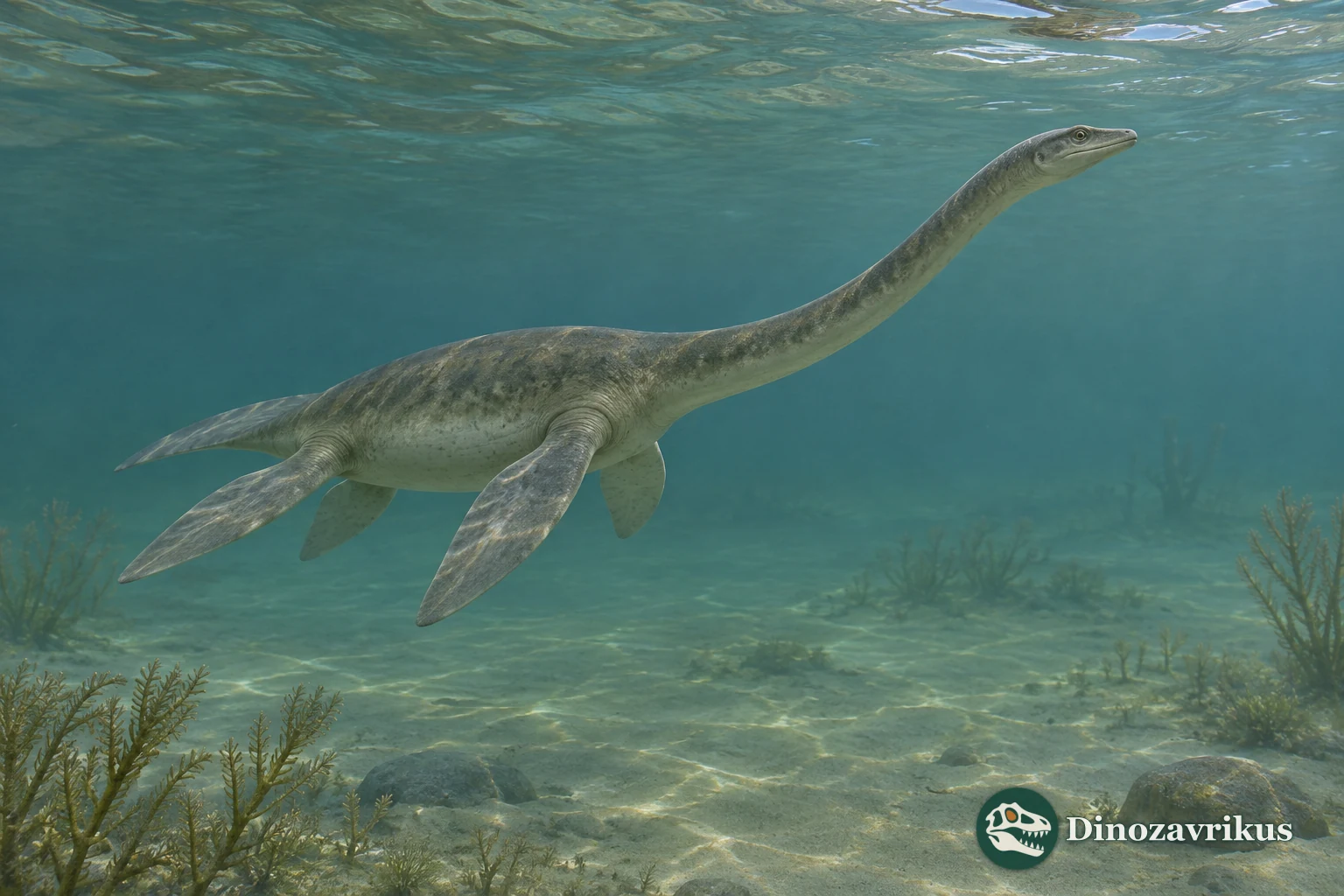
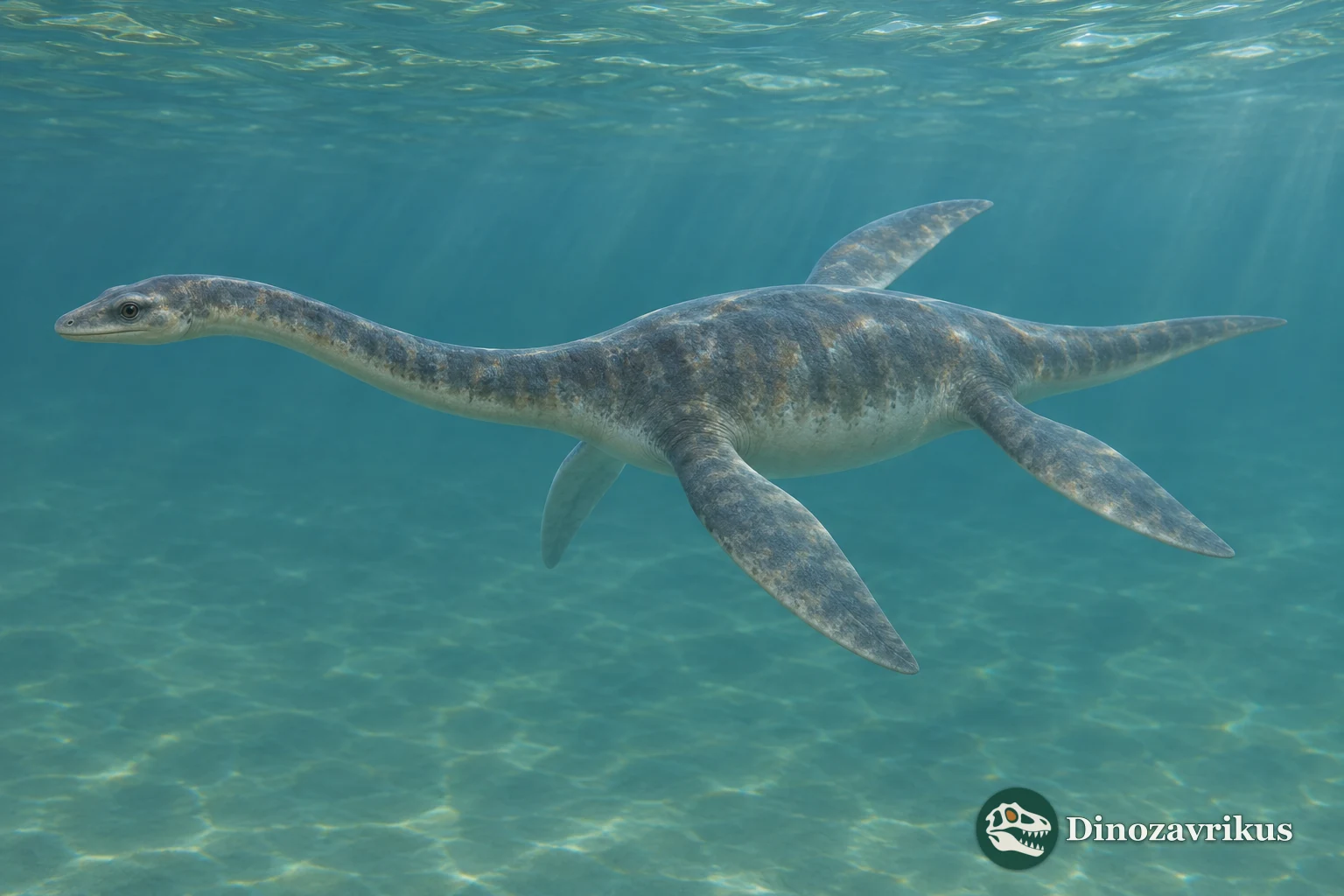
The full-body artwork on this page is a comparative reconstruction based on plesiosaur anatomy. It is not a portrait of the type specimen, and it should not be read as a measured adult. A more complete specimen would be needed to test the body plan and growth-related questions that NHMUK OR49202 cannot resolve.
Frequently asked questions
Where was Anningasaura found?
The type specimen comes from the Lias Group near Lyme Regis in Dorset, England. The published account gives an Early Jurassic age but does not securely identify the exact stage or bed.
What material is known?
NHMUK OR49202 preserves a complete skull, palate and lower jaw with eight associated neck vertebrae, including the atlas and axis. The individual was identified as juvenile.
How long was Anningasaura?
Its total length is unknown. The type has no trunk, limbs or tail, and its juvenile status does not reveal the size of a fully grown animal.
Why was it named Anningasaura?
Vincent and Benson named the genus in honour of Mary Anning, whose fossil collecting is closely associated with Lyme Regis. The name alone does not show that she collected the type specimen.