

Anserpica kiliani is known from one bone of the shoulder girdle found in central France. The original description placed the bird with the magpie goose family. A later comparison with a possible early member of the crane order showed why that identification remains open.
Quick facts
| Type species | Anserpica kiliani |
|---|---|
| Group | Birds, exact relationships uncertain |
| Age | Late Oligocene, reference level MP 29 |
| Locality | Créchy quarry, Allier, France |
| Holotype | FSL 367 053, nearly complete right coracoid |
What can the fossils tell us?
The shaft and most of the joint surfaces survive. The lateral process is broken, limiting comparison with modern bird shoulder girdles.
One opening enters the bone and the other carried a nerve. Their placement suggested comparison with the magpie goose. Other features have parallels in different birds.
The fossil came from the Créchy-route bed, correlated with mammal reference level MP 29. The bone itself has no direct numerical date.
A single fossil from Allier
Cécile Mourer-Chauviré, Didier Berthet and Marguerite Hugueney named the genus in 2004. Anser and Pica are the Latin names for geese and magpies, an allusion to the living magpie goose. The species name honours the geologist Wilfrid Kilian.
The type bone, FSL 367 053, is a right coracoid. In birds this bone braces the shoulder against the breastbone. The distance from the head to the inner corner at the far end is 30.1 mm. The original authors described it as about half the size of the corresponding bone in a living magpie goose and noted its comparatively slender shaft.
Why the identification is uncertain
The fossil has a large opening on its dorsal surface that extends deep into the shaft. A separate opening for the supracoracoid nerve lies some distance from the socket for the shoulder blade. Both features informed the comparison with magpie geese. On the ventral side, the nerve opening narrows to an elongated slit, unlike the wide opening in the modern magpie goose.
Gerald Mayr drew attention to the resemblance between this bone and a coracoid attributed to Geranopsis, a possible early relative of cranes and their allies. The shoulder bone alone has not settled the relationship. A skull or other parts of the skeleton would allow independent comparisons.
The setting at Créchy
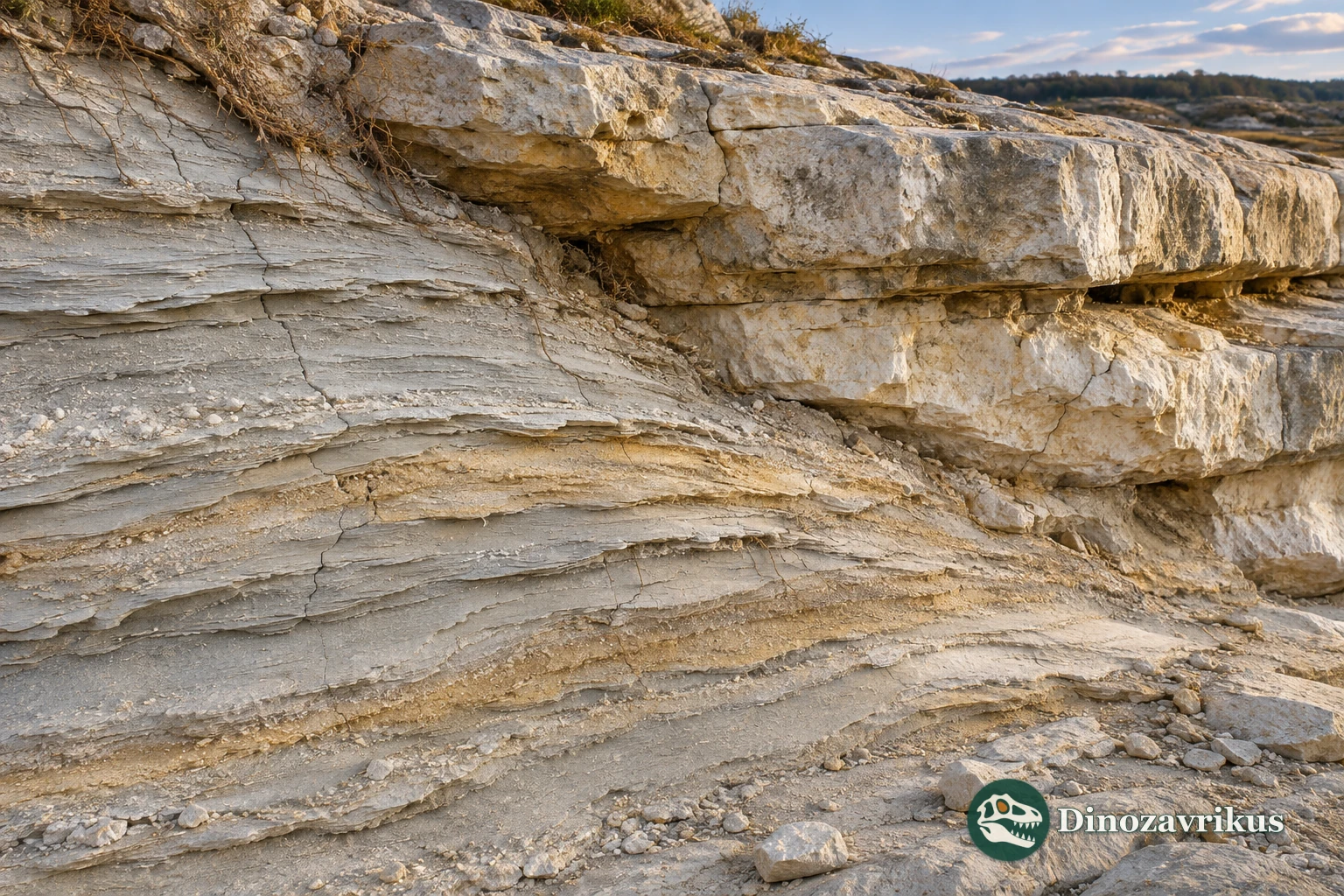
The type comes from a late Oligocene bed at the Créchy quarry. The bird assemblage includes the early cormorant relative Borvocarbo. The sediments and fossils document a lake setting. They give no direct evidence of where Anserpica fed or how it moved.
Frequently asked questions
What is a coracoid?
It is a bone that braces the shoulder girdle against the breastbone. It preserves attachment and joint surfaces that can be compared among birds.
How many specimens are known?
The description is based on a single right coracoid. No other skeletal parts were included in the type material.
Does the name mean it was a goose?
The name refers to the original comparison with the magpie goose. It does not determine the bird’s relationships.
Can its body size be estimated?
The bone is small relative to that of a living magpie goose, but one coracoid cannot provide a reliable total length or mass.