

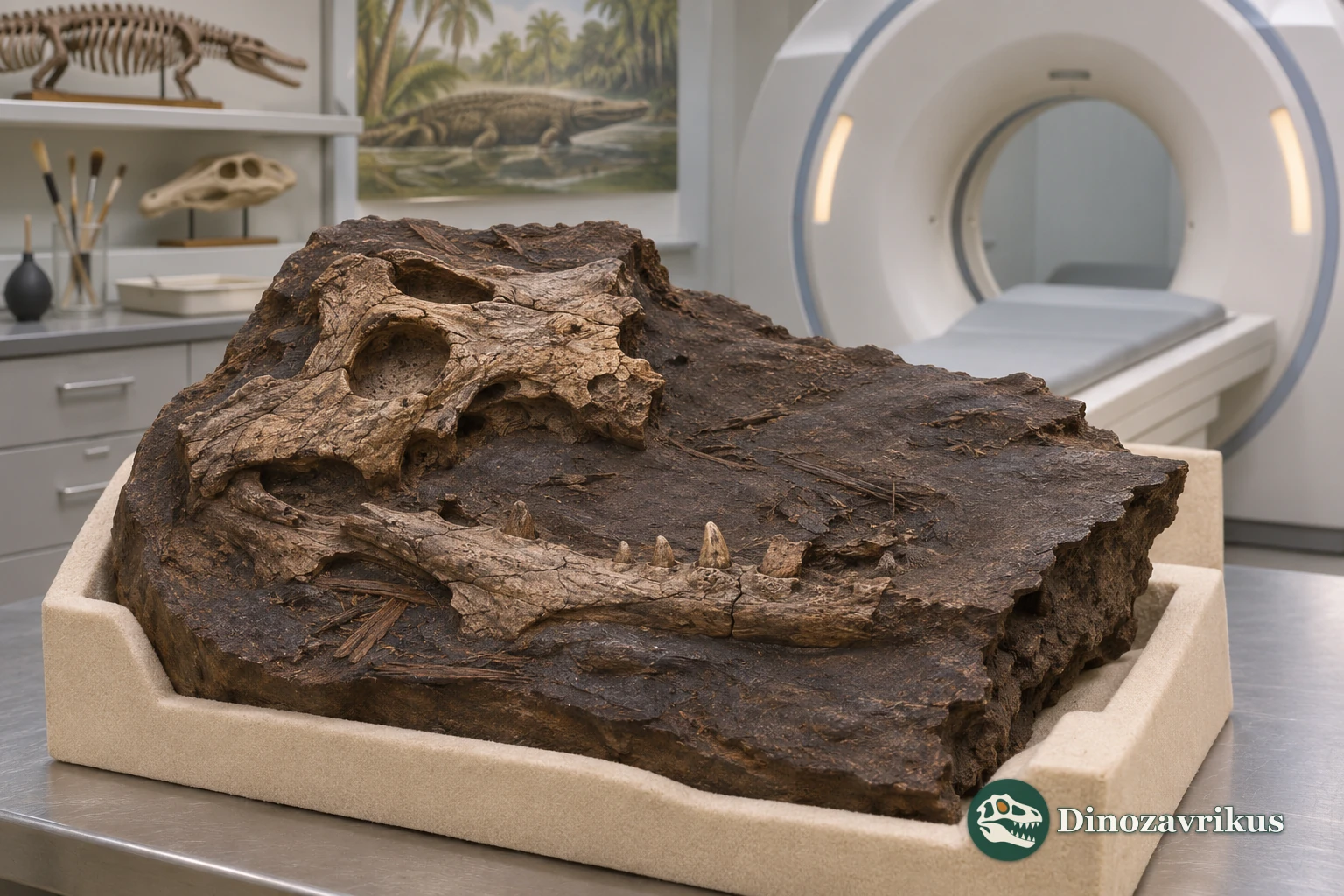
Antecrocodylus chiangmuanensis lived in what is now northern Thailand during the middle Miocene. The type specimen preserves the rear portions of the skull and lower jaw. These bones allow comparisons with other fossil crocodilians, while the missing snout leaves much of its appearance unresolved.
Quick facts
| Species | Antecrocodylus chiangmuanensis |
|---|---|
| Age | Middle Miocene |
| Region | Northern Thailand |
| Holotype | Posterior skull and lower jaw |
| Deposits | Chiang Muan and Mae Moh lignite seams |
What can the fossils tell us?
The remaining bones of the skull and jaw yield characters for anatomical comparison. The front of the snout is missing, so its shape and complete skull length remain uncertain.
The scans revealed structures within the fossil block. The scan records material that survived and cannot recover the missing parts.
The type came from Chiang Muan. The research team referred additional fossils from Mae Moh to the same species after comparison.
Fossils from two mines
Jeremy Martin and colleagues described the species from material recovered at Chiang Muan in Phayao Province. Their paper appeared online in 2023. Additional fossils from lignite beds at Mae Moh in Lampang Province were referred to the species, so the published record draws on two separate sites in northern Thailand.
Both occurrences are middle Miocene. The seams formed from accumulations of plant matter. They record the conditions in which sediment accumulated, with limited direct evidence of the waterways the animal usually occupied.
What the broken skull can show
The type specimen lacks the front of the skull. The authors studied the preserved bones of the jaw and rear of the head with the aid of a medical CT scanner. The scans let them examine bone inside the specimen without extracting individual elements.
The preserved region supplies characters for comparing crocodilians. The overall shape of the muzzle, total body length and particular prey cannot be established from it.
Near the base of the true crocodile lineage
The original analysis placed Antecrocodylus on an early branch close to Crocodylidae, the family of true crocodiles. This is a proposed relationship among branches. It leaves open whether the species lies on a direct ancestral line.
Thailand also has crocodilian fossils from much older deposits. The Eocene Krabisuchus represents a different branch and a much earlier interval of the regional record.
Frequently asked questions
Where was the type specimen found?
It came from lignite deposits at Chiang Muan in Phayao Province, northern Thailand.
Which parts of the head survived?
The holotype comprises the rear parts of the skull and lower jaw, with the front of the snout missing.
Why did the researchers use CT imaging?
Scanning revealed bone inside the specimen and supplemented observations made on the exposed surfaces.
Was it an ancestor of living crocodiles?
The first analysis placed it near the base of the true crocodile lineage. That relationship does not demonstrate direct ancestry.