

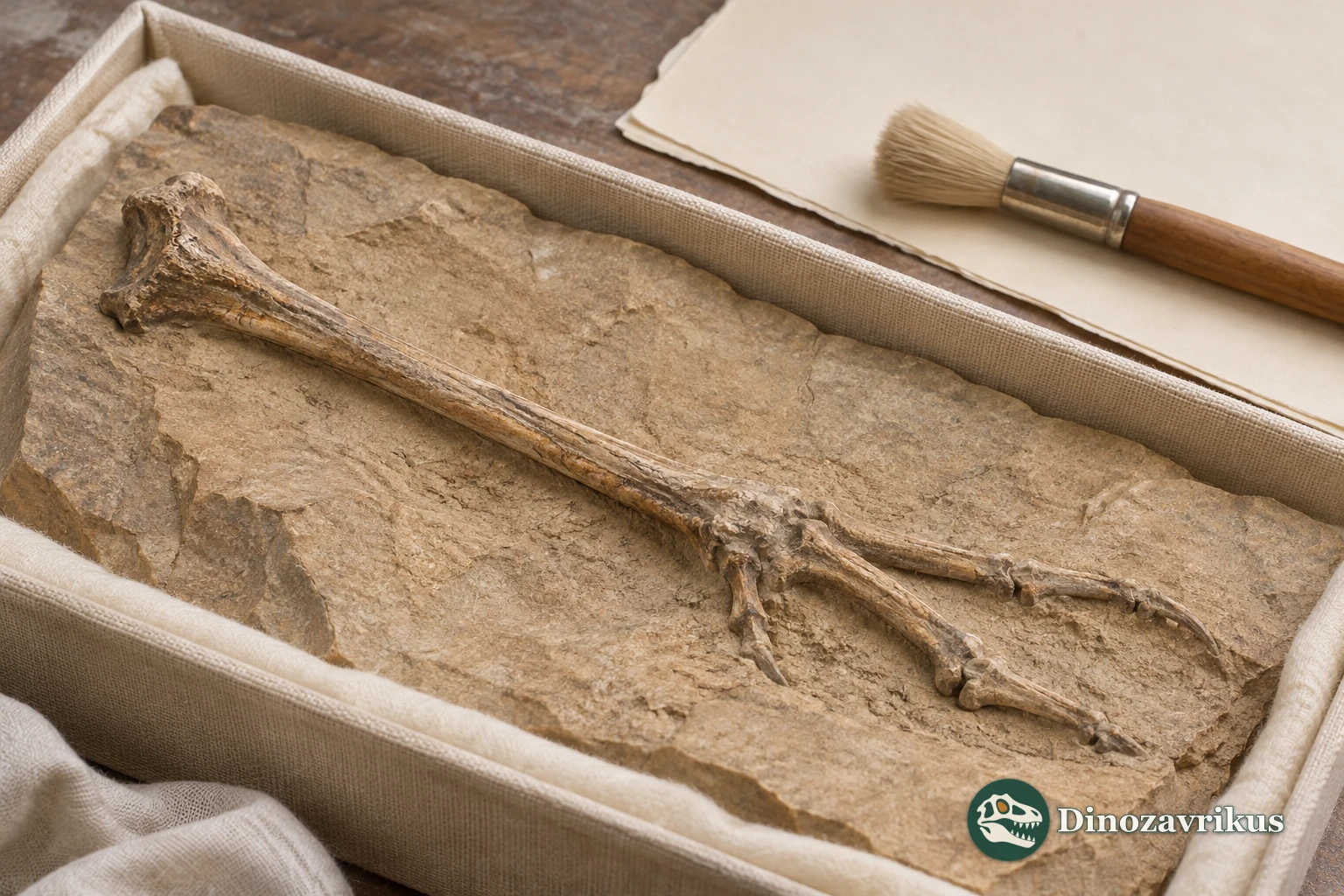
Apatosagittarius is known from a nearly complete lower foot bone and toe bones preserved at Ashfall in Nebraska. The elongated foot recalled that of a living secretarybird, suggesting a raptor that may have searched for prey on open ground.
Quick facts
| Family | Accipitridae |
|---|---|
| Locality | Ashfall Fossil Beds, Nebraska |
| Age of deposits | About 11.9 million years |
| Material | Nearly complete tarsometatarsus with phalanges |
| Named by | Alan Feduccia and Michael Voorhies, 1989 |
What can the fossils tell us?
The elongated tarsometatarsus records the proportions of one part of the leg. The lengths of the thigh and shin cannot be measured from it.
Similar foot proportions can evolve independently in ground-travelling raptors. The fossil gives no direct evidence of the shape of the head or wings.
Uranium–lead analysis of zircon dates the ash to around 11.9 million years ago. This is the age of a deposit, not an extinction date for the species.
The Ashfall foot
Alan Feduccia and Michael Voorhies described Apatosagittarius terrenus in 1989. The tarsometatarsus, the bone between the shin and the toes, was nearly complete, with phalanges still in place. One specimen is known from Ashfall. The genus name means false secretarybird, and terrenus refers to the ground.
The describers identified it as a hawk. Another extinct accipitrid, the Bahamian Titanohierax, had a relatively short, stout tarsometatarsus. The Nebraska bird is distinctive for the elongated form of the corresponding bone. Without the rest of the skeleton, this distinction says more about the foot than overall stature.
Convergence on the secretarybird
The living secretarybird moves on long legs and hunts on the ground. The original study proposed that the Nebraska hawk arrived independently at similar foot proportions, an example of evolutionary convergence. The fossil supports the possibility of extensive ground travel while leaving its speed, gait and prey-handling behaviour unknown.
No skull, trunk or wing bones are known. Familiar features of the living secretarybird, including its crest and snake hunting, cannot be assigned to the extinct hawk from the preserved foot.
A hawk from a landscape buried in ash
Volcanic fallout covered a waterhole at Ashfall, where the deposits preserved remains of birds and other animals. Uranium–lead dating of zircon at the base of the ash gave 11.86 ± 0.13 million years. Isotopic work on Ashfall ungulates also supports open habitat dominated by C3 plants.
Open ground is consistent with the suggested ecology of a walking raptor. A fossil’s burial site gives no direct evidence of where that individual hunted or how it died.
Frequently asked questions
What survives of Apatosagittarius?
The type specimen is a nearly complete tarsometatarsus with toe phalanges. The rest of its skeleton remains unknown.
Was it an ancestor of the secretarybird?
The study interpreted the resemblance as convergence. Similar proportions do not establish a direct evolutionary relationship.
How was the fossil dated?
The age comes from uranium–lead dating of zircon in the Ashfall volcanic ash. The estimate is about 11.9 million years.
Could it fly?
The foot supports discussion of walking on land. The absence of wing material leaves the flight capabilities uncertain.