

Aphelotoxon was a Late Cambrian trilobite from North America. In the type species, the front of the head shield comes to a point and the furrows delimiting the glabella and border are subdued. Nevada material helped distinguish species by the head margin and fine shell texture. South Dakota fossils show how the head changed through growth.
Quick facts
| Group | Trilobites, placed in Cliffidae in one classification |
|---|---|
| Age | Late Cambrian, Furongian |
| Region | North America: Nevada, Utah and South Dakota, USA |
| Diet | Unknown |
| Type species | Aphelotoxon acuminata |
| Material | Cranidia and other shell fragments, including early growth stages |
What can the fossils tell us?
The front margin of A. acuminata comes to a point, with furrows in front of the glabella generally weak.
A collection from an intermediate level in Nevada combines features of both forms. Palmer interpreted the series as a possible transition.
The order of the beds and the shape of the shells are consistent with a relationship. They leave the ancestry of particular populations open.
Why a separate genus was named
Allison Palmer first described the type species in 1960 under the tentative combination Bynumiella? acuminata. Re-examining the type material of that genus showed differences in the head. In 1965 he erected Aphelotoxon for the pointed forms from the Late Cambrian of the Great Basin.
The type species has small eye lobes and downsloping fixed cheeks. Some isolated shields resemble those of Cliffia, which was later placed with Aphelotoxon and Drabia in the family Cliffidae. A tail shield found on its own can preserve too few characters to distinguish these forms.
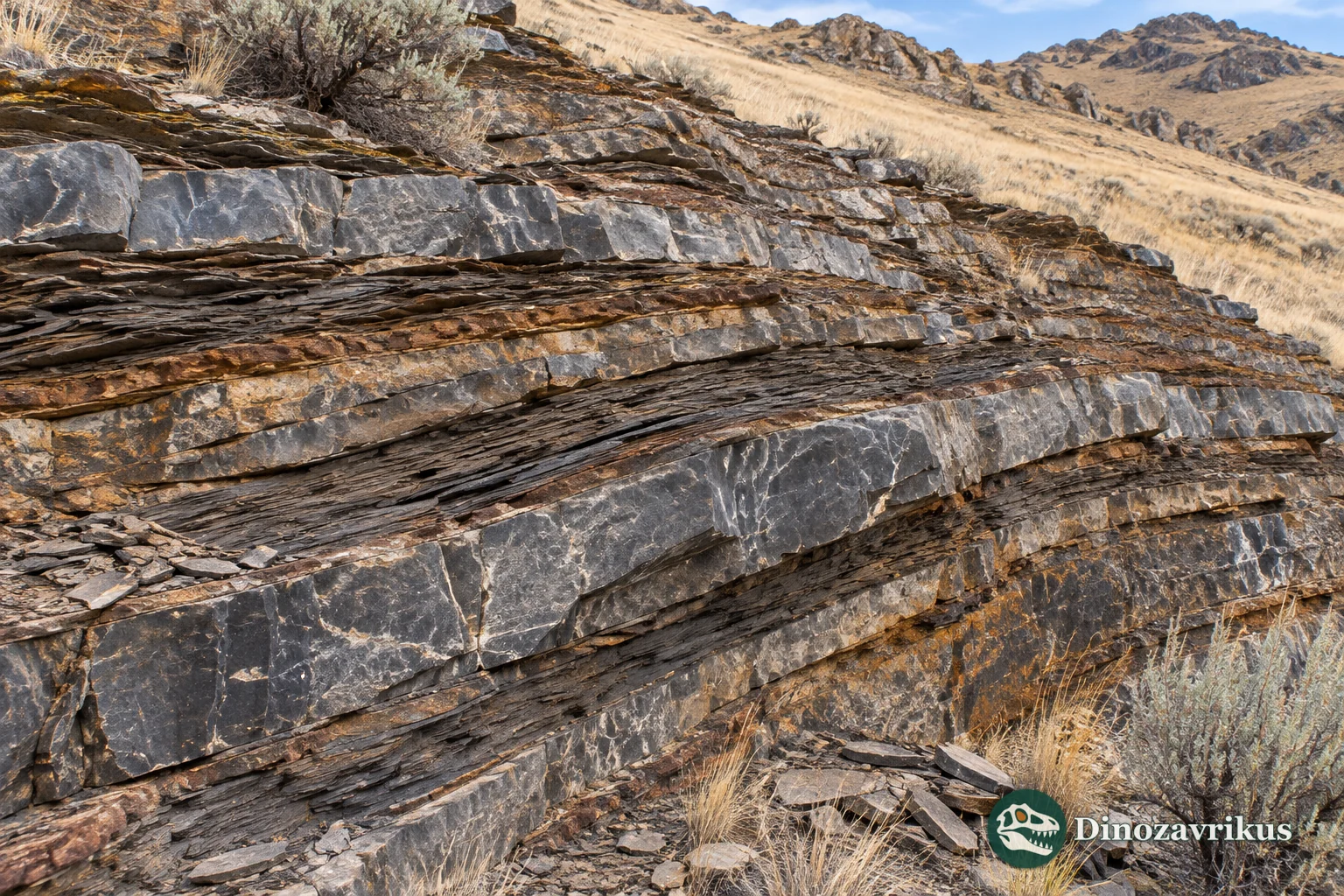
Three levels in Nevada’s Ruby Range
Palmer identified A. punctata in the lower beds by its prominent pits and distinct furrows. Around 46 m higher in the section, he found smoother material assigned to A. acuminata. The material from in between has a less distinct border and moderately pitted shell.
Palmer proposed that the smoother species might have descended from the strongly pitted one. The section records the order in which these features occur. A direct line of descent remains an inference from that sequence.
How the head changed with growth
Early shields of A. triangulata from the Deadwood Formation of South Dakota measure less than half a millimetre. They have a rounded outline. At later stages the cranidium elongates and a narrow area becomes visible just inside the front border. The documented sequence helps distinguish juvenile stages from superficially similar small shields of other trilobites.
Frequently asked questions
What distinguishes the type species?
In Aphelotoxon acuminata, the cranidium comes to a point at the front. Furrows in front of the glabella are usually weak.
Where were pitted and smooth shells found?
They were found in different beds in Nevada’s Ruby Range. Some intermediate specimens share features of both forms.
What did the early stages look like?
The smallest illustrated stages of A. triangulata from South Dakota have rounded shields less than half a millimetre long.
Why can isolated tail shields be hard to identify?
Closely related forms can have similar tails. Without matching head pieces, some specimens can only be assigned tentatively.