

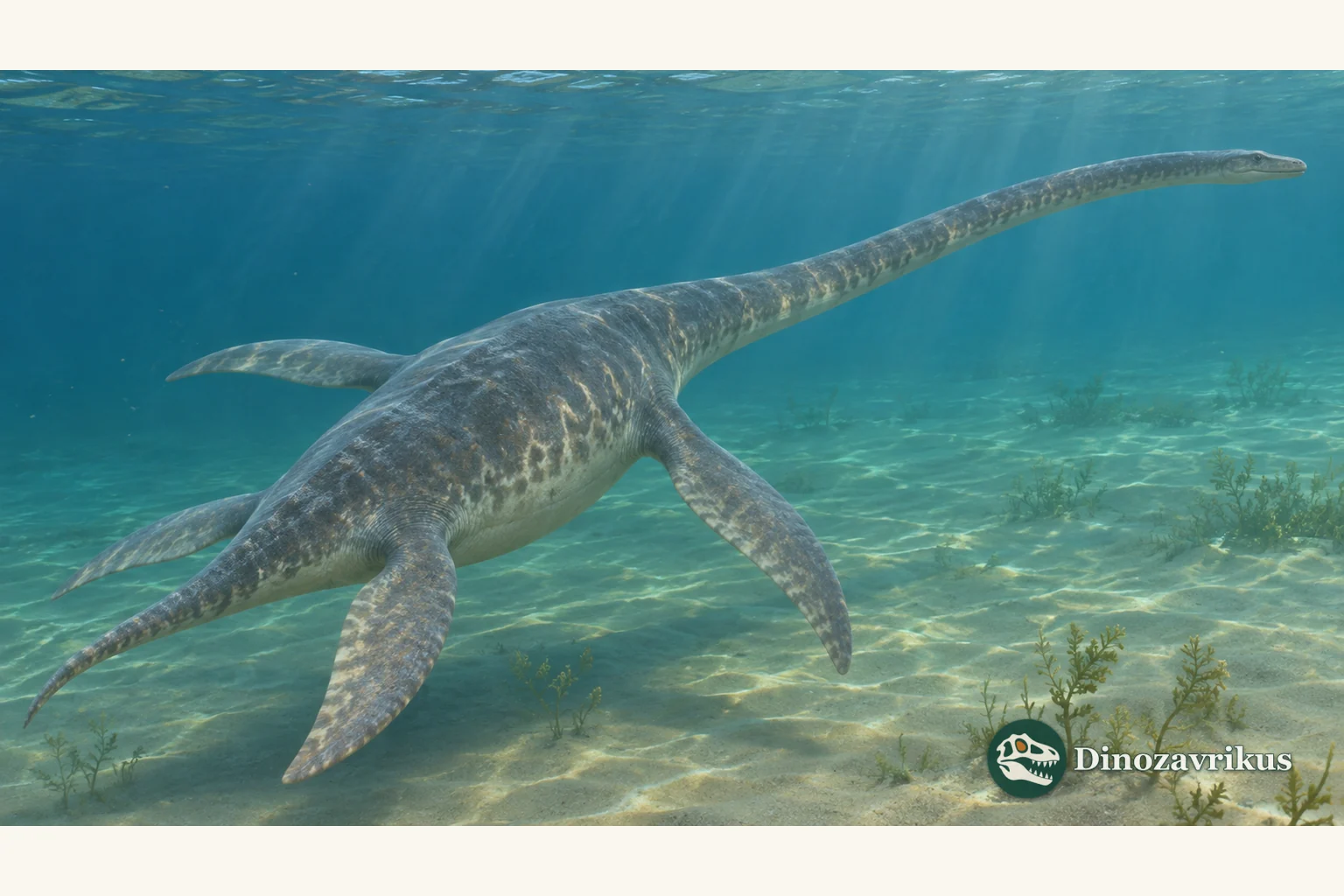
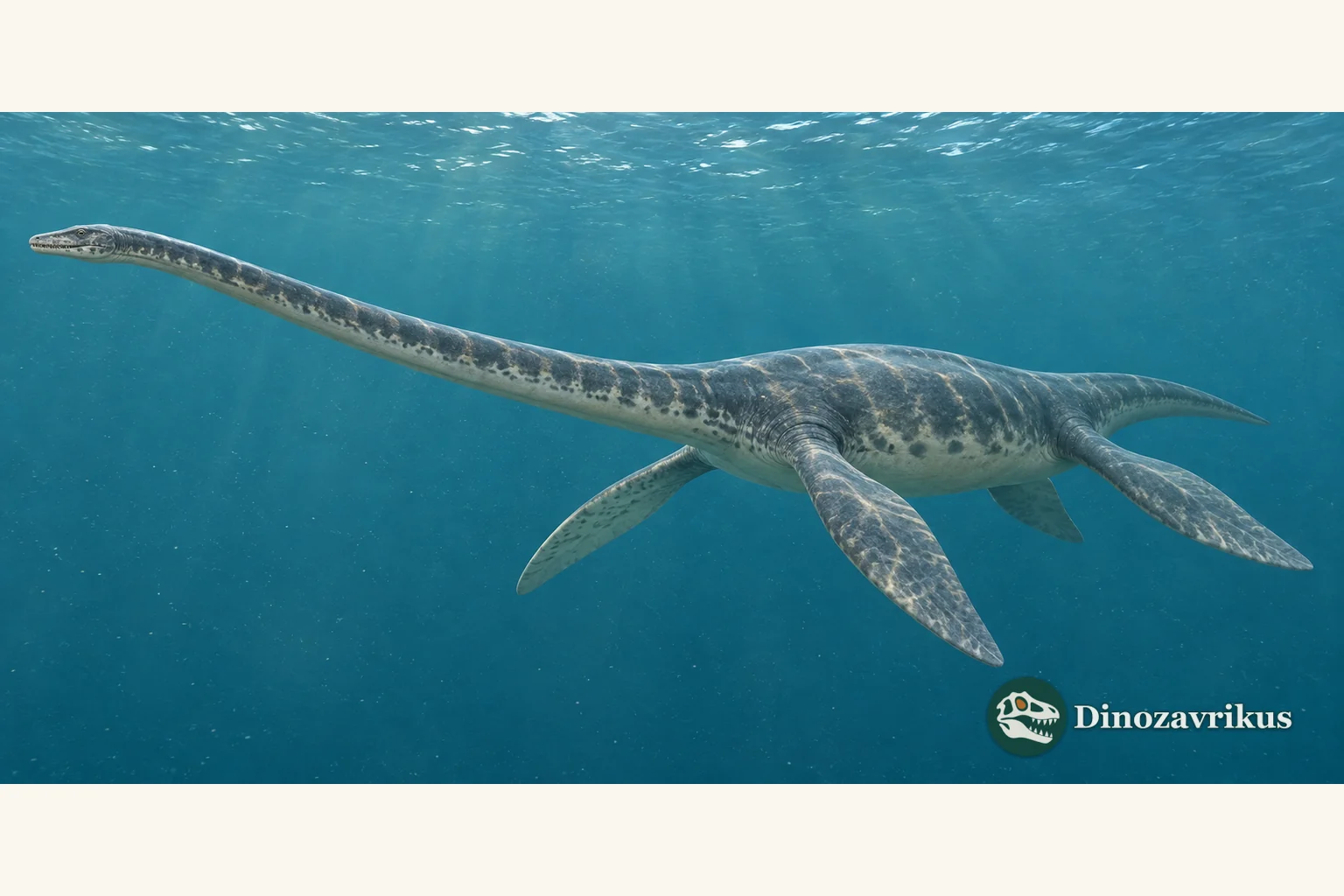
Aphrosaurus furlongi is a Late Cretaceous elasmosaurid plesiosaur from California, named from a partial skeleton. Its most distinctive feature is a deep longitudinal groove on the underside of the rear cervical vertebrae. The holotype also preserves parts of the limb girdles and paddles, but no skull, so its head, diet and total body length remain unknown.
Quick facts
| Type species | Aphrosaurus furlongi |
|---|---|
| Group | Plesiosaur; elasmosaurid |
| Age | Maastrichtian, Late Cretaceous |
| Formation | Moreno Formation, Tierra Loma Shale |
| Locality | Panoche Hills, Fresno County, California, USA |
| Holotype | CIT 2748, also catalogued as LACM 2748 |
| Known material | Girdle elements, four paddles and partial vertebral series |
| Body length | No reliable total-length estimate from the partial holotype |
Evidence guide
CIT 2748 preserves parts of the pectoral and pelvic girdles, all four paddles and portions of the vertebral column. It does not preserve a skull or a complete continuous spine.
The groove is a directly described feature of the posterior neck vertebrae. The 2019 redescription treats it as diagnostic in combination with girdle and limb traits.
O'Gorman's 2019 reassessment identified a combination of vertebral, girdle and limb characters and placed Aphrosaurus within Weddellonectia in its phylogenetic analysis. That placement is an analytical result, not a direct ancestor–descendant claim.
Without the head, teeth and much of the vertebral column, the fossil cannot establish a precise body length, specific prey, colour or swimming behaviour.
A name based on a partial skeleton
Samuel Paul Welles named Aphrosaurus furlongi in his 1943 study of Californian plesiosaurs. The species honours E. L. Furlong, whose assistance Welles acknowledged. The type specimen was recorded as CIT 2748; museum catalogues also use LACM 2748, and the combined form LACM/CIT 2748 appears in later literature.
Welles discussed another juvenile specimen, CIT 2832, separately from the holotype. It has its own catalogue number and should not be used to inflate the vertebral count of CIT 2748. The genus name is associated with the Greek word for sea foam, a literary reference rather than evidence about colour or behaviour.
What the holotype preserves
The type includes parts of the shoulder and pelvic girdles, fore- and hind paddles, ten recognized posterior cervical vertebrae, eleven vertebrae of uncertain position, and seventeen crushed dorsal vertebrae. The sequence is incomplete: it does not connect the skull to the tail or preserve every section of the spine.
That distinction matters when considering reconstructions. The long neck familiar from elasmosaurids is a comparative expectation, not a complete neck measured in this specimen. Morenosaurus provides a useful comparison from the same broad formation, but the two genera are distinguished by details of their preserved bones.
The grooved neck vertebrae
Welles described a deep, roughly semicylindrical groove along the ventral surface of the posterior cervical centra. Its width was reported at about one centimetre. The 2019 redescription treated the feature as distinctive when considered alongside a short, broad clavicle–interclavicle complex, an anterior depression on the humerus and an accessory element on the hind limb.
The diagnosis therefore rests on a combination of anatomical characters rather than on a long neck or general resemblance to other plesiosaurs. Re-examination also refined how some pelvic elements were identified and how they contacted neighbouring bones. These changes concern interpretation of the same fossil, not a second skeleton.
Age, locality and marine setting
The specimen came from the Panoche Hills in Fresno County, California, in the Moreno Formation's Tierra Loma Shale. The unit is Maastrichtian in age. Stratigraphy dates the enclosing rocks; it does not give the bone an exact calendar age. The formation records marine deposits along the Late Cretaceous margin of western North America.
The fossils establish that a plesiosaur lived in this marine setting. They do not preserve stomach contents, coprolites or prey directly associated with the holotype. Because the skull and teeth are missing, a species-specific diet cannot be reconstructed from this specimen.
What remains unknown
The available material does not provide a dependable total body length. The skull, much of the axial skeleton and the continuous outline of the animal are absent; a precise number would depend heavily on how missing sections were restored. Estimates repeated in popular summaries are not tied here to a measured complete skeleton or a validated method.
The fossil also does not reveal colour, soft tissues, swimming speed, hunting strategy, growth or reproduction. Phylogenetic analyses place the genus among elasmosaurids and the 2019 analysis recovered it within Weddellonectia. Comparisons with Aristonectes can show anatomical diversity, but neither genus is established as the other's direct ancestor.
Frequently asked questions
What is known from the Aphrosaurus holotype?
CIT 2748 preserves parts of the shoulder and pelvic girdles, all four paddles and a partial vertebral series. It does not include a skull or a complete spine.
What makes its neck vertebrae distinctive?
A deep longitudinal groove runs along the underside of the rear cervical centra. The 2019 redescription considered it diagnostic together with features of the girdles and limbs.
Where was Aphrosaurus found?
The type came from the Panoche Hills in Fresno County, California, in the Tierra Loma Shale of the Moreno Formation.
How long was Aphrosaurus?
Its total body length is not securely established. The partial holotype lacks the skull and much of the vertebral column needed for a direct reconstruction.