

Morenosaurus stocki was an elasmosaurid plesiosaur from the Late Cretaceous of California. Its type specimen preserves much of the trunk, pelvis, and limbs, but lacks the skull, front of the neck, and parts of the paddles. The fossil is unusually informative about the body behind the head, while total length and relationships still involve comparison and reconstruction.
Quick facts
| Type species | Morenosaurus stocki |
|---|---|
| Group | Elasmosaurid plesiosaur |
| Age | Late Cretaceous; Maastrichtian |
| Formation | Moreno Formation, Tierra Loma Shale |
| Locality | Panoche Hills, Fresno County, California, USA |
| Type specimen | CIT 2802, designated by Welles in 1943 |
| Known material | Trunk, posterior neck, pelvis, tail, and limb elements; skull and front of neck absent |
| Total length | About 8 m in Welles's historical estimate; not directly measured on a complete skeleton |
Evidence guide
Welles designated CIT 2802 as the type of Morenosaurus stocki. It preserves much of the postcranial skeleton but lacks the skull, anterior neck, and parts of the paddles.
The type description lists 23 posterior cervicals, two pectorals, 17 dorsals, three sacrals, and 30 caudals. The often-cited total of 46 cervical and 99 vertebrae comes from another specimen used for comparison.
Welles estimated a total length of about 8 m, although the type lacks the head and front of the neck. A later table's roughly 3.63 m value covers a partial trunk-and-tail measurement, not the same span.
Phylogenetic studies place Morenosaurus among elasmosaurids and have recovered it near southern forms in some analyses. A branch in a tree shows inferred shared characters, not a direct ancestor or an uncontested lineage.
A Moreno Formation elasmosaur
Samuel Paul Welles described Morenosaurus stocki in 1943 from fossils collected in the Panoche Hills of Fresno County, California. The genus name refers to the Moreno Formation; the species honours geologist Chester Stock, who led the collecting work. Welles explicitly designated specimen CIT 2802 as the type. That original designation identifies the fossil that carries the name, even though other referred specimens add anatomical information.
A separate Los Angeles museum record documents CIT 2749, collected by Robert Wallace and Arthur Drescher in 1939, with skull and jaw fragments and indeterminate limb material. It is useful comparative evidence, but it is not CIT 2802 and should not silently replace Welles's type designation. The distinction matters because different specimens preserve different parts of the animal.
What the type skeleton preserves
Welles called CIT 2802 a fairly complete skeleton, while noting three major gaps: the head, the anterior part of the neck, and parts of the paddles. His listed sequence includes 23 posterior cervical vertebrae, two pectorals, 17 dorsals, three sacrals, and 30 caudals. The separate count of 46 cervicals and 99 vertebrae overall belongs to another specimen discussed for comparison, not to the type itself.
The type also preserves parts of the shoulder girdle, forelimbs, pelvis, and hind limbs. That material makes Morenosaurus informative for comparing body proportions among elasmosaurids. It does not make the skeleton a fully articulated portrait: bones were not all preserved in life position, and the missing regions require reconstruction.
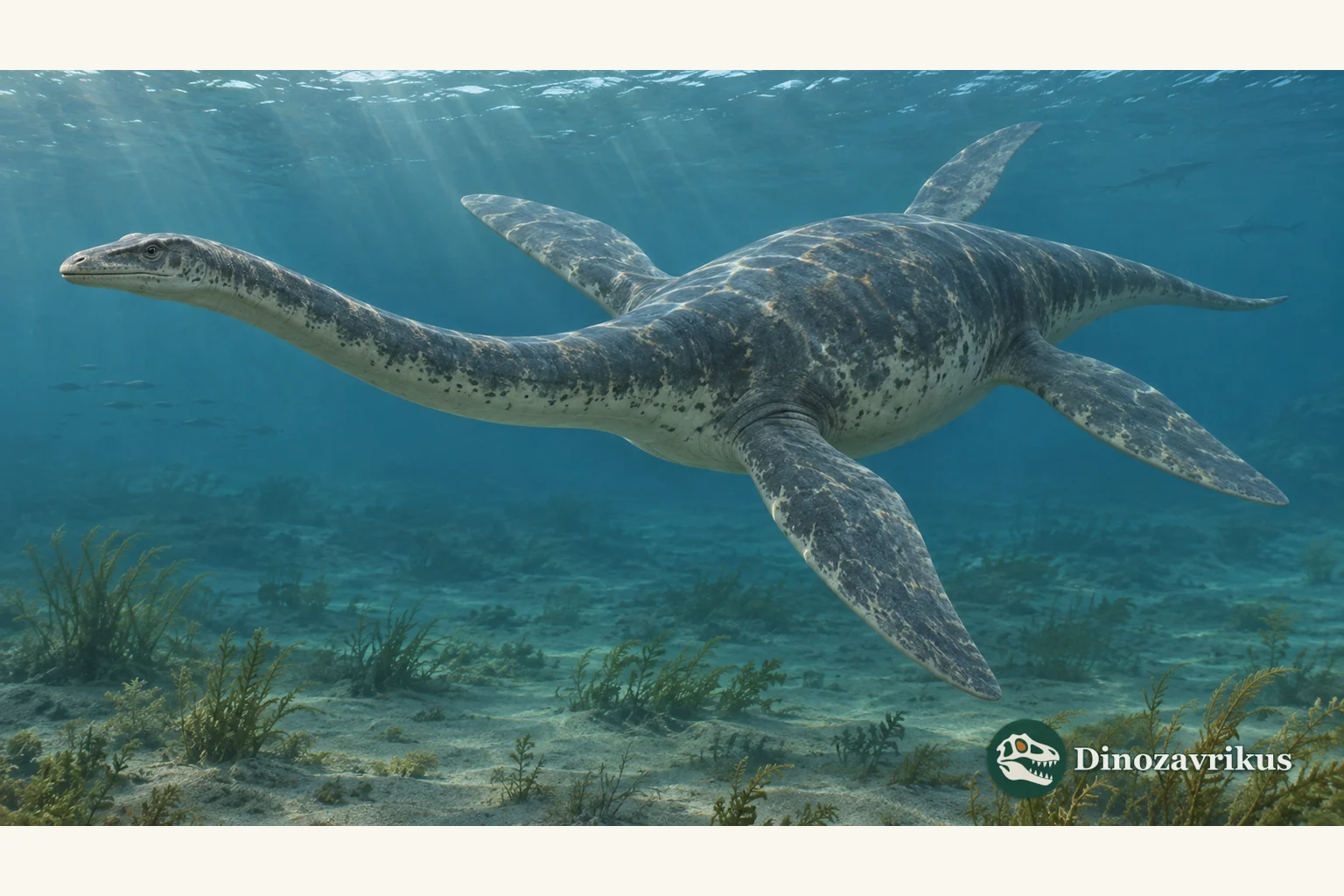
A shorter neck and diagnostic anatomy
Morenosaurus is usually described as having a shorter neck than the most extremely long-necked elasmosaurids. Welles reported 46 cervical vertebrae for comparative material, but the front of the neck is absent from CIT 2802. Counts also depend on how transitional vertebrae are assigned to the neck or chest, so the number should be tied to the specimen and description that produced it.
The original diagnosis considered several bones, including the interclavicle and clavicles, shoulder blades, coracoids, humerus, and femur. Features such as the broad rear of the coracoid and robust limb bones are part of a combination used in classification. They do not independently determine swimming speed, turning ability, or the exact outline of the soft tissues. Compare the evidence available for Eromangasaurus and Muraenosaurus.
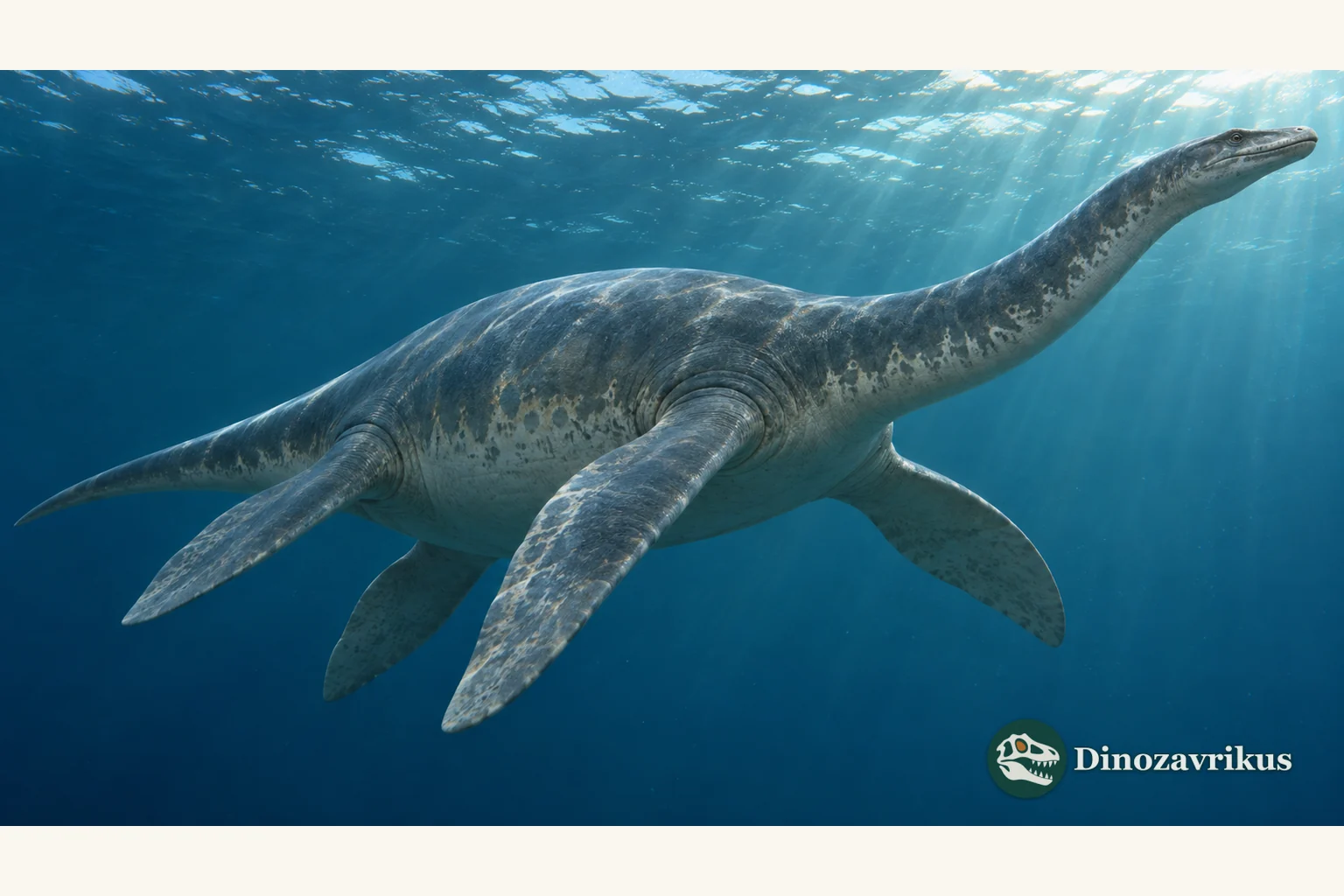
How long was Morenosaurus?
Welles estimated the animal at about 8 m long. This is a historical reconstruction, not a direct measurement of an intact skeleton: the type lacks its skull and anterior neck, and the preserved bones do not form one continuous articulated line. The estimate depends on how the missing regions and spaces between bones are restored.
A later comparative table gives a value of roughly 3.63 m for a partial trunk-and-tail span. That figure measures a different portion of the skeleton and is not an alternative estimate of total length. Body mass, exact adult proportions, colour, skin, and soft tissues are not established by the known specimens.
Classification and the Cretaceous sea
Morenosaurus is an elasmosaurid. Phylogenetic analyses have placed it within Weddellonectia and compared it with southern elasmosaurids such as Aphrosaurus, Kawanectes, and Vegasaurus. A 2026 analysis recovered it near Kawanectes and Vegasaurus in one tree. Such results depend on the taxa and skeletal characters included; they do not show that one named genus was the direct ancestor of another. For broader context, see Elasmosaurus.
The Moreno Formation records a marine setting along western North America during the Maastrichtian. The type's missing skull means its teeth cannot identify prey, and no stomach contents, associated prey, or feeding traces establish a specific diet for Morenosaurus. Its four paddles are supported by bones, while swimming style, speed, social behaviour, and reproduction remain unknown. The images on this page are palaeoart, not photographs of CIT 2802.
Frequently asked questions
Where was Morenosaurus found?
The type specimen CIT 2802 came from the Panoche Hills in Fresno County, California, in the Moreno Formation.
Which fossil is the type specimen?
Welles designated CIT 2802 as the type of Morenosaurus stocki in 1943. CIT 2749 is a different museum-recorded specimen and should not be substituted for it.
How long was Morenosaurus?
Welles estimated about 8 m, but the type lacks the skull and front of the neck. The figure is a reconstruction, not a measurement of a complete articulated skeleton.
Was it related to southern elasmosaurids?
Some phylogenetic analyses place Morenosaurus near southern elasmosaurids, including Kawanectes and Vegasaurus. These are analytical relationships, not proof of direct ancestry.