

Eromangasaurus australis was an Early Cretaceous elasmosaurid from Queensland, Australia. Its main specimen is a badly crushed skull associated with only a small amount of cervical material. In 2005, two researchers independently described that same fossil under different names; a later taxonomic clarification established the combination used today. The skull is informative, but it does not preserve a complete body or a direct measurement of the animal’s total length.
Quick facts
| Type species | Eromangasaurus australis |
|---|---|
| Group | Elasmosaurid plesiosaur |
| Age | Early Cretaceous; upper Albian |
| Locality | Yambore Creek near Maxwelton, Queensland, Australia |
| Formation | Toolebuc Formation, Eromanga Basin |
| Holotype | QM F11050, a badly crushed skull |
| Body length | Unknown; the known material is incomplete |
Evidence guide
QM F11050 preserves a nearly complete but badly compressed skull. Kear described a combination including seven premaxillary tooth positions and an elongate mandibular symphysis with a ventral keel. The living animal’s exact head outline is not directly preserved.
The skull was associated with a fused atlas-axis complex and several cervical vertebrae, with additional cervical elements catalogued separately. These bones do not make up a complete skeleton or establish the full neck length.
Sven Sachs named QM F11050 Tuarangisaurus australis, while Benjamin Kear named it Eromangasaurus carinognathus. Kear’s 2007 clarification transferred the species to Eromangasaurus as E. australis.
The locality is assigned to the Toolebuc Formation near Maxwelton. Upper Albian is a biostratigraphic age for the rocks, not a direct date on the bone.
One fossil and two descriptions
The name history began with a single specimen, QM F11050. In separate 2005 papers, Sven Sachs described it as Tuarangisaurus australis, while Benjamin Kear erected Eromangasaurus and called the animal E. carinognathus. These were not two finds or two species established from different skeletons; both accounts concerned the same Queensland material.
In 2007, Kear clarified the genus-level classification and transferred the species to Eromangasaurus as E. australis. Recent Australian checklists retain that combination. The change records a taxonomic decision about how to name the fossil, not a new specimen or a change in the animal’s anatomy. Another Australian elasmosaurid, Callawayasaurus, is known from substantially more complete skeletons, which allow a different level of anatomical description.
A crushed skull and a few neck bones
The holotype QM F11050 is a nearly complete skull in terms of the bones represented, but it is badly crushed. The associated record includes a fused atlas-axis complex and three cervical vertebrae catalogued under QM F12216 and QM F12217. Two more cervical vertebrae, QM F12219, were recovered later. The separate catalogue numbers matter: the material is not one intact skeleton laid out from skull to tail.
Early assessments tentatively compared the vertebrae with other named Australian elasmosaurids. Later work judged some older names nondiagnostic and reassessed the material using the skull. This history shows why isolated vertebrae can be difficult to identify: they preserve useful anatomy, but many species share features of the neck. The complete body, shoulder and pelvic girdles, paddles and tail are not represented by the holotype.
What the skull can diagnose
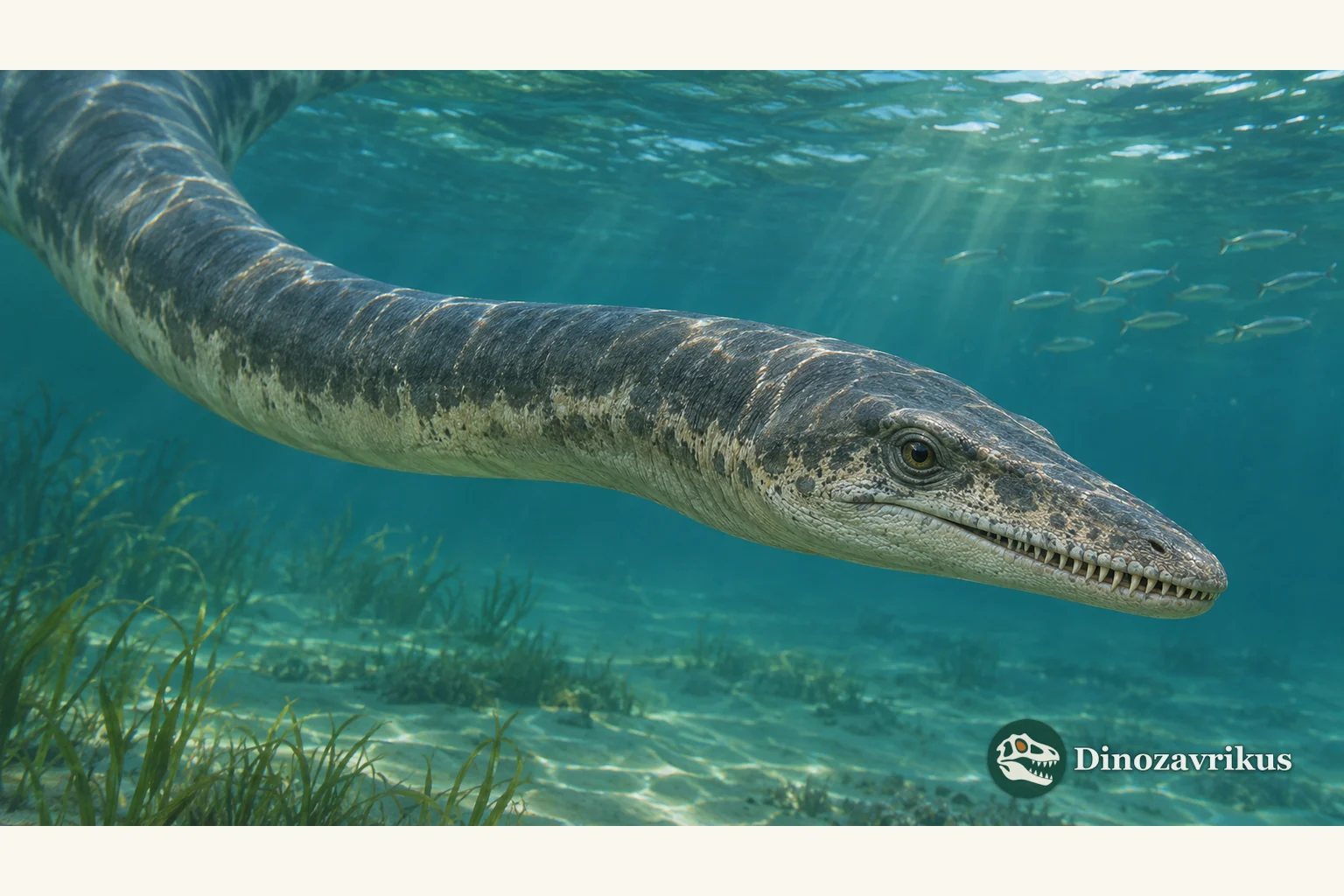
Kear distinguished the taxon using a combination of cranial features. The description records seven premaxillary tooth positions and an elongated mandibular symphysis with a prominent ventral keel. Such structures can be compared directly with other elasmosaurids, even though compression altered the skull’s original three-dimensional shape.
The bone surfaces and tooth sockets provide stronger evidence for classification than a speculative reconstruction of the soft outline of the head. They do not provide an undistorted skull volume, a reliable body-length estimate or a complete set of proportions. For the different kind of cranial evidence available in another plesiosaur, compare the profile of Kimmerosaurus.
An Upper Albian sea in Queensland
The fossil locality is Yambore Creek near Maxwelton in northern Queensland. The specimen is assigned to the marine Toolebuc Formation, within the Rolling Downs Group of the Eromanga Basin. Australian taxonomic and stratigraphic reviews place the relevant beds in the upper Albian, late in the Early Cretaceous. This is an age inferred from the stratigraphic position and associated microfossils, not a direct measurement of the fossil itself.
The formation records marine environments and a diverse fossil assemblage. That regional context does not identify the prey of this individual or establish how far offshore it lived. Teeth and plesiosaur relationships are consistent with a predatory marine reptile, but no stomach contents or directly associated prey are known for the holotype. A broader introduction to the group is available in the overview of plesiosaurs and pliosaurs.
The limits of a whole-animal reconstruction
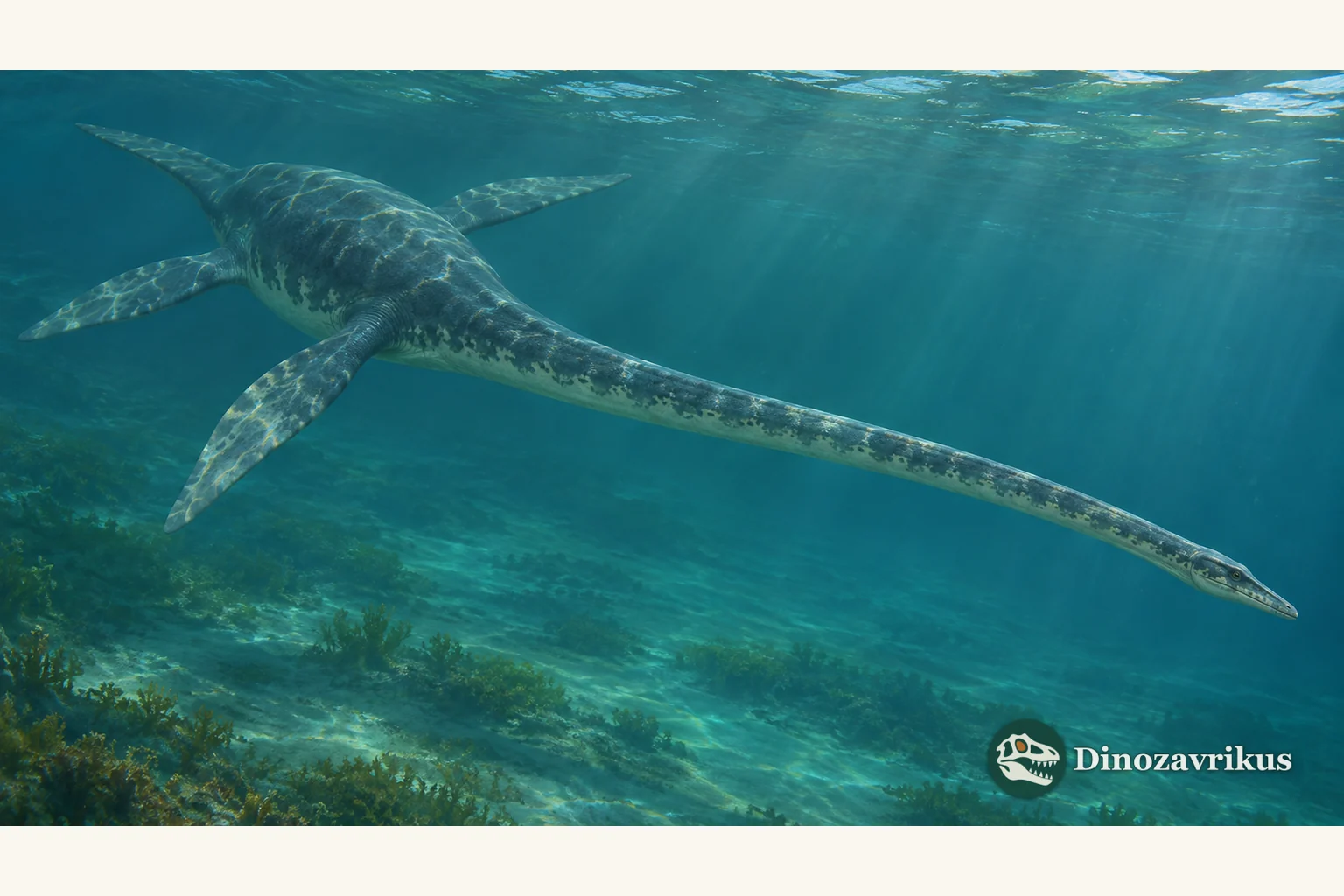
Elasmosaurid relationships support a general body plan with a long neck and four paddle-like limbs. For Eromangasaurus, however, the skull and a few cervical bones do not determine the proportions of those limbs, the trunk, the rest of the neck or the tail. The animal shown here is an artistic reconstruction based on the broader group, not a completed fossil skeleton.
No dependable total length or body mass can be calculated from the known material without a clearly stated comparative model. Colour, skin, soft tissues, growth, reproduction and swimming behaviour are also unknown. The value of Eromangasaurus lies in its diagnostic skull and in the documented history of its classification, not in a complete account of its biology.
Frequently asked questions
What fossils are known for Eromangasaurus?
The main specimen is a badly crushed skull, QM F11050, associated with a fused atlas-axis complex and a few cervical vertebrae. It is not a complete skeleton.
Why did the fossil receive two names?
Sachs and Kear independently described the same specimen in 2005 as Tuarangisaurus australis and Eromangasaurus carinognathus. Kear’s 2007 clarification established Eromangasaurus australis.
Where and when did it live?
It comes from the Toolebuc Formation near Maxwelton in Queensland, assigned to the upper Albian of the Early Cretaceous.
How long was the animal?
Its total length is not established. The skull and limited neck material do not preserve the body proportions needed for a direct measurement.