

Callawayasaurus colombiensis is an Early Cretaceous plesiosaur from the Paja Formation near Villa de Leyva, Colombia. Two substantially complete skeletons preserve most of the body, including an unusually long neck with 56 cervical vertebrae in the holotype. The fossils also record a complicated collection history: a holotype sent to Berkeley, a second skeleton kept in Bogotá, and a separately catalogued skull returned to Colombia in 2018. The anatomy is unusually informative, but colour, soft tissues and a directly measured total body length are not preserved.
Quick facts
| Type species | Callawayasaurus colombiensis |
|---|---|
| Group | Elasmosaurid plesiosaur |
| Age | Early Cretaceous; upper Aptian |
| Locality | La Catalina, near Villa de Leyva, Boyacá, Colombia |
| Holotype | UCMP 38349, a substantially complete articulated skeleton |
| Neck | 56 cervical vertebrae in the holotype |
| Length | About 8 m in a museum estimate; not a direct measurement of a complete body |
Evidence guide
UCMP 38349 is the holotype; SGC MGJRG.2018.V.1 is the second skeleton from Bogotá. A separately catalogued partial skull, UCMP 125328, is referred to the same species. These catalogue numbers do not describe one continuously preserved skeleton.
The count is an anatomical observation from the fossil. It does not measure the soft-tissue outline, flexibility, swimming posture or speed of the living animal.
The specimens come from segment E of the Paja Formation. Stratigraphic work correlates the published material with upper Aptian assemblages; the historical locality record does not securely fix every specimen to one measured bed.
Two regions of fused cervical centra in UCMP 38349 have been discussed as possible spondylosis deformans. The proposed diagnosis is cautious and does not establish cause, pain or impaired movement.
A Colombian plesiosaur first named in 1962
A vertebrate expedition involving the University of California, Berkeley, Colombia's geological service and Tropical Oil Company discovered the holotype near La Catalina on 11 January 1945. The Colombian Geological Survey's historical account names palaeontologist Ruben Arthur Stirton and geologist José Royo y Gómez in the expedition's work. More than thirty boxes of fossil material were sent to Berkeley on loan in May 1945 for study. The specimen later became part of a long-running effort to document and return Colombian palaeontological heritage.
Samuel P. Welles described the species in 1962 as Alzadasaurus colombiensis. Kenneth Carpenter's 1999 revision placed it in the new genus Callawayasaurus, honouring palaeontologist Jack Callaway. The species epithet stayed with the same animal. Some later sources repeat a misspelling of the original epithet; the correct spelling used here is colombiensis. The taxonomic change is a revised classification, not evidence that the animal itself changed or that a new fossil species was found. Other Colombian forms such as Traskasaura provide comparisons within the regional plesiosaur record, not a direct ancestor sequence.
Two skeletons and a separately catalogued skull
The holotype, UCMP 38349, is an articulated skeleton with slight compression in parts of the skull and shoulder region. It is missing the tail, the ilia and ischia, and some distal limb elements. A second, substantially complete skeleton is catalogued in Bogotá as SGC MGJRG.2018.V.1. It was reported from a nearby position in the section, although the historic descriptions contain conflicting information about the exact relative locations. The Bogotá specimen is more complete in some respects, but part of the left middle skull was not recovered.
A partial skull separately catalogued at Berkeley as UCMP 125328 was returned to the Servicio Geológico Colombiano in 2018. The 1999 taxonomic treatment lists it as referred material, rather than as the holotype. The return therefore adds to the history and custody of the known fossils; it should not be counted as a third complete skeleton. The Bogotá mount includes a skull replica informed by material from both specimens, so an exhibit reconstruction and an original fossil should not be confused.
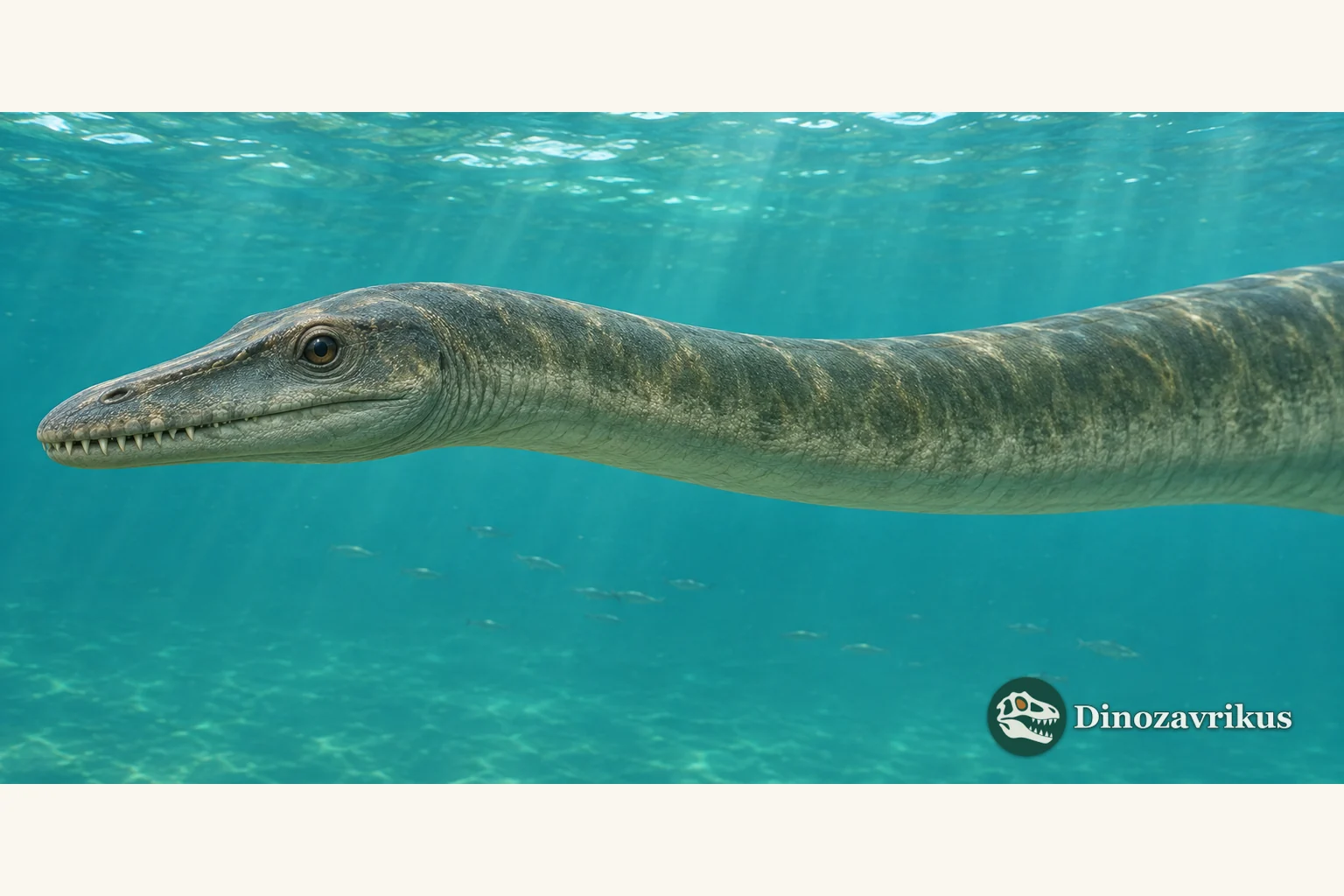
A long neck and a measurable anatomical record
The holotype preserves 56 cervical vertebrae. Carpenter also described elongate external nostrils, positioned over the third to fifth maxillary teeth, and the lack of adult bony bars across the pectoral and pelvic girdles. These details can be checked on bones and help distinguish the species in anatomical comparisons. They do not, on their own, explain how the animal held its neck or how it moved through water.
The closed jaws retain most teeth in their sockets, and delicate hyoid elements occur beneath the skull. Stones around the rib cage were reported as gastroliths. Their presence is direct evidence of stones associated with one skeleton; it does not identify a particular prey item or prove a specific digestive function. The long neck, four paddles and compact trunk in the illustrations are a reconstruction informed by plesiosaur anatomy, not a photograph of the fossil animal.
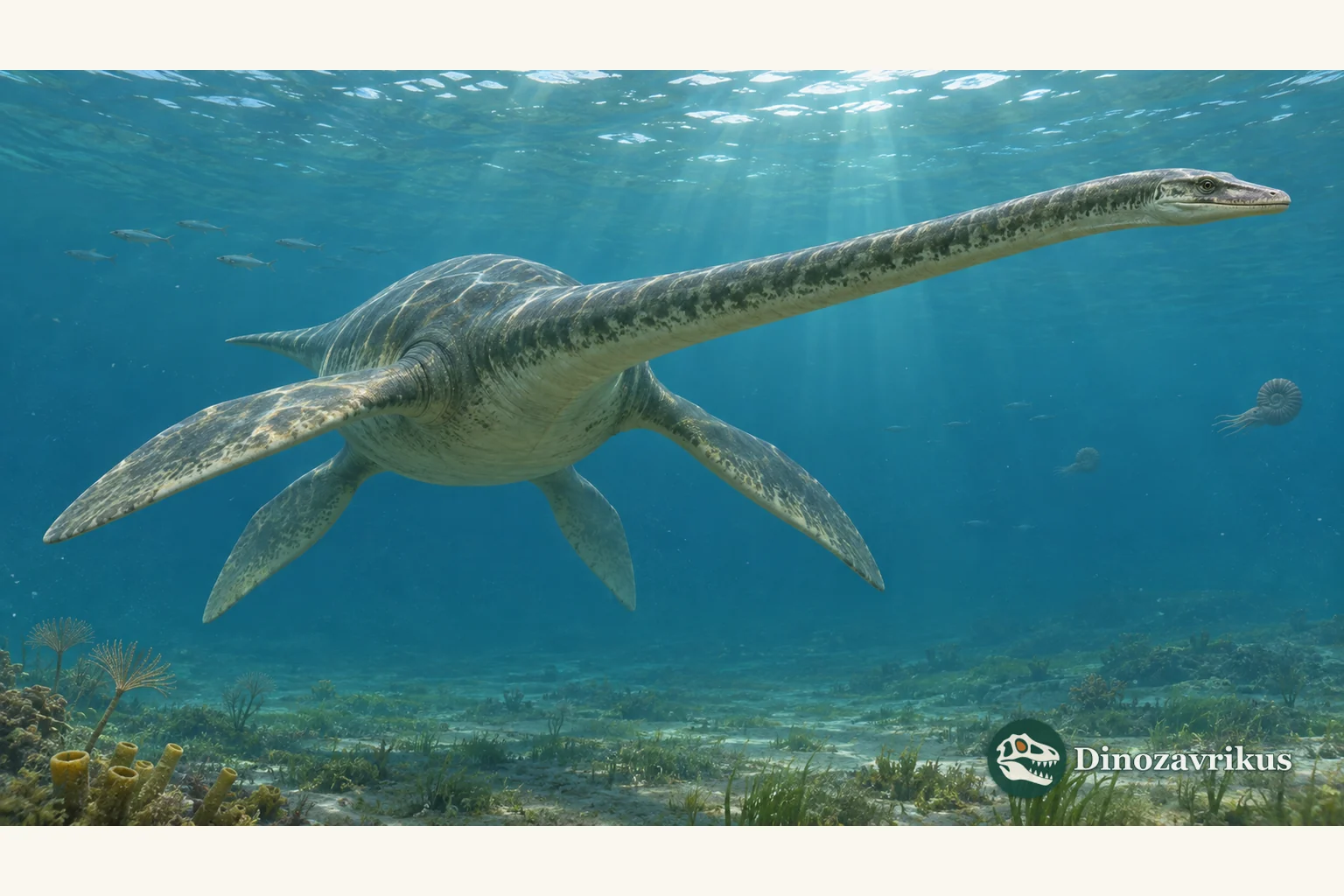
Upper Aptian rocks near Villa de Leyva
Both principal skeletons came from the La Catalina area of the Paja Formation, west of Villa de Leyva in Boyacá. A recent stratigraphic study locates the published material in segment E of the Arcillolitas abigarradas Member and correlates the sampled beds with upper Aptian ammonite zones. Because the older locality notes disagree about the two skeletons' exact relative positions, the formation, locality and stage provide a more secure description than a metre-level claim.
Fine-grained rocks and nearby marine fossils record a coastal marine setting in which articulated skeletons could be buried and preserved. This context describes the deposit, not the exact depth or habitat preference of each individual. For a broader account of the group, see the overview of plesiosaurs and pliosaurs.
Length, movement and the limits of reconstruction
A Colombian Geological Survey museum display gives an approximate total length of about eight metres. A technical overview reports roughly seven metres along the vertebral column of the Bogotá mount. Those figures use different definitions and include restored elements; neither is a direct measurement of an intact, complete body. They are useful as clearly labelled museum estimates, not precise limits for every individual.
Four paddle-like limbs support the familiar plesiosaur swimming body plan. Bones alone do not preserve the exact stroke, speed, turning ability or feeding depth. A separate study noted two regions of fused cervical centra in UCMP 38349 and cautiously discussed possible spondylosis deformans. That interpretation remains tentative, and the fossil cannot reveal whether the changes caused pain or affected movement. Growth, reproduction, body mass, colour and soft-tissue anatomy remain unknown for this species.
Frequently asked questions
Where was Callawayasaurus found?
The principal skeletons came from the La Catalina area near Villa de Leyva in Boyacá, Colombia, in the Paja Formation.
How many neck vertebrae are known?
The holotype, UCMP 38349, preserves 56 cervical vertebrae. This count is anatomical evidence, not a measurement of flexibility or swimming posture.
How long was the animal?
A museum reconstruction gives an approximate total length of about eight metres, while a technical account reports around seven metres along the vertebral column of a mounted specimen. These are different reconstructed measurements, not a direct measurement of a complete body.
What happened to the skull returned to Colombia?
The partial skull catalogued at Berkeley as UCMP 125328 was returned to the Servicio Geológico Colombiano in 2018. It is referred material, distinct from the holotype number UCMP 38349.