

Apricosiren was a small salamander from the Early Cretaceous. It was named from an atlas, the first vertebra that articulates with the skull. Other atlases from Sunnydown Farm Quarry in Dorset show how the joint surfaces at the base of the head changed during growth.
Quick facts
| Group | Salamanders (Caudata) |
|---|---|
| Age | Early Cretaceous, Berriasian |
| Region | Europe, United Kingdom (Dorset) |
| Type species | Apricosiren ensomi |
| Scientific name | Apricosiren |
| Diet | Exact prey is unknown |
What can the fossils tell us?
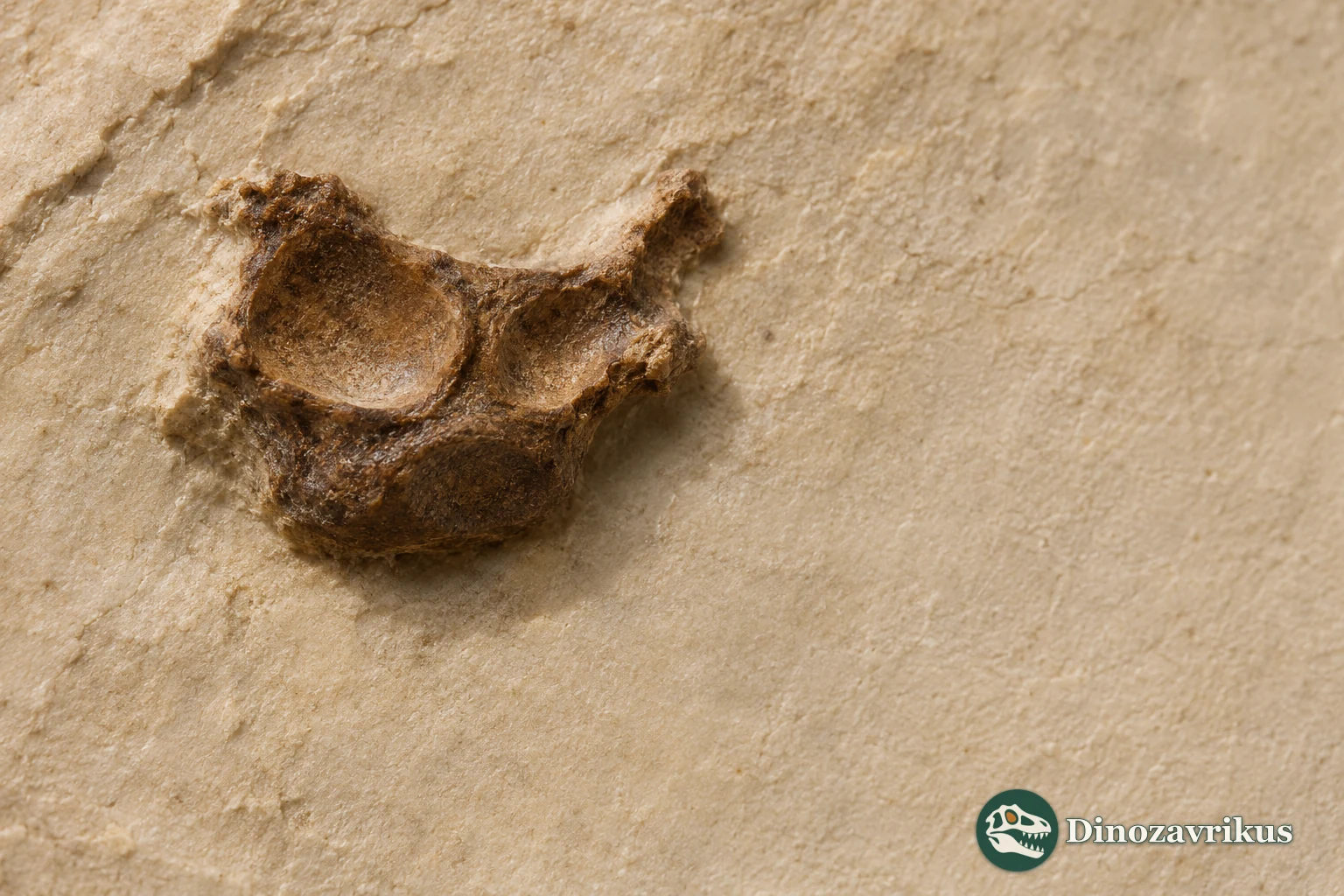
The holotype, DORCM GS61, is the body of the first vertebra. Other vertebrae and lower jaw fragments come from the same fossil-bearing level.
The two joint surfaces are separate in small specimens and approach the midline in larger ones. The authors interpreted this variation as growth and ossification.
The isolated vertebrae and jaws allow comparisons with other salamanders. They do not establish which family Apricosiren belongs to.
A find from the Purbeck beds
Susan Evans and G. J. McGowan described Apricosiren ensomi in 2002. The type specimen comes from a lower microvertebrate level of Sunnydown Farm Quarry, near Langton Matravers. The bed belongs to the Cherty Freshwater Member of the Lulworth Formation, in the Purbeck Limestone Group. The Berriasian fossils are held in the geology collection of the Dorset Museum in Dorchester. The species was named in honour of Paul Ensom.
What the first vertebra shows
The atlas has a prominent central projection between two oval joint surfaces. The projection is divided at its tip in the smaller specimens. In larger ones the projection becomes smoother and the joint surfaces meet at the midline. A strong longitudinal ridge runs along the underside of the vertebral body. The series helped the authors tell identifying characters from features that changed as the bone grew.
What the jaws and other vertebrae add
The dentary fragments preserve a robust junction at the front of the lower jaw. The trunk vertebrae have short transverse projections with two separate surfaces for attachment of the ribs. The identification of a possible tail vertebra is less certain. That distinction matters because features of the tail vertebrae have been used to compare Apricosiren with other salamanders.
Comparison with other early salamanders
The authors of the original description noted several similarities to Valdotriton from Spain. They left the exact family assignment open. Kiyatriton provides another record of early salamanders, from deposits in Asia. Such finds document the diversity of early salamanders even when the known fossils are isolated bones.
Frequently asked questions
Where was Apricosiren found?
The type vertebra came from Sunnydown Farm Quarry in Dorset, southern England.
What is an atlas vertebra?
The atlas is the first vertebra of the spine. Its front joint surfaces articulate with the skull.
What evidence shows how the skeleton grew?
Small and large atlases differ. In larger specimens the joint surfaces reach the midline and the central projection changes shape.
Which family did Apricosiren belong to?
It belongs to the salamander group Caudata. The available bones leave its placement within a particular family unresolved.