

Araripemys was a side-necked turtle from the Early Cretaceous of northeastern Brazil. Its fossils preserve a long neck, a low carapace and a small, cross-shaped plastron. Measurements of the forelimbs suggest that it was an agile swimmer.
Quick facts
| Group | Turtles, side-necked, araripemydids (Araripemydidae) |
|---|---|
| Age | Early Cretaceous (late Aptian to Albian) |
| Region | South America (northeastern Brazil) |
| Type species | Araripemys barretoi |
| Holotype | DGM 756-R, incomplete shell |
| Scientific name | Araripemys |
| Diet | Exact diet unknown |
What can the fossils tell us?
Llewellyn Price named the turtle in 1973 from the incomplete shell DGM 756-R. Most known individuals come from the Romualdo Formation.
A specimen described in 2020 retains a skull. It made it possible to compare the Crato turtles more closely with the material from Romualdo.
Smaller individuals tend to show larger gaps between bones relative to shell size. The outline of the carapace can be angular or oval.
Shells from two formations
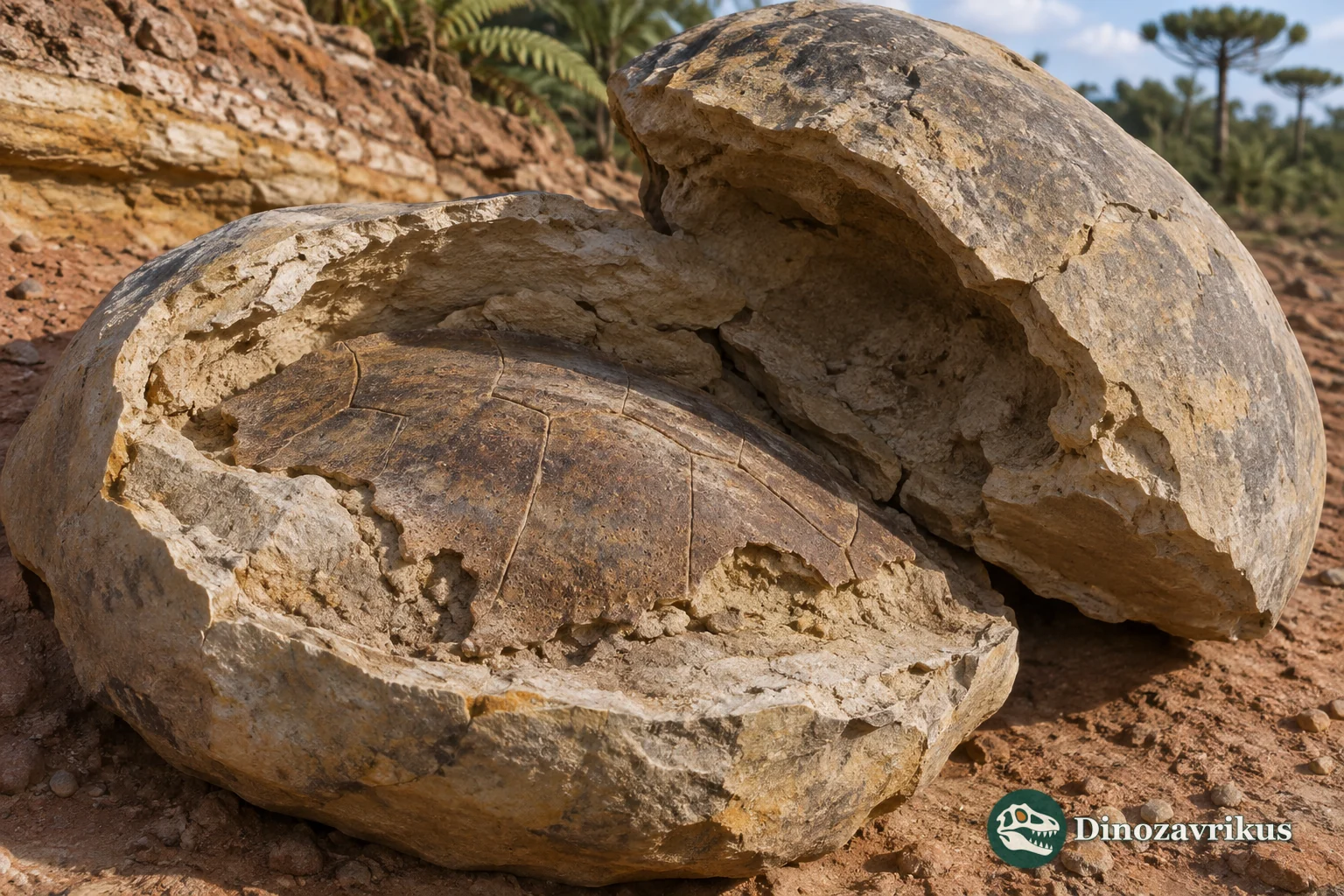
The incomplete shell DGM 756-R from the Romualdo Formation is the holotype of Araripemys barretoi. Many specimens from Romualdo were encased in limestone nodules. Three-dimensional preservation helped reveal details of the skull, neck and limbs that are absent from the type.
Early records from the older Crato Formation consisted chiefly of fragments and incomplete skeletons. In 2020, Saulo Limaverde and colleagues described thirteen individuals, including a nearly complete skeleton with a skull from Crato. That material helped tie together the turtle records from the two formations of the Araripe Basin.
What makes a shell different?
Araripemys had a flattened shell with an oval or angular outline. Gaps between the rib-bearing plates and the rim tend to be proportionally larger in smaller specimens. Small openings can persist in large individuals. Some plastral bones carry fine pits, which can occur alongside ridges and grooves.
The name Araripemys arturi was proposed in 2005 for shell and limb material from Crato. An oval shell was one of the proposed distinguishing features. The same outline turned up among fossils already referred to A. barretoi. The 2020 revision treated the two species names as synonyms.
Evidence for a capable swimmer
A low shell and the proportions of the forelimbs are consistent with an aquatic lifestyle. Comparisons of forelimb measurements with those of living turtles suggest that Araripemys was an agile swimmer suited to large bodies of water. The exact diet and the degree of salt tolerance are less certain.
A series of cervical vertebrae documents the exceptionally long neck. Foxemys belongs to a different family of side-necked turtles and offers a view of their history in younger Cretaceous deposits in Europe.
Frequently asked questions
What is preserved in the holotype?
DGM 756-R is an incomplete shell from the Romualdo Formation.
What was found in the Crato Formation?
A nearly complete skeleton with a skull was described in 2020. Several less complete individuals are also known.
Why is Araripemys arturi treated as a synonym?
Features of its fossil, including the oval outline, fall within the variation documented for Araripemys barretoi.
How do we know it was a capable swimmer?
The shell and measured forelimb proportions support that interpretation. The fossils give no measurement of its swimming speed.