

Archaeotherium was a large entelodont of Oligocene North America, known especially from skulls and teeth. Its nickname “hell pig” can suggest a dedicated predator, but the resemblance to pigs is superficial and a powerful skull alone does not prove habitual hunting or scavenging. Dental microwear research instead points to differences in feeding mechanics among size groups.
The best-known species, Archaeotherium mortoni, is represented in the White River region by skulls, jaws and parts of the skeleton. These fossils document anatomy and constrain possible diets; they do not preserve coat, colour or daily behaviour. The genus belongs in the ancient mammal catalogue, within the wider history of the Palaeogene.
Quick facts
| Scientific name | Archaeotherium Leidy, 1850; type species A. mortoni |
|---|---|
| Group | Entelodontidae, within Cetartiodactyla |
| Age | Oligocene, North America |
| Main regions | Great Plains and western North America |
| Known material | Skulls, jaws, teeth and postcranial bones |
| Feeding evidence | Dental microwear varies between size groups |
| Body mass | No single reliable value for the whole genus |
What can the fossils tell us?
Joseph Leidy introduced Archaeotherium in 1850, with A. mortoni as the type species. A Smithsonian skull recorded as a paratype is not the holotype; later museum finds must be kept distinct from the name-bearing type.
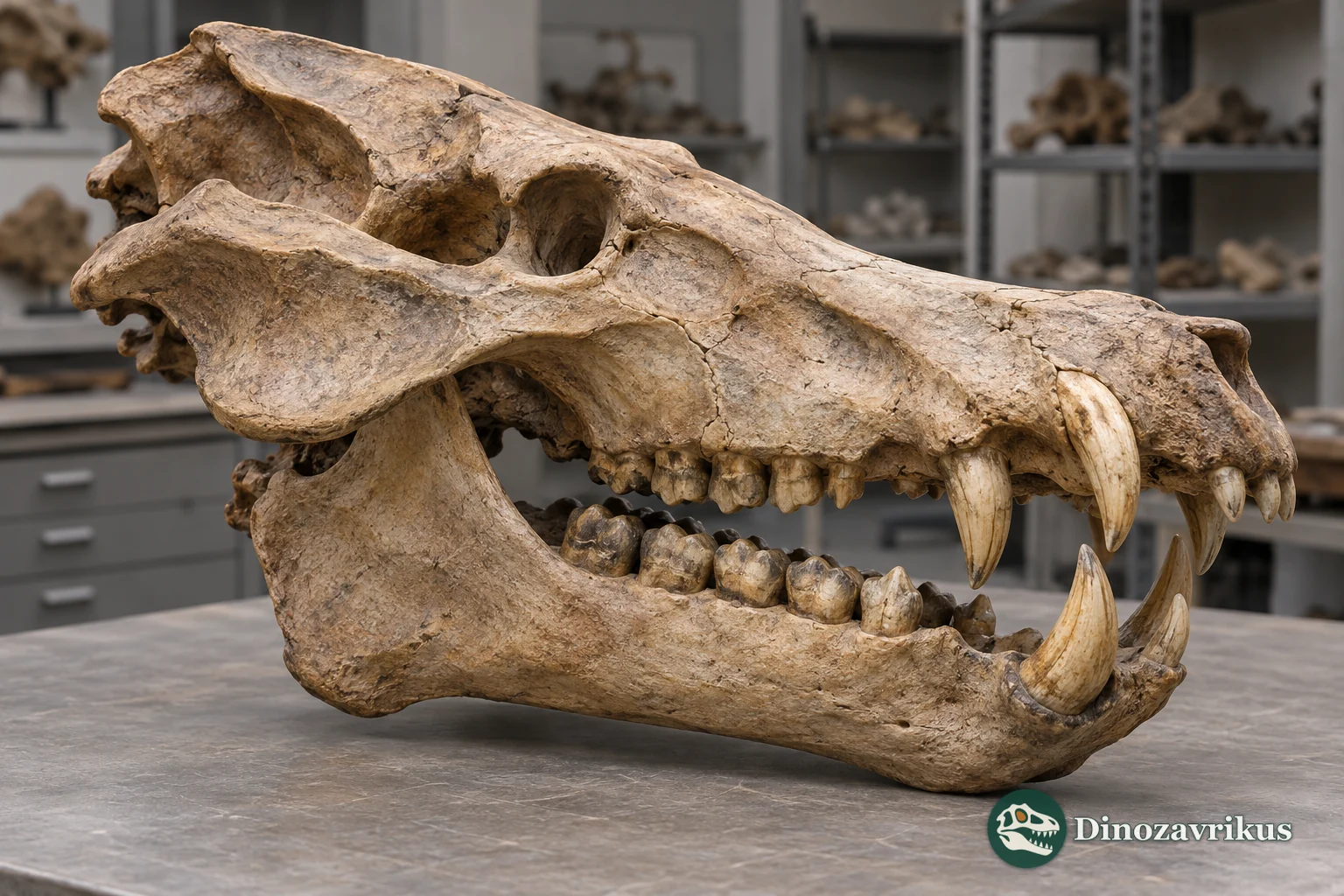
Skulls preserve a long muzzle, broad cheek arches and bony projections, while the tooth rows combine large canines and grinding teeth. These features constrain anatomy and food processing but do not establish a particular hunt or meal.
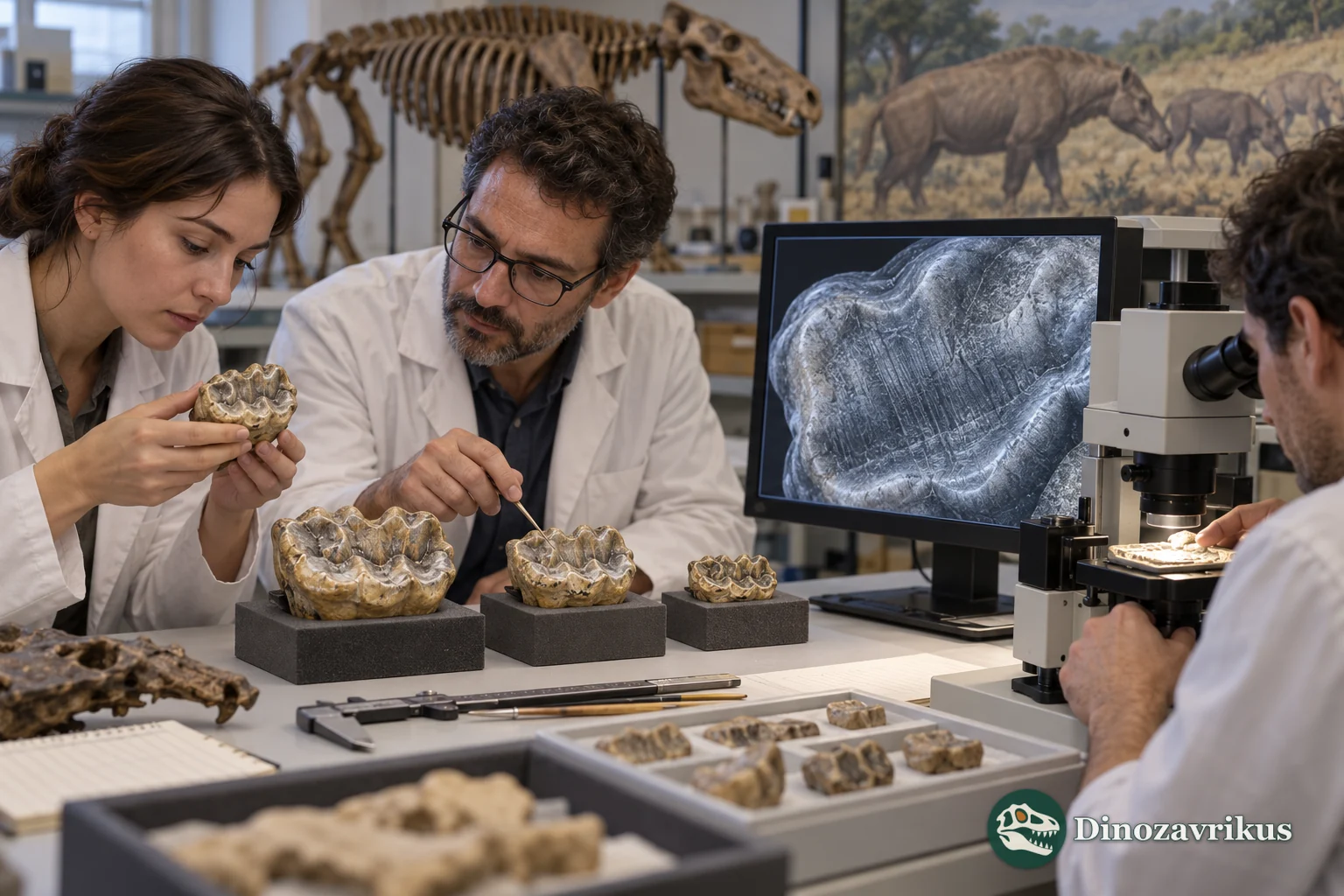
A 2026 study found microwear differences between larger and smaller Archaeotherium. The pattern is compatible with different feeding mechanics, including hard or brittle items in larger forms, but it cannot identify an exact food or prove bone consumption.
Fossils come from several North American deposits, including the Chadron and Brule formations. Specimens from different horizons are not one animal or a single snapshot of the genus’s habitat.
Discovery and the name
Joseph Leidy introduced the genus Archaeotherium in 1850 as North American fossil mammals were being compared with European forms. Its type species is A. mortoni. During the nineteenth and early twentieth centuries, authors moved some large entelodont material among names such as Elotherium and Entelodon. Those combinations reflect changing taxonomic ideas and should not be mistaken for several animals preserved in one skeleton.
Collectors working in the White River Basin brought skulls and other bones to museums from what are now South Dakota, Nebraska, Wyoming and neighbouring states. Smithsonian catalogue records document a paratype of A. mortoni collected by John Evans in 1849, as well as separate Brule Formation material collected by N. H. Darton in 1898. The latter is a museum specimen, not the species holotype. Keeping type material separate from later finds matters because the name is anchored to a particular specimen and description.
Age, formations and habitat
Archaeotherium lived during the Oligocene, after the major cooling that followed the warm Eocene. Fossils occur in the Chadron and Brule formations of the White River succession, among other North American deposits. These formations preserve river channels, floodplains, open ground and wooded margins, with environments changing through time and across the basin.
A fossil’s presence in a formation establishes its geological context, not a complete landscape portrait. Bones from several horizons cannot be assembled into one simultaneous community. Researchers compare stratigraphy, sediment and associated fossils before describing local conditions. One savanna image therefore cannot stand for every Archaeotherium locality or every stage of its history.
Skull, teeth and body size
The skull was long and massive, with broad cheek arches and prominent bony projections. Fossil bone establishes the outline of these structures, but not whether they carried thick skin, cartilage or a display covering. Bright colours, scars and horn-like sheaths in popular images remain artistic choices without direct soft-tissue evidence.
The jaws carried incisors, large canines, premolars and rounded cheek teeth. This combination could seize, tear and crush a range of foods; it is not the narrow slicing equipment of a specialised carnivore. At the same time, broad teeth do not prove a purely plant-based diet. The skull is informative about possible mechanics, while wear, isotopes and associated remains address other parts of feeding ecology.
Species, sex and growth stage matter when comparing size. Very large skulls are not averages for the genus, and the surviving limb material does not provide one agreed body-mass estimate that applies to every species. Any whole-body reconstruction depends on a named specimen, its completeness and a comparative model.
What dental microwear says about diet
Microscopic scratches and pits record mechanical contact between teeth and food shortly before death. A 2026 study compared enamel textures in larger and smaller Archaeotherium and found differences between the groups. The larger forms had a texture more compatible with processing hard or brittle objects, while the smaller group showed a pattern associated with more slicing of softer items.
Possible hard objects include plant parts such as roots or nuts as well as animal material. Microwear does not identify a specific ingredient and cannot show whether an item was eaten regularly or opportunistically. It also does not prove that a large Archaeotherium routinely cracked bones. The result supports dietary flexibility and cautions against assigning one menu to every species or individual.
Bite marks and skeletal damage need similar care. A mark may result from conflict, feeding on a carcass or activity after death. Without a diagnostic pattern and secure context, it cannot establish that Archaeotherium was a regular predator of large prey.
Movement and relationships
Postcranial bones add evidence beyond the conspicuous skull. Limb proportions and joint surfaces are consistent with a terrestrial, four-legged mammal able to support a substantial head and body. They do not preserve an exact running speed, stamina or hunting style. Comparing bones with living mammals produces a range of plausible mechanics rather than a direct observation of movement.
Archaeotherium belongs to Entelodontidae, an extinct family within the cetartiodactyl radiation. It was not an ancestor of domestic pigs. The family’s more precise position among extinct hoofed mammals has varied across phylogenetic analyses as new taxa and characters were added. Its large skull and nickname do not settle those relationships.
Several older genus names, including Megachoerus and Pelonax, have been associated with Archaeotherium in later revisions. The treatment of individual species depends on the diagnostic material and taxonomic study being followed. The broader entelodont family profile and the separate account of Entelodon explain how this North American genus compares with relatives.
Disappearance
Archaeotherium is absent from younger records after its Oligocene history. The fossil record dates its presence and disappearance, but does not identify a single cause. Changing vegetation and climate altered mammal communities, and interactions with other large mammals may have mattered locally. None of these possibilities currently justifies a simple story in which one new predator displaced the genus.
Frequently asked questions
Was Archaeotherium a pig?
No. It was an entelodont, a member of a separate extinct family of cetartiodactyl mammals. Pigs and entelodonts share a broad ancestry within hoofed mammals, but Archaeotherium was not a modern pig or its direct ancestor.
Was Archaeotherium a predator?
The evidence does not support one answer for every species and size group. Teeth and microwear suggest varied feeding mechanics, including the processing of both softer foods and hard or brittle items. A skull alone cannot prove regular hunting.
What was the type specimen of Archaeotherium mortoni?
The species name is anchored to its name-bearing type. A Smithsonian skull often discussed in online records is catalogued as a paratype, not the holotype. Later specimens from the Brule Formation are separate finds.
How did Archaeotherium differ from Entelodon?
They are distinct entelodont genera. Archaeotherium is known chiefly from North America, while Entelodon is known from Eurasia. Their comparison depends on diagnostic bones and geological context rather than the shared nickname “hell pig.” No. It was an entelodont, a member of a separate extinct family of cetartiodactyl mammals. Pigs and entelodonts share a broad ancestry within hoofed mammals, but Archaeotherium was not a modern pig or its direct ancestor. The evidence does not support one answer for every species and size group. Teeth and microwear suggest varied feeding mechanics, including the processing of both softer foods and hard or brittle items. A skull alone cannot prove regular hunting. The species name is anchored to its name-bearing type. A Smithsonian skull often discussed in online records is catalogued as a paratype, not the holotype. Later specimens from the Brule Formation are separate finds. They are distinct entelodont genera. Archaeotherium is known chiefly from North America, while Entelodon is known from Eurasia. Their comparison depends on diagnostic bones and geological context rather than the shared nickname “hell pig”.Frequently asked questions
Was Archaeotherium a pig?
Was Archaeotherium a predator?
What was the type specimen of Archaeotherium mortoni?
How did Archaeotherium differ from Entelodon?