

Small bones from limestone fissures in southern France gave Archaeotrogon its name. Its stout upper wing bones reminded Alphonse Milne-Edwards of living trogons. The fossils were later placed in their own family, and comparisons with other ancient birds changed the interpretation of their affinities.
Quick facts
| Family | Archaeotrogonidae |
|---|---|
| Larger clade | Strisores |
| Age | Late Eocene to Oligocene |
| Locality | Quercy phosphorites, France |
| Material | Isolated wing, shoulder and leg bones |
| Genus named | Alphonse Milne-Edwards, 1892 |
What can the fossils tell us?
Humeri assigned to the type species measure about 25–30 mm. Their form can be compared directly, while plumage remains unknown.
Recent excavations linked many bones to particular fissure fills. The exact horizon of specimens in old collections is often missing.
Skeletons of Archaeodromus and Hassiavis preserve additional characters for the family. Their anatomy cannot all be assigned to Archaeotrogon itself.
The bones from Quercy
Milne-Edwards named Archaeotrogon venustus in 1892. Many bones from the older phosphorite collections reached museums without a record of the exact fissure or horizon. Even a well-identified specimen can therefore be hard to date closely.
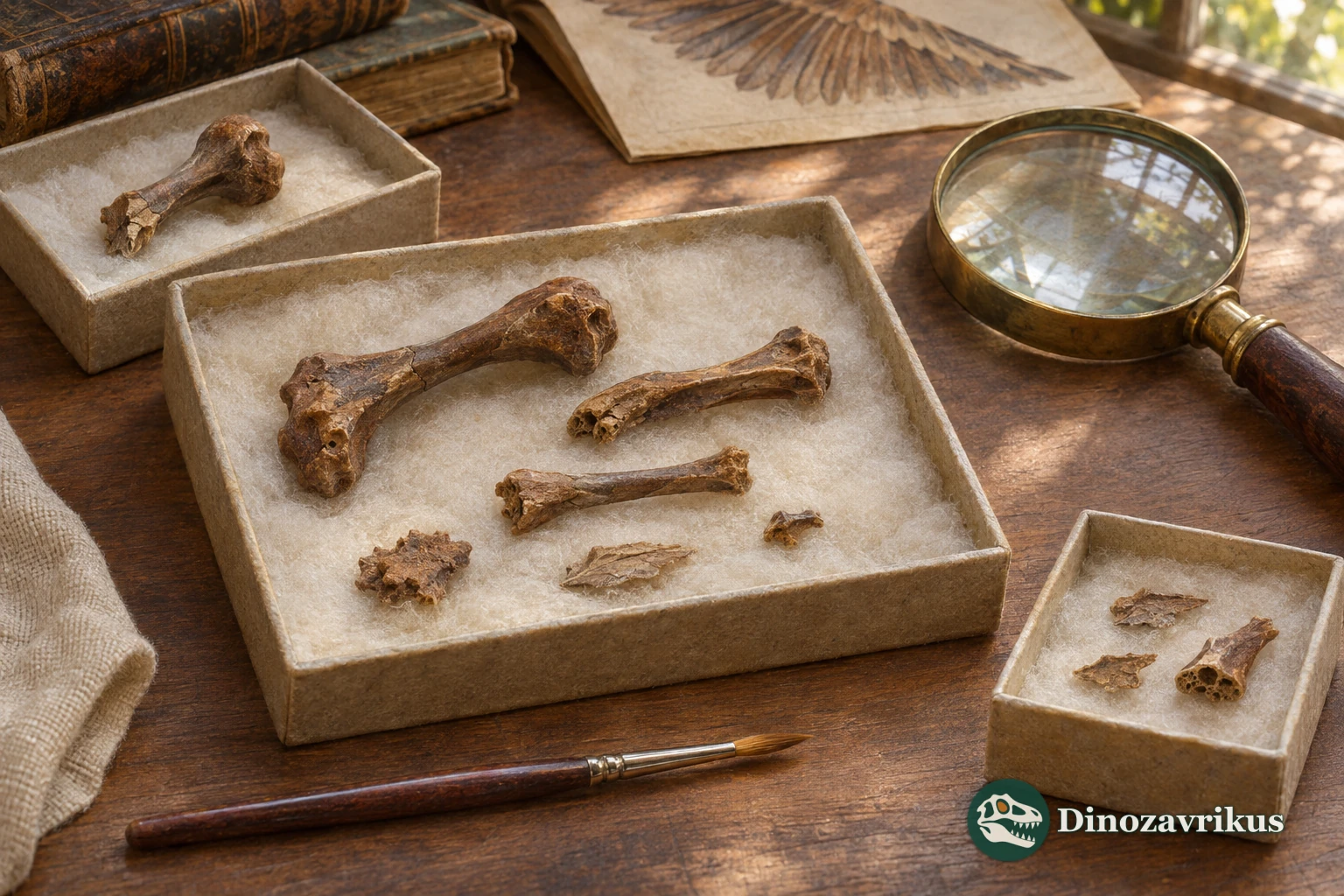
Cécile Mourer-Chauviré studied material from newer excavations in 1980 and erected Archaeotrogonidae. Bones assigned to the type species include parts of the shoulder girdle, wings and hindlimbs. Its humeri measure 25.0–29.7 millimetres in length. This gives a recorded dimension for the upper wing rather than the whole animal.
Evidence for several species
The 1980 revision recognised four species. Bones of Archaeotrogon zitteli tend to be larger than those of the type species. Both occur at Mas de Got B and Pech du Fraysse. That overlap matters because a simple replacement of the smaller species by the larger one would not explain their co-occurrence.
The larger bones of A. cayluxensis stand out in this classification. The right humerus QU 15796, the Paris holotype of A. hoffstetteri, has a more slender shaft than similar-length humeri of the other small forms. The exact horizon of that specimen is unknown.
Why the identification changed
Similarity to trogons explains the name. Current work places the family in Strisores, which includes nightjars, swifts and related groups. In Gerald Mayr’s 2021 analysis a link to nightjars was recovered under constraints derived from living birds’ molecular relationships. Other anatomical comparisons allow a relationship with the group containing owlet-nightjars, swifts and hummingbirds.
Some decisive comparisons use skeletons of other genera from the London Clay and Messel. The Quercy bones provide a different kind of record. A skull such as the one preserved in Scandiavis can provide evidence unavailable from isolated wing bones. Bill shape, colour and daily activity are correspondingly difficult to establish for Archaeotrogon.
Frequently asked questions
Was Archaeotrogon a true trogon?
That was the early interpretation. Later comparisons favour placement among the relatives of nightjars, swifts and other strisoreans.
Where was it found?
The genus is known from phosphorite fissure fills in Quercy in southern France.
Is its call known?
The fossil material can be used to compare skeletal anatomy. It preserves no evidence of the call.
Is the English Archaeodromus the same genus?
It belongs to the same fossil family, but was described as a separate genus.