

Argovisaurus martafernandezi was a large ichthyosaur from the Bajocian seas of what is now Switzerland. Its only known specimen, PIMUZ A/III 5279, preserves a nearly complete skull, much of the vertebral column and ribs, and parts of the shoulder girdle. The reconstructed skull is about 1.2 metres long, but the limbs and tail are missing, so the total body length is not a direct measurement.
Its fossils offer a rare view of Middle Jurassic ichthyosaurs and of the boundary between direct bone evidence and reconstructed body form.
Quick facts
| Scientific name | Argovisaurus martafernandezi |
|---|---|
| Holotype | PIMUZ A/III 5279, the only known specimen |
| Age | Bajocian, Middle Jurassic |
| Locality | Oberegg quarry near Auenstein, Aargau, Switzerland |
| Rock unit | Lower Acuminata beds, Hauptrogenstein Formation |
| Preserved material | Nearly complete skull, parts of the shoulder girdle, vertebral column and ribs |
| Skull length | About 1.2 m in the authors’ reconstruction |
| Complete body length | Not directly measured from a complete skeleton |
What can the fossils tell us?
PIMUZ A/III 5279 includes a nearly complete skull, parts of the pectoral girdle, much of the vertebral column and ribs. The limbs and tail are not known.
The authors describe a robust snout, anterior pseudoalveoli, distinctive braincase features and unusual rib articulations. Several teeth are incomplete, so their crowns cannot be fully characterised.
Changes in the lower jaw and a dorsal rib were interpreted as pathological reactions, possibly after injury. The fossil does not identify the cause or circumstances.
Analyses place the specimen near early Ophthalmosauria, but its position differs between character matrices. A tree is an analytical hypothesis, not a directly observed ancestry.
Discovery and preparation
The fossil was found at the Oberegg quarry near Auenstein in Switzerland’s Canton of Aargau more than two decades before its scientific description. Private collector Elmar Meier recovered most of the material. The Palaeontological Institute and Museum of the University of Zurich acquired it in 2019. Preparation took about three years, with work by Thomas Imhof and several colleagues.
Florent Miedema, Nicole Klein, Daniel Blackburn, Patrick Sander, Erin Maxwell and co-authors described Argovisaurus martafernandezi in 2024. The generic name refers to Argovia, the Latin name of Aargau. The species honours ichthyosaur researcher Marta Fernández. The holotype remains the only known specimen and is held by the University of Zurich’s palaeontological collection.
What the specimen preserves
PIMUZ A/III 5279 includes a nearly complete skull, fragments of the pectoral girdle, much of the dorsal vertebral column and numerous ribs. Thirty-seven presacral vertebral centra, including the atlas and axis, and five possible front caudal centra were reported. The longest nearly complete rib is about 95 centimetres long. The limbs and tail are absent, so this is a substantial but incomplete skeleton.
The bones were found in separate blocks and some were displaced. In the museum mount, the positions of certain blocks are interpretive because their original locations cannot be reconstructed with certainty. The display conveys a scientific hypothesis about how the pieces fit, not a photograph of an articulated carcass.
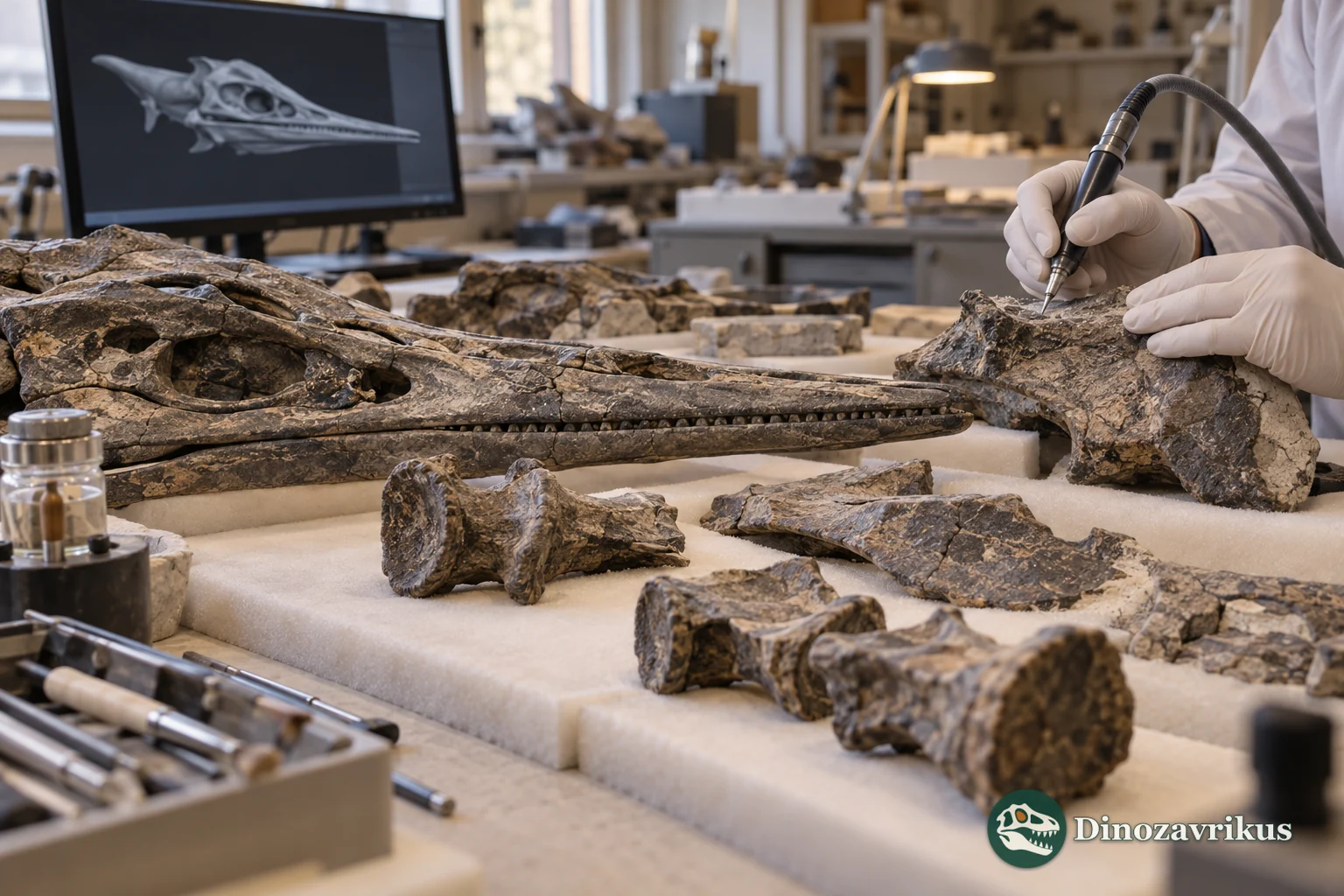
The Bajocian sea of Aargau
The holotype came from the Lower Acuminata beds of the Hauptrogenstein Formation. The original description places it in the Middle to Late Bajocian; regional biostratigraphic work narrows the beds to the Middle Bajocian. This dates the sedimentary layer, not the animal to a particular year.
The succession includes echinoderm fragments, bivalves, belemnites, ammonites and traces of burrowing organisms. These fossils help describe the marine setting and the substrate. They do not prove that every listed organism lived alongside this ichthyosaur at the same moment: a bed can accumulate material over many events.
Skull anatomy and diagnosis
The authors reconstructed the skull at roughly 1.2 metres long. Its snout and jaws are robust, and the anterior premaxilla and dentary bear pseudoalveoli, shallow depressions unlike ordinary tooth sockets. Only a few incomplete teeth are preserved; enamel and dentine are absent from the best-preserved root. The complete shape of the tooth crowns therefore cannot be described from this specimen.
The diagnosis relies on a combination of features in the skull base, occiput, cheek, jaws, clavicles and ribs. Some characters resemble those of Mollesaurus or Platypterygius, but a shared feature does not make the taxa identical. The Jurassic Mollesaurus and the later Platypterygius provide useful comparisons, not proven ancestors.
Abnormal bone and its limits
Parts of the left lower jaw, several cranial bones and one dorsal rib have unusual surface structures and remodelling. The authors interpreted some changes as a response to trauma, while noting that certain asymmetries could also reflect normal individual variation. The observations concern the shape and texture of the fossil bone; the proposed biological explanation is an inference.
The bones do not identify what caused the damage, whether another animal was involved, or how the individual fared afterwards. A pathological feature is not a record of a witnessed attack.
Relationships and size
One phylogenetic analysis placed the specimen near the base of Ophthalmosauria. A second analysis gave a less stable position within the wider group. The authors treated Argovisaurus as an early-diverging ophthalmosaurian based on the characters that could be observed, while showing that its exact position changes with the character matrix and taxon sample. This does not establish it as a direct ancestor of later ichthyosaurs.
The skull estimate of about 1.2 metres comes from reconstruction of preserved bones. Total body length is not a direct measurement because the limbs and tail are missing. The cover is a natural-history interpretation: body outline, colour and soft tissues are not preserved in the fossil.
Frequently asked questions
Where was Argovisaurus found?
Its holotype came from Oberegg quarry near Auenstein in Canton Aargau, Switzerland, in the Lower Acuminata beds.
What parts of the skeleton are known?
The only specimen includes a nearly complete skull, parts of the shoulder girdle, much of the vertebral column and ribs. The limbs and tail are missing.
How large was Argovisaurus?
The authors reconstructed a skull about 1.2 metres long. The total body length is not directly measured from a complete skeleton.
Was Argovisaurus an ancestor of Ophthalmosaurus?
No direct evidence establishes that relationship. Analyses place it near early ophthalmosaurian branches, but its exact position varies among matrices.