

Mollesaurus periallus is an ichthyosaur from the Early Bajocian of Patagonia, Argentina. Its holotype preserves part of the skull together with articulated vertebrae and ribs. Those ribs were later examined histologically, while the front of the snout and the fins remain unknown.
Quick facts
| Type species | Mollesaurus periallus |
|---|---|
| Holotype | MOZ 2282; also MOZ 2282 V |
| Age | Early Bajocian, Middle Jurassic |
| Locality | Chacaico Sur, Neuquén Basin, Argentina |
| Rock unit | Los Molles Formation, Emileia giebeli Zone |
| Known material | Partial skull, vertebrae and articulated ribs |
| Missing elements | Rostrum tip and fins not recovered |
Evidence guide
The partial skull and blocks with articulated vertebrae and ribs belong to one skeleton. The snout tip and fins were not found.
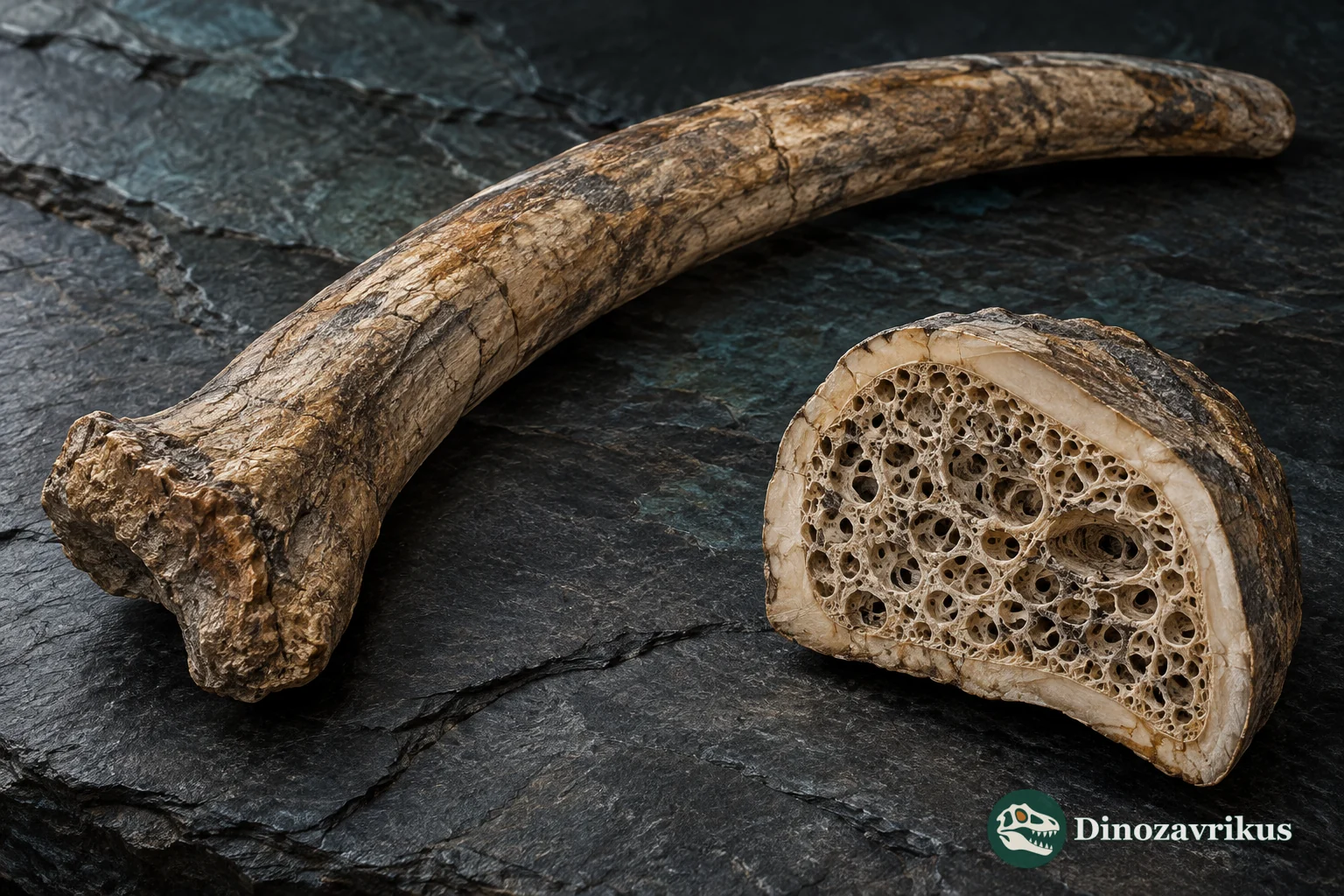
Sections show compact outer tissue and a cancellous inner region. Histology describes bone structure, not swimming speed.
It came from the Los Molles Formation at Chacaico Sur. The age is based on stratigraphic context, not the bone itself.
Studies place Mollesaurus among early ophthalmosaurian ichthyosaurs, but detailed relationships vary with the phylogenetic dataset.
One specimen, several stages of study
Marta S. Fernández named Mollesaurus periallus in 1999. The holotype, MOZ 2282, had earlier been reported from Chacaico Sur as material close to Ophthalmosaurus. Fernández recognised a distinct genus based on a combination of skull and postcranial characters. The name refers to the Los Molles Formation.
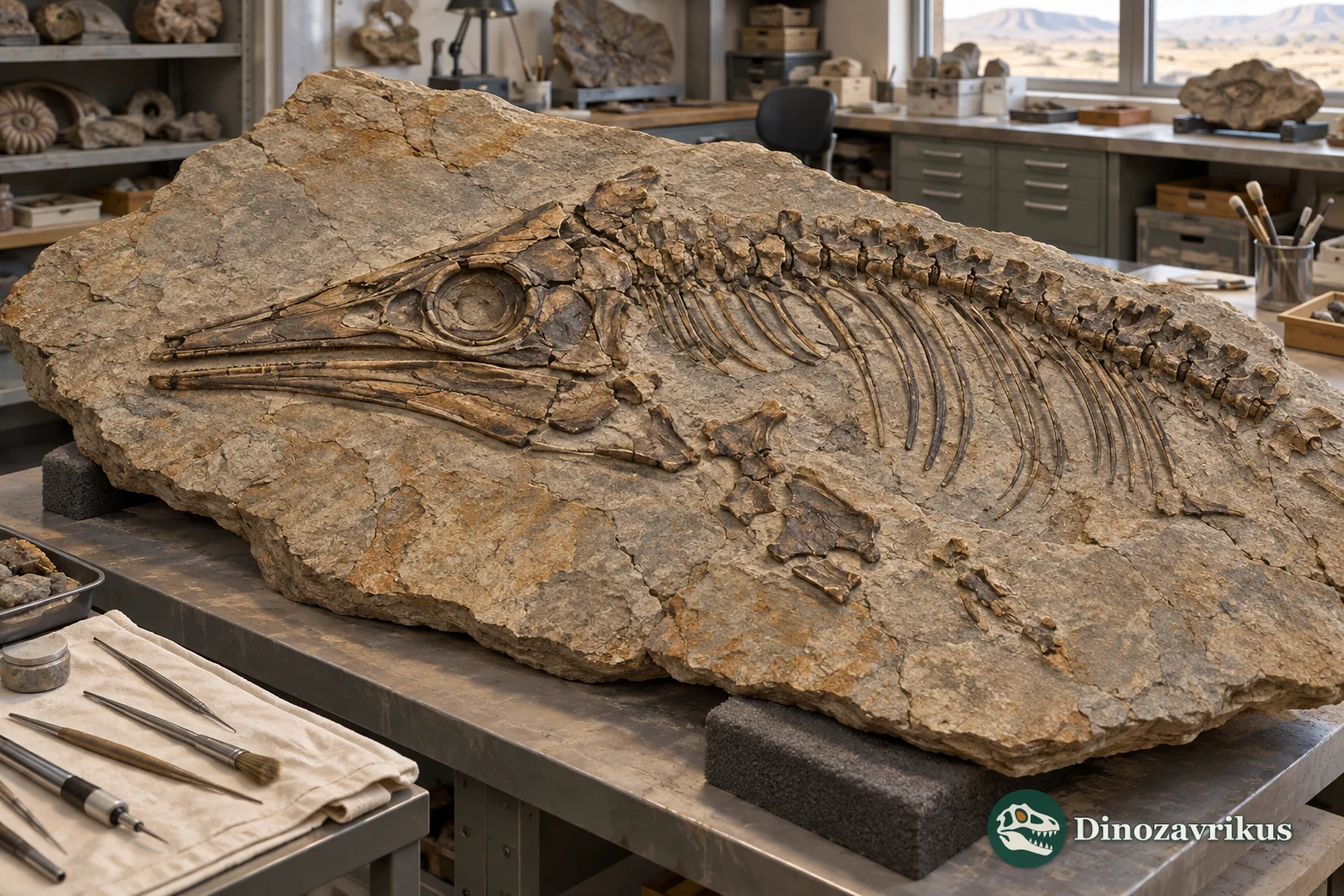
The holotype is not a single complete skeleton exposed on one slab. The skull and associated elements occur in a large block, while parts of the backbone and ribs are preserved in several smaller blocks. Fernández and Talevi’s later account also records a clavicle and a fragment of scapula; no fins were recovered. Incomplete fossils should not be filled in silently with the proportions of a better-known relative.
Related profiles: Caypullisaurus · Ophthalmosaurus · Stenopterygius.
Skull anatomy and reconstruction limits
The front of the rostrum is missing. The preserved skull has small teeth, a broad postorbital region and an enlarged orbit with a pronounced crest along its front margin. In the published description, the diameter of the sclerotic ring occupied about 42 percent of the orbital area. This is a measurement of the specimen, not a universal proportion for ichthyosaurs.
Vertebrae and ribs document the trunk, but the absent snout tip and fins make a complete-body length difficult to establish directly. A numerical estimate must state the model and comparison used; a drawing alone cannot supply the missing measurement. The cover is an artistic reconstruction, not a portrait of MOZ 2282.
Ribs under the microscope
In 2012, Maite Talevi and Marta Fernández examined four rib fragments that remained articulated with anterior and posterior dorsal vertebrae of MOZ 2282. The sections showed compact outer cortical tissue and a cancellous inner region. The sampled ribs shared a general histological pattern.
The authors argued that their result showed greater ecological diversity among advanced ichthyosaurs than previously recognised. Histology is evidence about bone microstructure; by itself it does not determine exact swimming style, diet, speed or diving depth. Comparison with ribs of Caypullisaurus can be informative, but differences in specimens and methods matter.
Age, locality and relationships
Chacaico Sur lies in the Neuquén Basin of northwestern Patagonia. The holotype comes from the Los Molles Formation and is associated with the Emileia giebeli ammonite zone, assigned to the Early Bajocian. Stratigraphy dates the rock and helps compare its fauna; one skeleton does not record the full duration of the genus.
Phylogenetic analyses have changed the position of Mollesaurus as character samples and codings changed. One analysis discussed by Fernández and Talevi recovered it near Ophthalmosaurus and Acamptonectes; other matrices differ in detail. It is best treated as an ophthalmosaurian ichthyosaur while noting that its exact relationships are analysis-dependent. Similarity to Ophthalmosaurus does not establish direct ancestry.
Frequently asked questions
Where was Mollesaurus found?
Its holotype comes from Chacaico Sur in the Neuquén Basin of Argentina, in the Los Molles Formation.
How old is Mollesaurus?
The fossil-bearing horizon is assigned to the Early Bajocian of the Middle Jurassic, including the Emileia giebeli ammonite zone.
What is preserved in the holotype?
Part of the skull, articulated sections of the backbone and ribs, and fragments of girdle bones are known. The snout tip and fins were not recovered.
What did rib histology show?
Sections of four rib fragments showed compact outer tissue and a cancellous inner region. This describes bone microstructure, not a precise swimming style or speed.