

Armadillosuchus arrudai was a Late Cretaceous notosuchian from Brazil. A rigid shield covered its neck, followed by seven overlapping rows of bony plates. That combination recalls the armour of an armadillo. The same fossil preserves its teeth and much of the left forelimb, which give clues to how it processed food and moved on land.
Quick facts
| Species | Armadillosuchus arrudai |
|---|---|
| Group | Sphagesaurid notosuchian |
| Age | Late Cretaceous |
| Locality | General Salgado, Brazil |
| Principal evidence | Skull, forelimb and dorsal armour |
What can the fossils tell us?
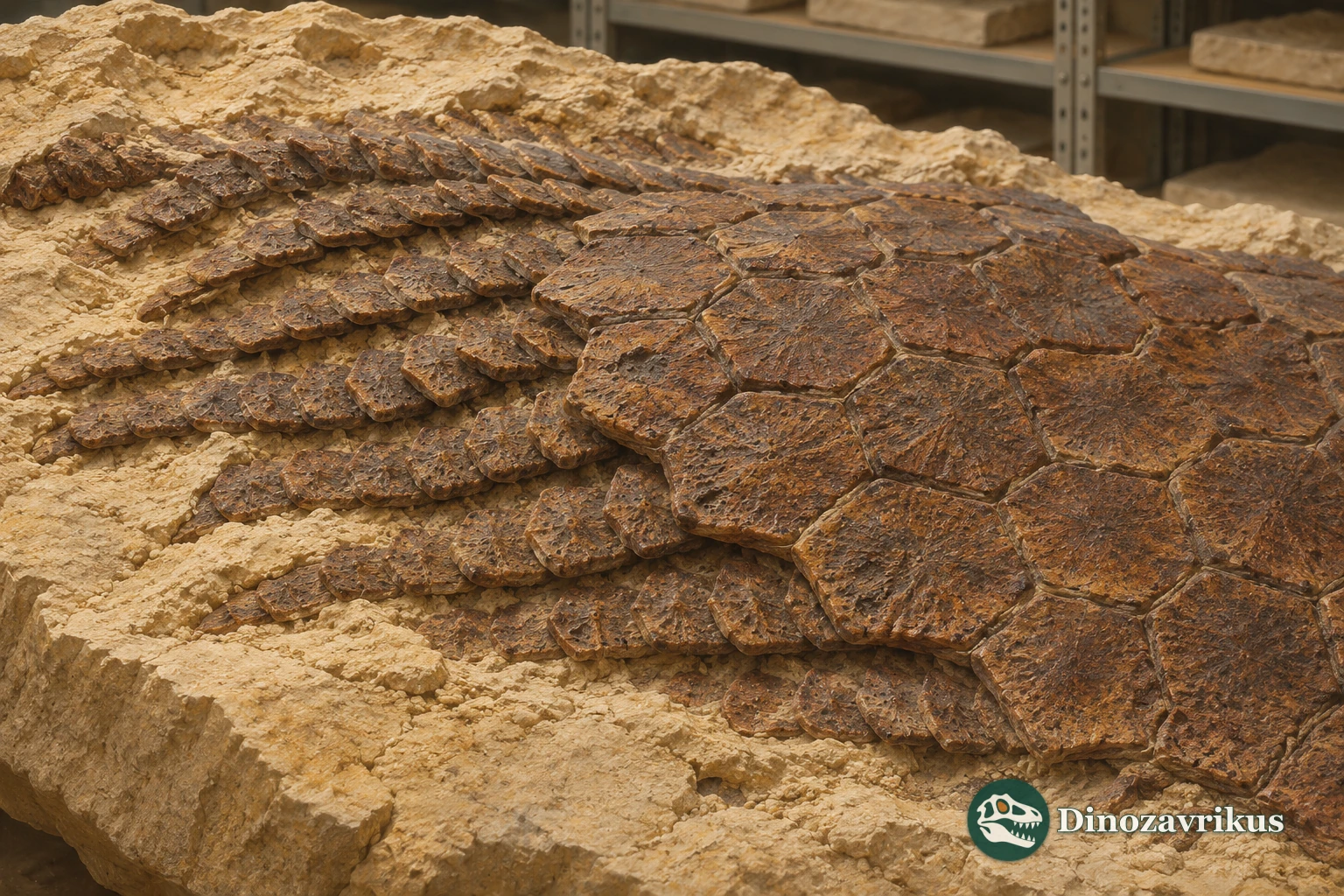
Plates in the shield meet closely. Plates in the transverse bands overlap, permitting some movement. The range of that movement is unknown.
Upper and lower teeth came into contact as the animal fed. The surfaces record wear, with the precise diet still unresolved.
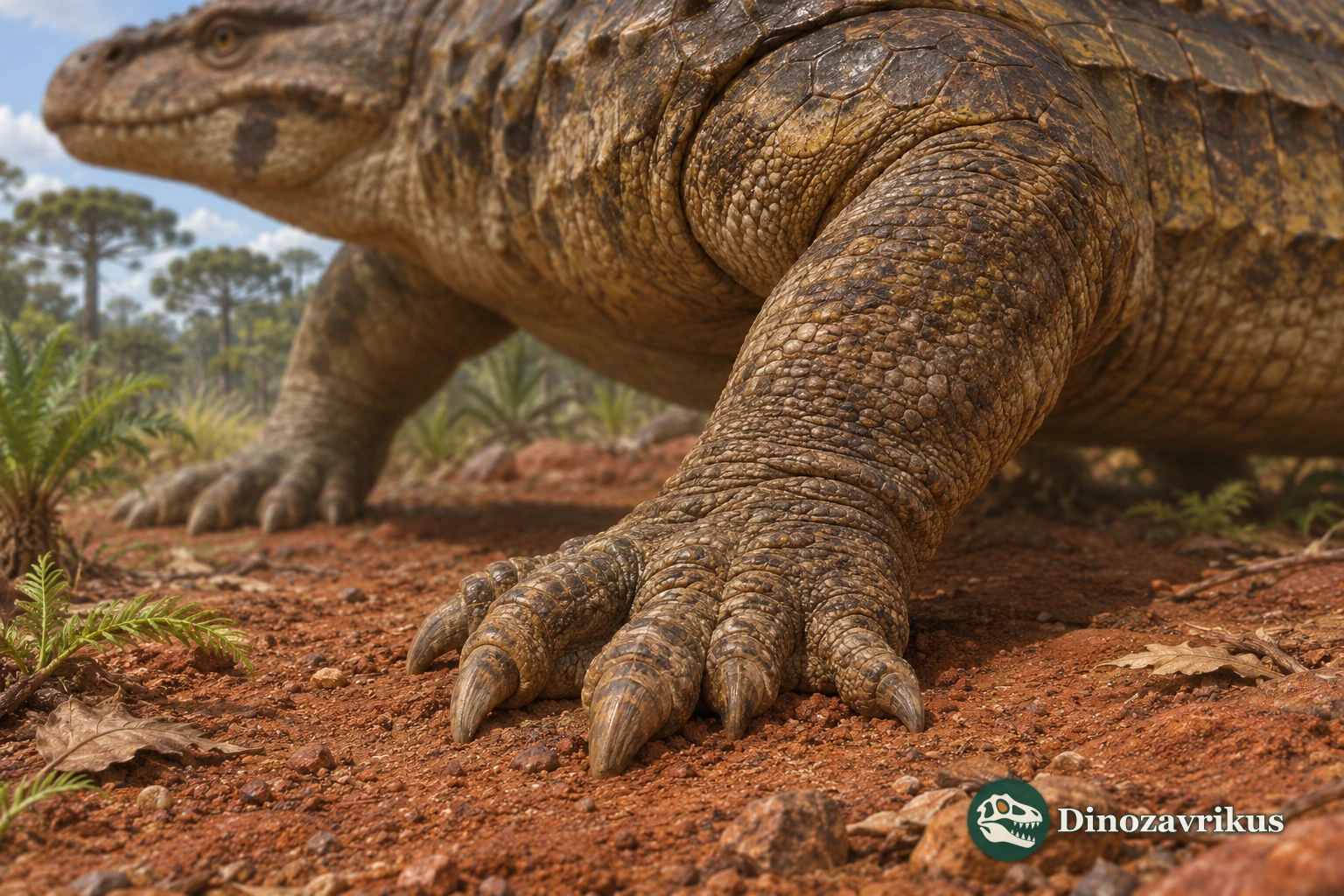
The left forelimb provides evidence of robust claws. Its anatomy is compatible with moving soil, but the behaviour cannot be observed directly.
A skeleton from São Paulo
Thiago Marinho and Ismar Carvalho described the species in 2009. The type specimen, UFRJ DG 303-R, came from continental rocks of the Adamantina Formation near General Salgado. It includes much of the skull, neck and front trunk vertebrae, the left forelimb and parts of the dorsal armour.
A second specimen, MPMA-64-0001-04, preserves parts of the jaws with teeth. These remains add to the record of the dentition preserved in the more complete skeleton.
A shield and seven bands
The neck shield consists of osteoderms, bones that develop in the skin. Many are hexagonal. Seven transverse bands of partially overlapping plates follow the shield. The armour farther back is less complete, leaving its full arrangement uncertain.
A thin section of an osteoderm from specimen LPRP/USP 0774 showed Sharpey’s fibres. Many ran almost perpendicular to the outside of the bone, consistent with skin firmly anchored to the plate. The fossil records the attachment, while the appearance of the skin remains unknown.
Food processing and movement
The front and rear teeth had different shapes. The second tooth on each premaxilla was enlarged and fanglike. The rear crowns were set obliquely and carry wear facets, a pattern also seen in the related Sphagesaurus. The wear shows that the teeth contacted one another during feeding. Evidence for the composition of the diet is limited.
The original description proposed that the broad shoulder blade, sturdy claw bones and strong neck could have helped Armadillosuchus dig. No trace of a burrow has been attributed to this animal, leaving the frequency and purpose of any digging open.
Frequently asked questions
What does the name Armadillosuchus refer to?
It refers to the resemblance between the overlapping bands of this notosuchian and the armour of an armadillo.
Could Armadillosuchus roll into a ball?
The overlapping bands suggest some flexibility. The maximum bend of the trunk is unknown.
What did Armadillosuchus eat?
The form and wear of its teeth show that it processed food in its mouth. The precise ingredients of the diet remain uncertain.
Where was the type specimen found?
It came from the Adamantina Formation near General Salgado in São Paulo state, Brazil.