

Arthrodytes is known from a stout upper wing bone and parts of the shoulder girdle from Patagonia. These remains support comparison with other penguins and help explain why one of the species originally assigned to the genus was later moved elsewhere.
Quick facts
| Group | Sphenisciformes |
|---|---|
| Age | Palaeogene, exact type horizon uncertain |
| Locality | Bajo de San Julián, Santa Cruz, Argentina |
| Material | Right humerus and parts of the shoulder girdle |
| Humerus length | 149 mm as reported by Ameghino |
| Genus named | Florentino Ameghino, 1905 |
What can the fossils tell us?
Ameghino measured the humerus at 149 mm. Its strength and proportions can be compared with other flippers, while the bird’s standing height remains unknown.
MLP M-606, M-607 and M-608 are catalogue numbers for casts of the bones. The copies preserve the form of the type material.
The revised treatment kept andrewsi in Arthrodytes and treated grandis as a synonym of a species in another genus.
The wing and shoulder from San Julián
Florentino Ameghino introduced the species as Paraptenodytes andrewsi in 1901 and transferred it to Arthrodytes in 1905. The find came from Bajo de San Julián in Santa Cruz Province, Argentina.
The type material consists of a complete right humerus, an incomplete coracoid and the shoulder end of the right scapula. The Museo de La Plata houses casts under numbers MLP M-606, M-607 and M-608. In 1946 George Gaylord Simpson noted that the bones were reported to have been found together. They preserve no skull, feet or trunk.
A robust flipper and a changing classification
Ameghino recorded a total humerus length of 149 millimetres and a maximum transverse shaft width of 35 millimetres. Simpson compared the orientation of the joint surfaces and shaft form. The Arthrodytes humerus is larger and stouter than that of Paraptenodytes antarcticus. A robust upper flipper fits a penguin that generated thrust underwater with its wings.
Carolina Acosta Hospitaleche’s 2005 revision moved Arthrodytes from Anthropornithinae to Paraptenodytinae in her classification. A subsequent update recognised andrewsi as the sole valid species and treated Arthrodytes grandis as a synonym of Paraptenodytes robustus. The two sets of fossil material should remain distinct when comparing measurements.
Marine beds and the age of the specimen
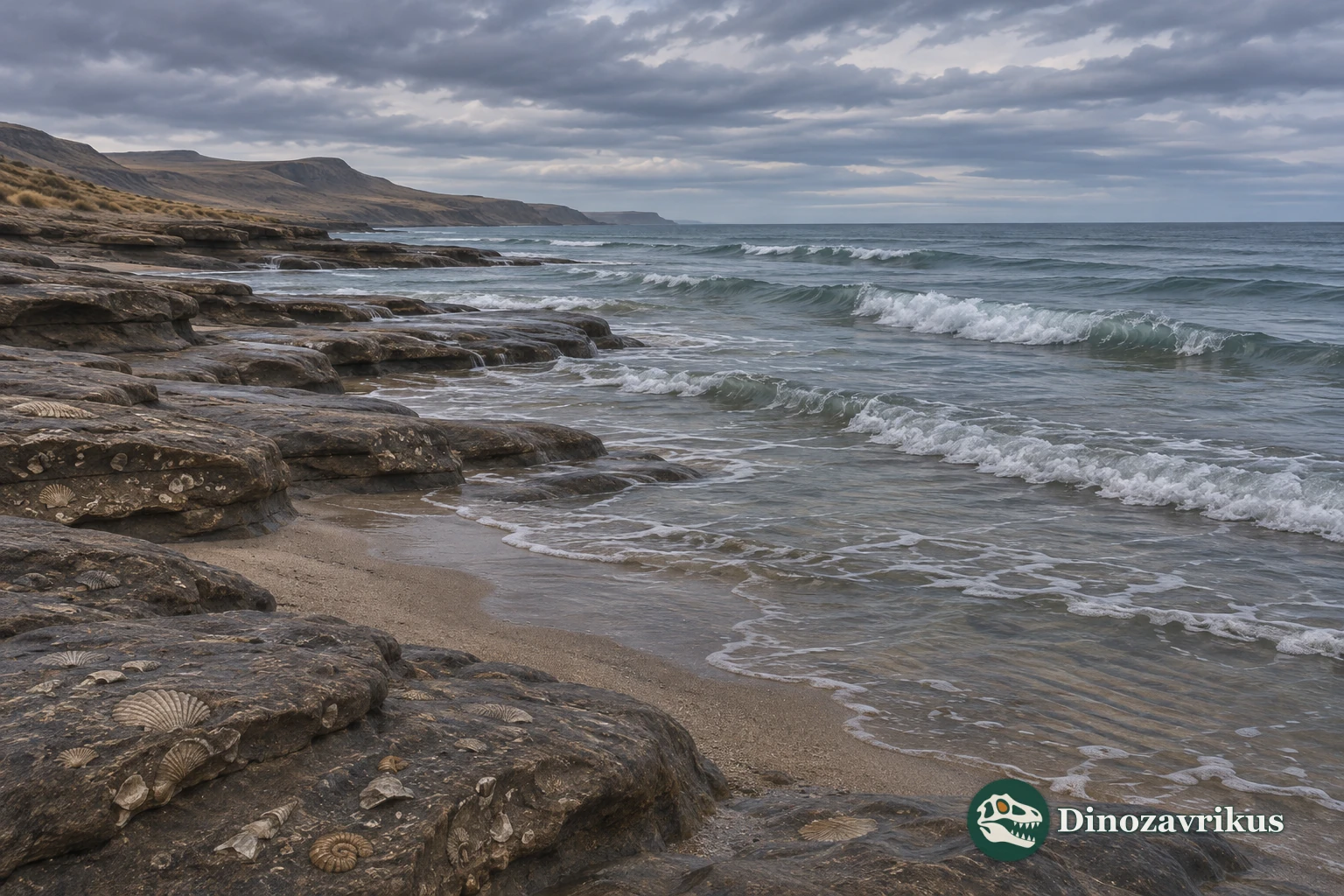
The material is assigned to the marine San Julián Formation. Penguin studies have conventionally given an age near the Eocene–Oligocene boundary for the occurrence. Geologists also identify younger Oligocene beds in the area. The precise horizon of this historical specimen remains less secure than its geographical provenance.
The bones that survive vary among Patagonian penguins. Eretiscus, for example, was identified primarily from a tarsometatarsus, whereas the Arthrodytes material documents the flipper and shoulder. No direct evidence establishes its colour pattern or specific prey.
Frequently asked questions
What bones are known?
The type material comprises a right humerus, an incomplete coracoid and the proximal end of a right scapula. The Museo de La Plata holds casts of all three.
How tall was Arthrodytes?
Standing height is unknown. The 149 millimetre measurement refers to the humerus.
How did it swim?
The humerus has the anatomy of a penguin flipper, consistent with producing thrust using the wings.
Where was it found?
The material is from Bajo de San Julián in Santa Cruz Province and is assigned to the marine San Julián Formation.