

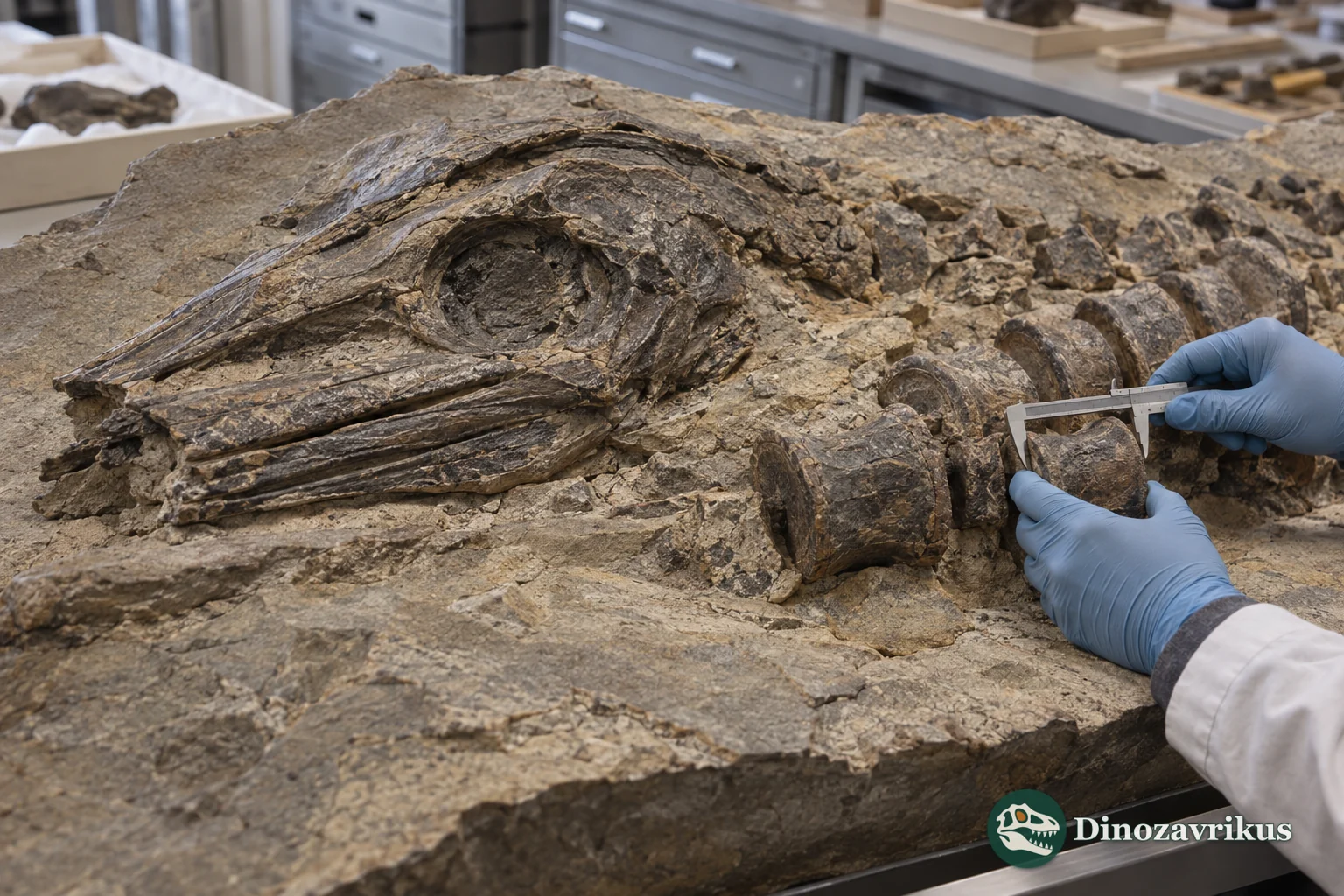
Athabascasaurus bitumineus is an ichthyosaur from Lower Cretaceous rocks of northern Alberta. Its holotype, TMP 2000.29.01, preserves a nearly complete skull and a substantial articulated skeleton. The premaxillae, front part of the lower jaw and other portions are missing, so even this unusually informative specimen does not provide a direct measurement of the complete animal.
Its anatomy helps document ichthyosaur diversity in the Albian seaway, while the incomplete fossil record leaves body size and behaviour uncertain.
Quick facts
| Scientific name | Athabascasaurus bitumineus |
|---|---|
| Holotype | TMP 2000.29.01, Royal Tyrrell Museum |
| Age | Lower Albian, Early Cretaceous |
| Locality | Syncrude Base Mine near Mildred Lake, Alberta, Canada |
| Rock unit | Wabiskaw Member, Clearwater Formation |
| Preserved material | Nearly complete skull without premaxillae, articulated vertebral series and parts of both girdles |
| Total length | Not directly measured from a complete skeleton |
What can the fossils tell us?
The skull lacks the premaxillae and the front half of the lower jaw. The articulated axial skeleton extends through the presacral region and front part of the tail; parts of the shoulder and pelvic girdles are also known.
The Wabiskaw Member of the Clearwater Formation dates the deposit to the Lower Albian. It does not give an exact year for the animal’s life.
The original description discusses a reduced supranarial process, maxilla shape, a broad postorbital region, enamel ridges and a presacral count of 42 vertebrae. These are observations on the type material.
Different character matrices have placed the taxon in different parts of Ophthalmosauridae. Those positions depend on comparisons and coding choices, not a directly observed family tree.
Discovery in northern Alberta
The skeleton was collected in 2000 on the west side of Syncrude Canada Ltd.’s Base Mine near Mildred Lake, about 35 kilometres north of Fort McMurray. Patrick Druckenmiller and Erin Maxwell described the genus and species in 2010. The name Athabascasaurus refers to the Athabasca River and region; bitumineus alludes to the bituminous sands where the fossil was uncovered.
The holotype is held at the Royal Tyrrell Museum of Palaeontology under number TMP 2000.29.01. Some secondary databases give a different number, but the primary description and subsequent scientific studies use TMP 2000.29.01.
What the holotype preserves
The skull is nearly complete in dorsal view but lacks the premaxillae and the front half of the lower jaw. Behind it, much of the presacral axial skeleton and a series of anterior caudal vertebrae remain articulated. Parts of the right scapula and coracoid, the pelvic girdle and a femur are also preserved. This is among the most complete Early Cretaceous ichthyosaurs known from North America, but it is not a complete skeleton.
The articulated vertebrae retain their relative positions, making them useful for anatomical study. Missing elements can be compared with other ichthyosaurs, but such comparisons do not turn inferred bones into preserved parts of the holotype.
The Lower Albian seaway
The fossil comes from the Wabiskaw Member of the Clearwater Formation, dated to the Lower Albian of the Early Cretaceous. A shallow inland sea covered this part of western North America. Other marine vertebrates occur in the same formation, but a shared rock unit does not mean all fossils were buried together or belonged to one living community.
Oil-sands mining exposed the fossil-bearing rock. The modern mine is part of the discovery history, not the ancient habitat. The deposit records a marine setting but does not establish the exact depth, season or daily route of this individual.
Features used to recognise the genus
The original diagnosis combines several cranial and postcranial characters. It includes a strongly reduced or absent supranarial process of the premaxilla, an elongated maxilla whose tallest point lies behind the external naris, a broad postorbital region, a square-shaped squamosal and a distinctive arrangement of the jaw bones. The tooth enamel has fine ridges, and the authors counted 42 presacral vertebrae.
These features distinguish the specimen in comparisons available to the authors. The taxonomy of Cretaceous ichthyosaurs has continued to change as researchers add specimens and revise character matrices. The animal’s bones do not change; its position in a classification can be reassessed.
Relationships and uncertainty
Athabascasaurus is generally treated as an ophthalmosaurid and often placed in Platypterygiinae. Phylogenetic studies have recovered it in different positions within the family, including placements closer to Platypterygius in some analyses. This variation reflects the taxa and characters included in each study. It is not direct evidence that one named genus descended from another.
Comparison with Platypterygius and Ophthalmosaurus helps show how researchers evaluate skull and pelvic characters across the family. The Early Cretaceous Muiscasaurus provides another example of how additional specimens can revise the interpretation of an ichthyosaur’s relationships.
Size, diet and swimming
The skull, vertebrae and girdle elements provide substantial anatomical evidence, but the skeleton lacks parts needed to measure the entire animal directly. Published summaries sometimes give a rounded length estimate. Such a figure depends on how missing sections are reconstructed and should not be presented as a measurement of TMP 2000.29.01.
Jaw and tooth anatomy can support comparisons of feeding mechanics, but no stomach contents establish a precise prey list. The vertebral column and limb bones inform studies of movement, yet they do not record exact swimming speed, dive depth or stroke sequence. Colour and soft tissue on the cover are artistic interpretation.
Frequently asked questions
Where was Athabascasaurus found?
Its holotype was collected in 2000 at Syncrude Base Mine near Mildred Lake, about 35 kilometres north of Fort McMurray, Alberta.
What is preserved in the holotype?
TMP 2000.29.01 includes a nearly complete skull without the premaxillae, much of the articulated vertebral column, parts of the shoulder and pelvic girdles, and a femur.
When did Athabascasaurus live?
It comes from the Lower Albian Wabiskaw Member of the Clearwater Formation in the Early Cretaceous.
How long was it?
The holotype does not preserve a complete skeleton from which total length can be measured directly. Rounded estimates depend on reconstructing missing parts.