

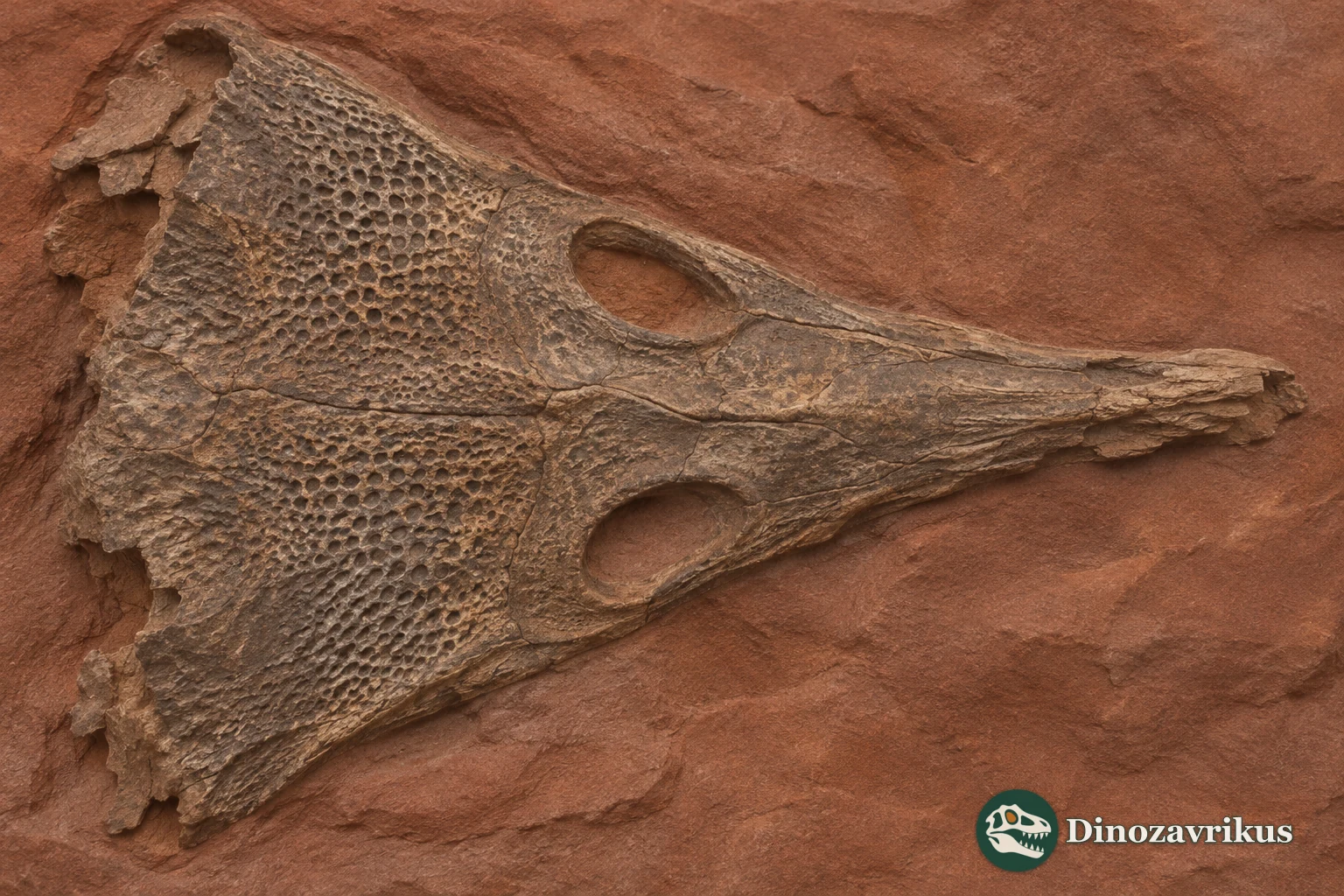
Australerpeton cosgriffi was a long-snouted temnospondyl from Permian rocks in southern Brazil. Its narrow rostrum resembled those of some archegosauroids. A re-examination of its skulls drew attention to a different set of features in the palate and occiput.
Quick facts
| Group | Temnospondyls, rhinesuchids |
|---|---|
| Age | Middle to Late Permian |
| Region | South America (Paraná Basin, Brazil) |
| Type species | Australerpeton cosgriffi |
| Scientific name | Australerpeton |
| Diet | Undetermined |
What can the fossils tell us?
The type UFRGS-PV-0227-P is a partial skull. Other specimens preserve the snout, a lower jaw, vertebrae from the trunk and tail, shoulder elements and small dermal scales.
A crest on the pterygoid and a combination of traits at the back of the skull support the placement of Australerpeton among rhinesuchids.
The jaws allow comparisons with other animals that captured prey in water. Its actual prey and the time it spent away from water remain unresolved.
The Serra do Cadeado material
Mário Barberena named the species in 1998. The holotype UFRGS-PV-0227-P lacks the snout and part of the right side of the skull. Other fossils, including UFRGS-PV-0228-P, preserve the narrow rostrum. They come from the Serra do Cadeado area in Paraná. The fossil-bearing levels of the Rio do Rasto Formation are assigned to the Middle to Late Permian.
Why the palate mattered
Estevan Eltink and colleagues studied the skull in multiple views. The pterygoid on the palate has a prominent oblique crest. At the rear of the skull, a groove for the stapes and a tabular horn that projects back and down helped link Australerpeton to Rhinesuchidae. The study treated the similarly tapered snout of taxa such as Konzhukovia as a case of independent evolution.
Backbone, limbs and scales
UFRGS-PV-0319-P preserves 18 complete trunk and five tail vertebrae, ribs, elements of both pairs of limbs and small dermal scales. A second skeleton, UFRGS-PV-0320-P, preserves more of the shoulder and forelimb. Together they show the body proportions and gave researchers material for comparing ossification in different individuals.
Life in Permian fresh water
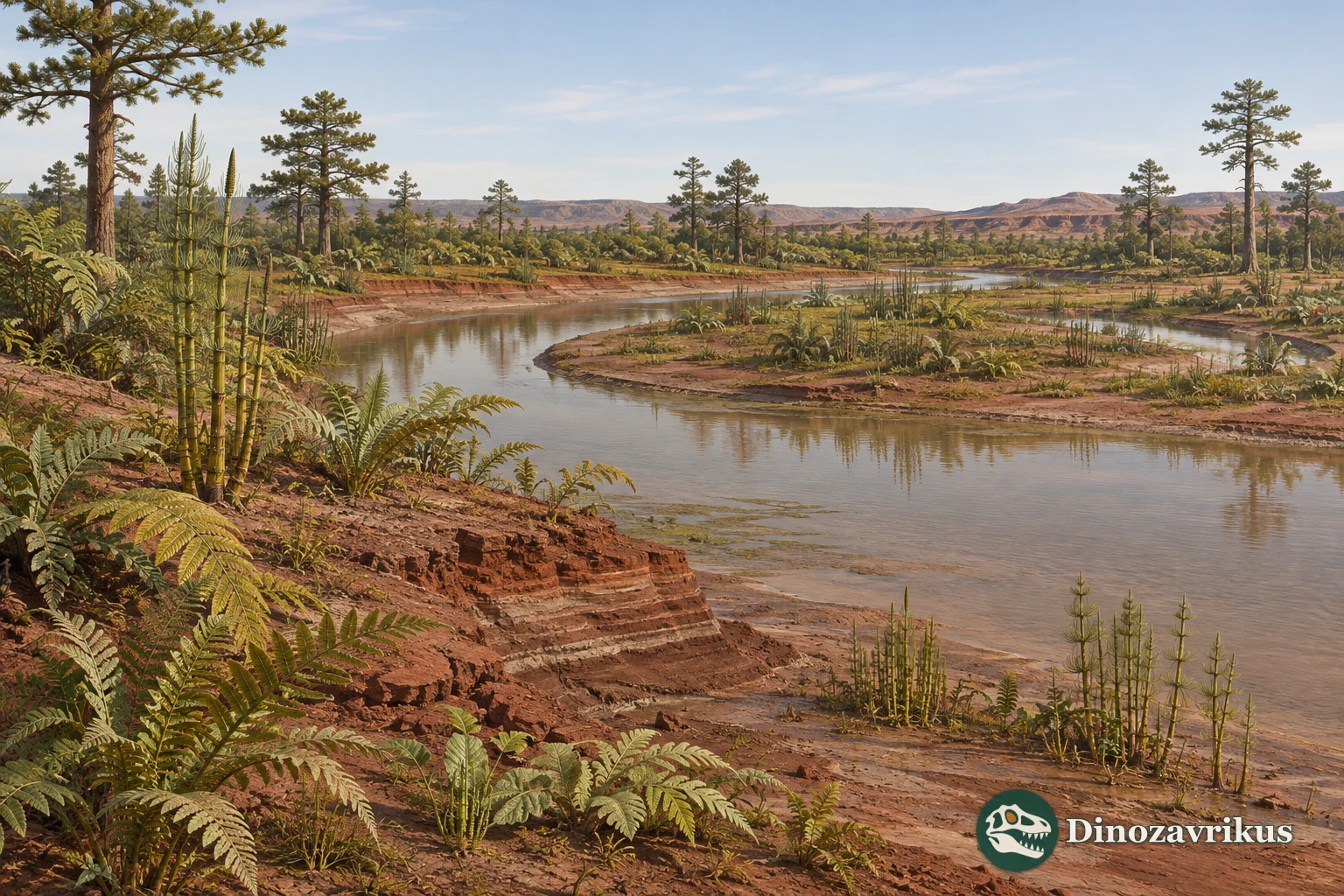
The slight curve of the ribs suggests a flattened trunk. That shape and weak ossification at the wrist and ankle are consistent with an aquatic lifestyle. Freshwater beds in the Rio do Rasto Formation also contain mud cracks, indicating intervals when exposed sediment dried. The skeletal evidence allows several possibilities for how often Australerpeton left the water.
Frequently asked questions
Where was Australerpeton found?
Its fossils occur in the Serra do Cadeado area of Paraná, southern Brazil, in deposits of the Rio do Rasto Formation.
What does the type specimen preserve?
UFRGS-PV-0227-P is a partial skull. It lacks the snout and part of the right side.
Why is Australerpeton classified as a rhinesuchid?
A combination of features in the palate and back of the skull supports that placement. One example is the oblique crest on the pterygoid.
What suggests that it lived in water?
The ribs point to a flattened trunk. That shape and weak ossification of the wrist and ankle fit an aquatic interpretation.