

Baltemys was a small fossil turtle with a narrow plastron. Grooves in the shell bones mark the course of ducts associated with musk glands. These features allow researchers to compare it with other early mud turtles.
Quick facts
| Group | Turtles, mud turtles |
|---|---|
| Age | Eocene, early Eocene for the type species |
| Region | North America: Wyoming and Colorado, United States |
| Type species | Baltemys staurogastros |
| Material | Carapaces and plastra, some partly articulated |
| Scientific name | Baltemys |
| Diet | No direct evidence |
What can the fossils tell us?
Grooves preserve the course of ducts associated with musk glands. They offer a skeletal character for comparisons and leave the composition of any secretions unknown.
The type specimen came from the part of the Willwood Formation assigned to Wasatchian 6. Stratigraphic relationships and the fossil fauna constrain its date.
Parts of the upper and lower shell of B. velogastros survived together. They reveal features of the bridge and plastron. Any complete outline involves reconstruction.
The Wyoming shells
J. Howard Hutchison described Baltemys staurogastros in 1991. The holotype comes from locality V81170 in the Willwood Formation. Its horizon falls in the sixth subdivision of the Wasatchian North American land mammal age, within the early Eocene.
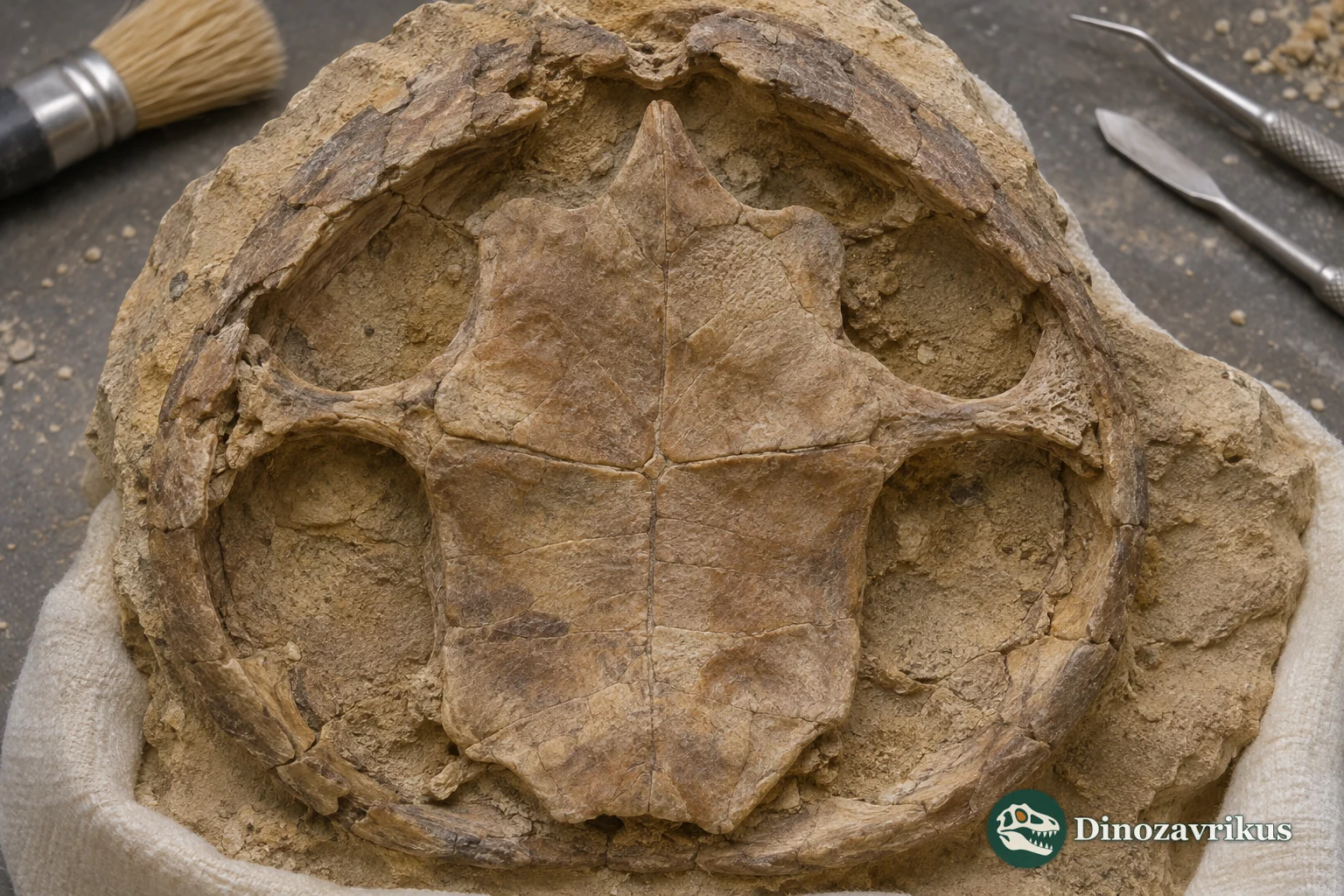
The plastron tapers towards the front and back, with lateral arms extending towards the sides of the shell. Its outline is roughly cross-shaped. The fossils studied by Hutchison lack the mobile plastral lobes that allow some living mud turtles to close their shells.
Comparisons with other mud turtles
Incised duct grooves and the pattern of bones down the middle of the carapace help place Baltemys among mud turtles. Some shell features resemble those of the living genus Staurotypus. Hutchison interpreted those similarities as retained ancestral features.
Hutchison also compared Baltemys with Xenochelys. Some species referred to Xenochelys have a broader plastron and shorter traces of musk gland ducts. The branching order of these early turtles depends on which characters can be assessed in each specimen.
A second species from Colorado
In 2015 Asher Lichtig and Spencer Lucas described B. velogastros from the Huerfano Formation. Specimen UCM 32796 preserves roughly half of a shell, with parts of both shields and several bones still joined. The lower shell and bridge provide characters that can be compared with those of the Wyoming species.
Frequently asked questions
When did Baltemys live?
The Wyoming type species is early Eocene. The Colorado species occurs in the Eocene Huerfano Formation.
How do fossils indicate the presence of musk glands?
Grooves in the shell mark the paths of their ducts. The glands themselves are soft tissues.
Could it close its shell?
The specimens described by Hutchison show no evidence of moving parts in the lower shell that could close its openings.
What did Baltemys eat?
The available fossils chiefly document the anatomy of the shell. Direct evidence of diet is unavailable.