

Xenochelys was a North American turtle in the mud turtle family. The type species was described from a 20 cm shell found in South Dakota. Fossils from Wyoming preserve traces of gland ducts and offer a comparison of the lower shell in several early species.
Quick facts
| Group | Turtles, mud turtles |
|---|---|
| Age | Eocene, late Eocene for the type species |
| Region | North America: United States |
| Type species | Xenochelys formosa |
| Holotype | AMNH 1097, nearly complete shell |
| Scientific name | Xenochelys |
| Diet | No direct evidence |
What can the fossils tell us?
The carapace measures 20 cm long and 12.9 cm wide. These are direct shell measurements and leave the animal’s sex and mass uncertain.
Fossils from Wyoming preserve grooves associated with musk gland ducts. The grooves offer comparative characters but leave the physiology of the glands unknown.
The type species occurs in the late Eocene Chadron Formation. Florida fossils are late Oligocene and were referred to Xenochelys provisionally.
The shell discovered in South Dakota
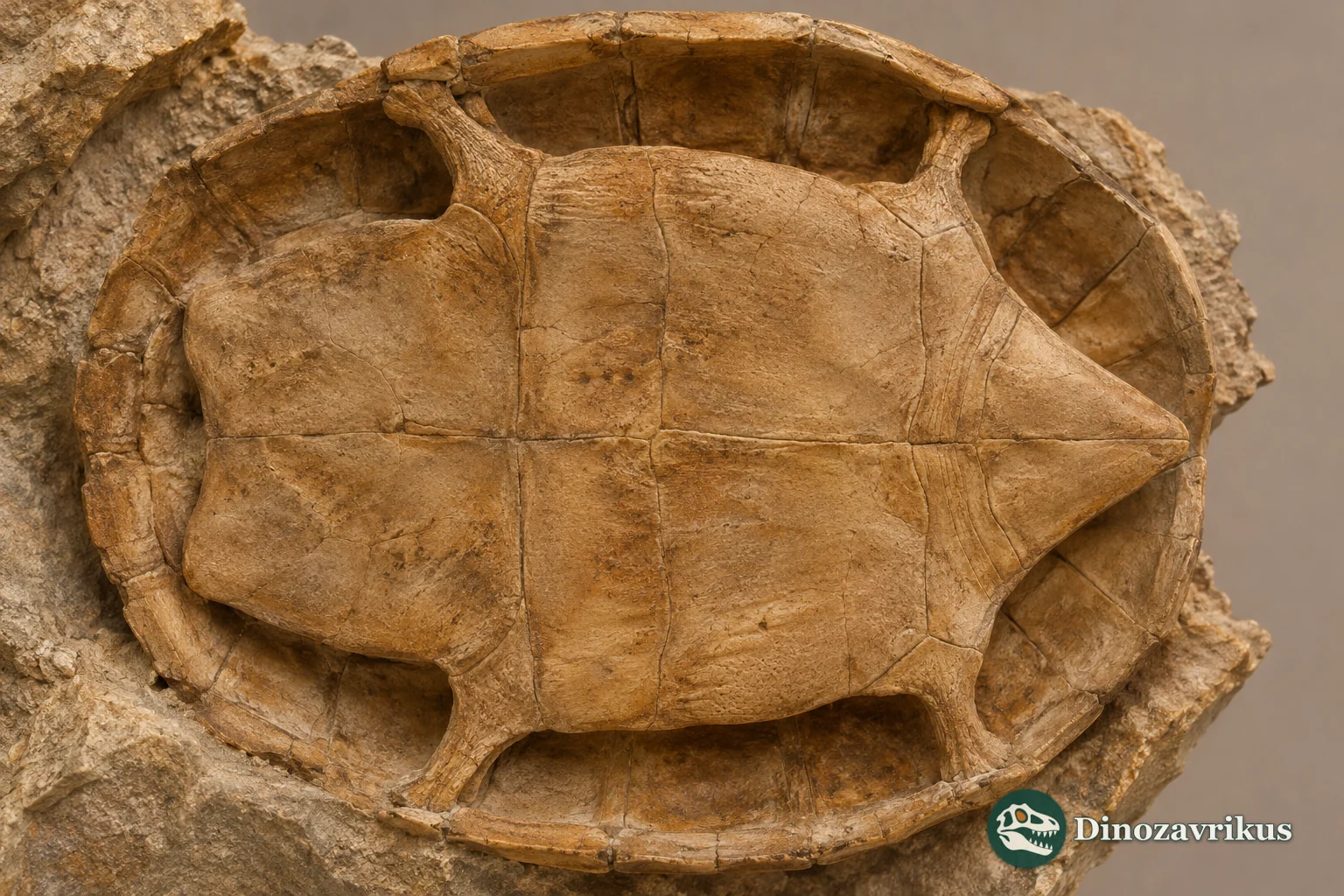
Albert Thomson found a nearly complete shell at Quinn Draw in 1904. Oliver Perry Hay described it in 1906 as Xenochelys formosa. The American Museum of Natural History holds the holotype AMNH 1097. The original description called the deposits Oligocene. Later work dates the Chadron material to the late Eocene within the White River Group.
The carapace is 20 cm long and 12.9 cm wide, and the plastron measures 16.3 cm in length. Low ridges are visible near the front and rear of the carapace. The shell documents the size of the individual, while the colour of its external scutes is unknown.
What changed in early mud turtles
In 1991 J. Howard Hutchison described X. lostcabinensis from the early Eocene and X. bridgerensis from the middle Eocene of Wyoming. He compared the grooves left by musk gland ducts, a small intergular scute near the front of the plastron, and the breadth of the lower shield. The examined material showed no mobile plastral lobes.
Another North American genus, Hoplochelys, had prominent longitudinal ridges. Evolutionary analyses use a wider set of characters, including how the upper and lower shields meet. Species referred to Xenochelys can emerge on different branches of the mud turtle lineage in these analyses.
The late Oligocene fossils from Florida
Brooksville 2 yielded two associated parts of a plastron now catalogued as UF 150006 and UF 150007. Jason Bourque described the late Oligocene material as X. floridensis and considered the assignment to the genus provisional. The specimens show that similar mud turtles survived in Florida later than the age of the South Dakota type species.
Frequently asked questions
When did the type species live?
The South Dakota specimen dates to the late Eocene. Historical publications gave the same beds an Oligocene age.
How big was the type specimen?
Its carapace is 20 cm long and 12.9 cm wide.
Could Xenochelys close its shell?
The Eocene material studied by Hutchison lacks evidence of mobile plastral lobes. Several living mud turtles have mobile parts of the plastron.
What did Xenochelys eat?
Direct evidence of its diet is unavailable. The best documented fossils are shells and shell fragments.