

Baptanodon natans was an ophthalmosaurid ichthyosaur in the Late Jurassic sea that covered part of present-day Wyoming. Some studies have placed the North American species in Ophthalmosaurus. A 2022 analysis retained Baptanodon after comparing new skull and limb fossils with European material.
Living color and swimming behavior in the cover image are artistic choices. The fossils document bone anatomy and rock context, not a witnessed animal.
Quick facts
| Species studied | Baptanodon natans |
|---|---|
| Group | Ophthalmosauridae |
| Age of new fossils | Oxfordian, Late Jurassic |
| Location | Near Kaycee, Wyoming, United States |
| Geological unit | Redwater Shale, Sundance Formation |
| Key specimens | TATE v9302 and TATE v7037 |
| Evidence | Braincase, forefins, girdle and vertebrae |
What can the fossils tell us?
The three-dimensional TATE v9302 braincase preserves the back of the skull. Its foramen magnum and occipital and basisphenoid bones differ from those of European Ophthalmosaurus icenicus.
TATE v9302 includes both forefins and girdle elements. Humeral proportions help identify Baptanodon, but a separate unusual humerus does not establish a second named species.
TATE v9302 and v7037 were collected in 2018 about 20 metres apart at different Oxfordian Redwater Shale levels near Kaycee.
Why the genus is debated
The North American species has been called both Baptanodon natans and Ophthalmosaurus natans. Close relationship does not alone settle whether the forms belong to one genus. Massare and Connelly's 2022 comparison retained Baptanodon because the examined braincase and limb features differ from European O. icenicus.
Compare Ophthalmosaurus and Aegirosaurus to see variation among related marine reptiles. Their shared streamlined outline is less informative for taxonomy than preserved bone details. The wider history of ichthyosaurs spans several distinct lineages.
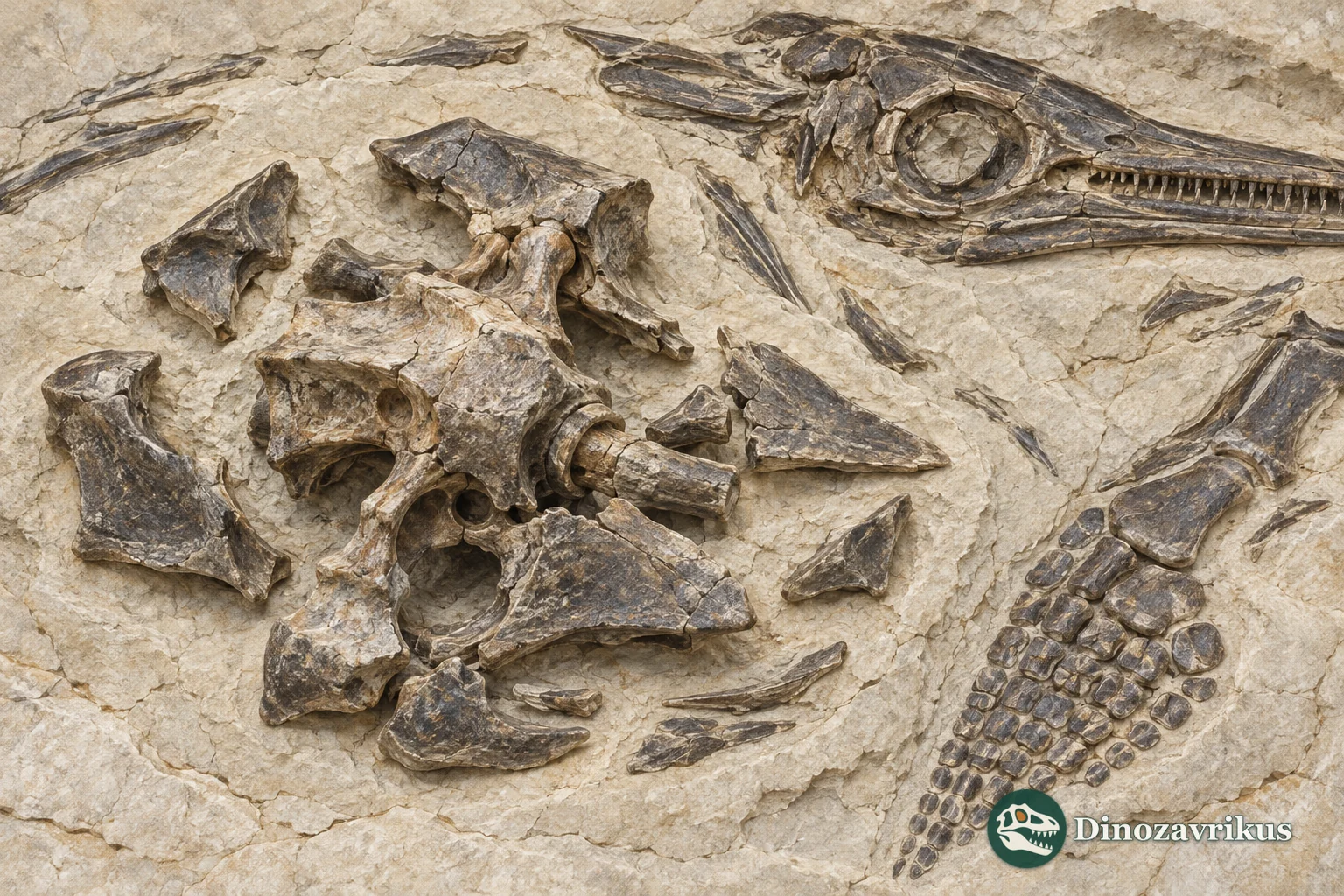
Two Sundance Formation specimens
TATE v9302 and v7037 were collected in 2018 northwest of Kaycee, Wyoming, from separate Oxfordian levels of the Redwater Shale, upper Sundance Formation. They lay about 20 metres apart, so they are two individuals, not pieces of a single skeleton. Neither new find is the species holotype.
TATE v9302 includes articulated three-dimensional braincase parts, skull fragments, both forefins, girdle elements, vertebrae and ribs. TATE v7037 has a disarticulated braincase and partial postcranial material. Features of the foramen magnum, supraoccipital, basioccipital and basisphenoid can therefore be compared directly with European specimens.

Fins and remaining uncertainty
The studied American humeri are longer and narrower than comparable elements of O. icenicus. A different isolated humerus, UW 24234, could represent another taxon, but the authors treated this as tentative. It is not a confirmed second Baptanodon species.
The Redwater Shale records a marine environment, unlike Wyoming's present landscape. Its fossils do not provide a secure living color, exact swimming speed or a complete dietary record for this species. Artwork can suggest a setting while remaining separate from direct skeletal evidence.
Frequently asked questions
Where were the new Baptanodon specimens found?
TATE v9302 and v7037 came from Oxfordian Redwater Shale near Kaycee, Wyoming.
Why has it been called Ophthalmosaurus?
The forms are close relatives, but the 2022 study retained Baptanodon based on braincase and forefin differences.
Are the two TATE specimens one skeleton?
No. They were found about 20 metres apart at different levels and represent separate individuals.
Is a second Baptanodon species confirmed by a humerus?
No. The isolated UW 24234 is only tentatively proposed as another taxon.