

Barbaturex was a large iguanian lizard from the middle Eocene of Myanmar. It was described from lower jaw fragments in the Pondaung Formation. Jaw length helped researchers estimate body size, while tooth wear offered clues to how the lizard processed food.
Quick facts
| Group | Iguanians (Iguania), acrodontans |
|---|---|
| Age | Middle Eocene, Bartonian |
| Region | Asia, Myanmar, Pondaung Formation |
| Estimated length without tail | About 0.98 m snout to vent, estimated from the jaw |
| Type species | Barbaturex morrisoni |
| Scientific name | Barbaturex |
| Diet | Likely predominantly herbivorous |
What can the fossils tell us?
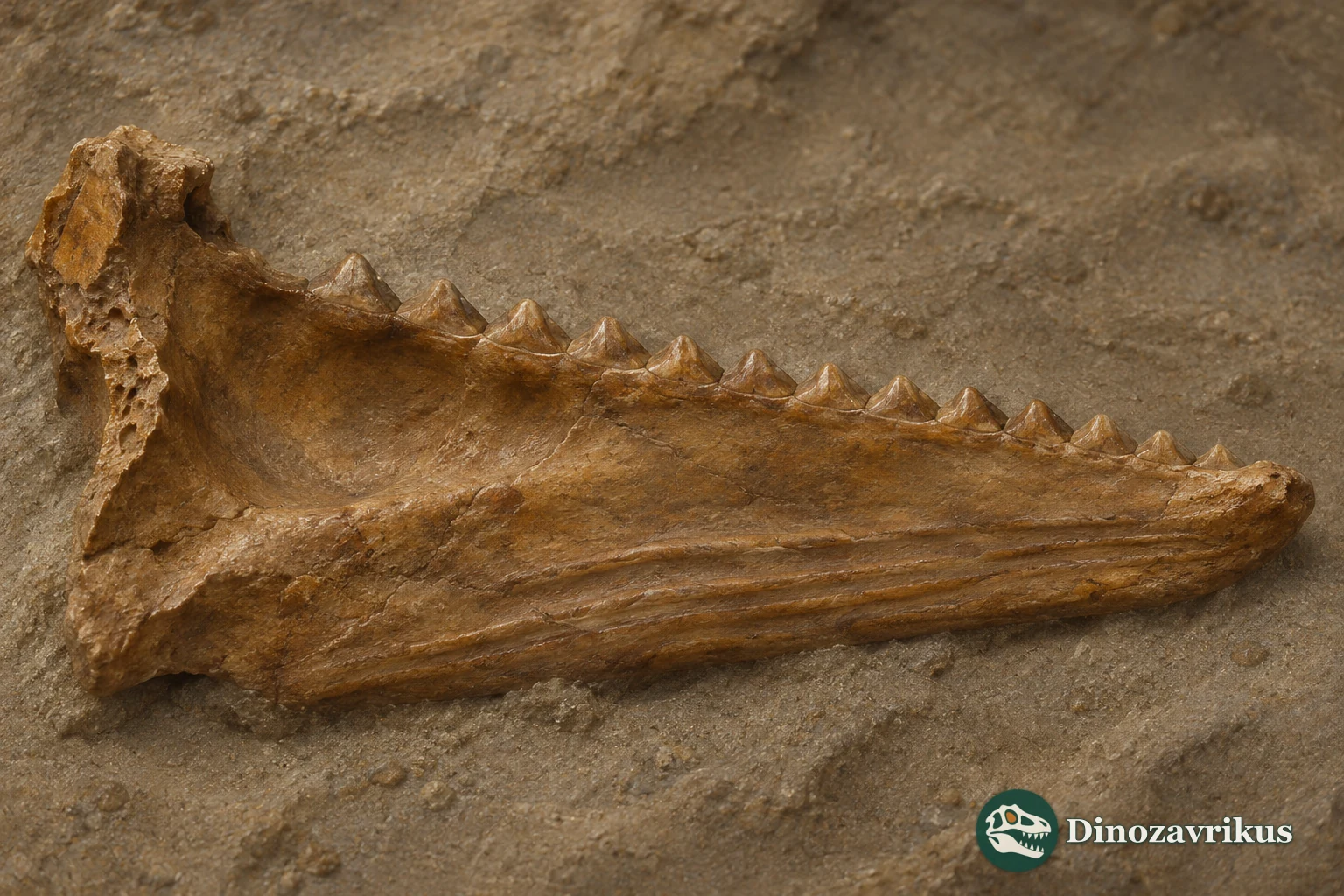
UCMP 142227 is an incomplete right dentary. Other jaws preserve rear teeth and the sculptured lower margin.
Length without the tail was estimated from jaw and body measurements of living lizards. Wear on the teeth points to a shearing bite.
Without an articulated skeleton, the length of the tail cannot be established. The teeth do not identify which plants the lizard ate.
The Pondaung fossils
Jason Head and colleagues described Barbaturex morrisoni in 2013. The type specimen comes from the Pondaung Formation in the Sagaing region. Fossil-bearing beds near the village of Bahin in the same formation were dated to about 37.2 ± 1.3 million years ago. Besides several pieces of dentary, the authors referred fused frontal bones to the lizard on the basis of their size.
How the jaws processed food
The front teeth were attached to the inner face of the jaw. Most of the teeth farther back sat on its upper edge. The triangular rear crowns show continuous wear facets, evidence that the teeth passed closely against each other to shear food. The authors linked that mechanism and crown shape to a predominantly plant-based diet. Comparisons of scattered skull bones also help resolve the relationships of other early iguanians, such as Suzanniwana.
Estimating length and mass
With no complete skeleton, the team used the relationship between dentary length and snout-to-vent length in living acrodontans. Their model yielded about 98 cm without the tail. The average mass estimate was 26.7 kg, with estimates ranging from 18.9 to 36.9 kg. These figures come from comparisons with living animals.
A lizard among Eocene mammals
The same assemblage includes a variety of plant-eating mammals. The estimated mass of Barbaturex exceeds that of some of them. This shows that a large herbivorous lizard could occur alongside diverse mammals. The authors also explored how a warm climate could have supported large body sizes and high plant productivity.
Frequently asked questions
What does the name Barbaturex mean?
It combines Latin words for bearded and king. The first refers to ridges on the underside of the lower jaw.
Who was the species named after?
The name morrisoni honors singer Jim Morrison.
Does the estimate of about a metre include the tail?
It measures only the distance from the tip of the snout to the vent. Tail length is unknown.
What supports the inference of herbivory?
Triangular rear crowns and wear facets indicate a shearing bite. Researchers compared this structure with that of living plant-eating agamids.