

Bemalambda was a pantodont mammal in Paleocene southern China. Several skulls and many postcranial bones make it unusually well represented among early mammal fossils. Even this substantial record cannot directly disclose coat colour, precise diet or routine behaviour.
It belongs in the ancient mammal catalogue. North American Pantolambda was another pantodont, but sharing a broad group does not mean the fossils came from the same habitat or moment.
Quick facts
| Scientific name | Bemalambda Chow and colleagues, 1973 |
|---|---|
| Type species | B. nanhsiungensis |
| Group | Pantodonta |
| Type skull | IVPP V4116 |
| Locality | Nanxiong Basin, Guangdong, China |
| Age | Paleocene; precise correlation debated |
| Material | Skulls, jaws, teeth and numerous skeletal bones |
What can the fossils tell us?
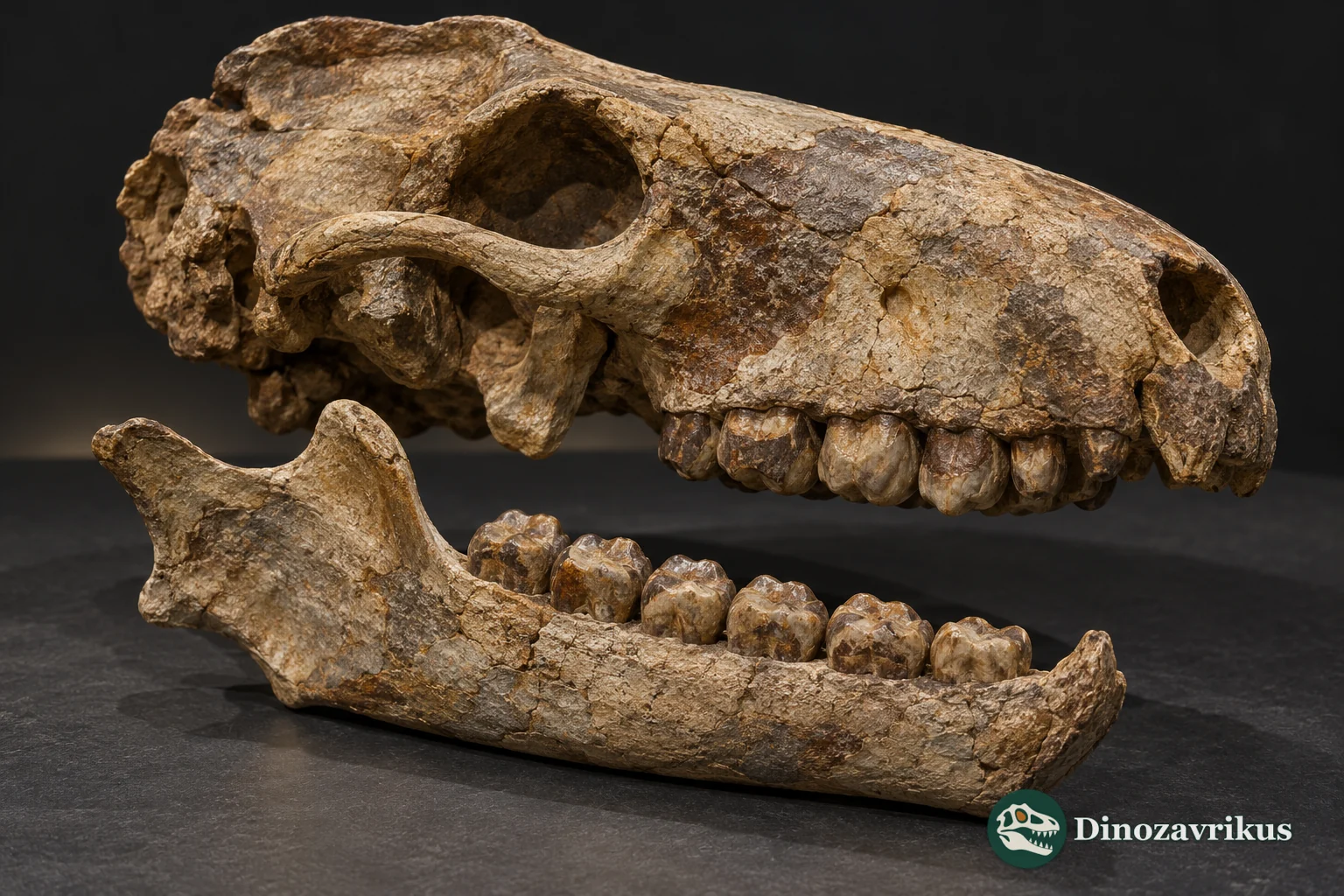
IVPP V4116 lacks its incisors and first two upper premolars. Additional skulls reveal variation, although sediment pressure distorted many specimens.
Vertebrae, shoulder blades, arm and leg bones, pelvis and foot bones occur in the described collection. Four humeri referred to B. nanhsiungensis measure 154.6–168.3 mm in length.
The fossils are from Paleocene red beds above Late Cretaceous strata in southern China. Researchers have revised the regional correlation; the precise date of an individual skull is not directly measured.
The type skull and Nanxiong collection
Chow and colleagues named Bemalambda nanhsiungensis in 1973. Their expanded 1977 monograph identifies IVPP V4116 as the type: a relatively complete skull without incisors or upper P1 and P2. A derivative online description instead labels jaw fragment V4146 as the holotype, but the primary monograph lists V4146 as additional material. The primary catalogue is the basis for the identification here.
The monograph lists six more fairly complete skulls, jaw parts, individual teeth, vertebrae, scapulae, long limb bones, pelvic bones and foot elements. Sediment pressure compressed and distorted a number of these specimens. An odd width in one crushed skull should not automatically be treated as a feature of the living animal.
Teeth, other species and food
The facial region of B. nanhsiungensis is described as roughly two-thirds the skull length. A long sagittal crest, relatively slender zygomatic arches and aspects of the mandible provide comparisons. These are observations on bone, not direct measurements of chewing force or diet.
Tooth-cusp positions and crown proportions distinguish material referred to B. nanhsiungensis from the more robust B. pachyoesteus and B. crassa in the original comparison. Wear alters the chewing surface of an isolated tooth. A recent study of early Paleocene Asian mammals deliberately treats diets as uncertain, since dental shape alone does not reveal stomach contents.
What the limb bones add
The collection contains vertebrae, scapulae, pelvis, humeri, radii, ulnae, femora, lower-leg and foot bones. The original measurement table gives lengths of 154.6–168.3 mm for four humeri assigned to B. nanhsiungensis. These are bone lengths, not shoulder heights or masses for every member of the genus.
Joint anatomy can support comparisons of support and movement. Yet habitual burrowing or a particular running speed cannot be inferred confidently without a targeted functional analysis. Fur colour, the soft muzzle and the posture in the cover are artistic choices.
Red beds and changing age estimates
A 1973 stratigraphic paper placed Bemalambda in the lower Luofuzhai Formation above Late Cretaceous Nanxiong strata. That early account cautiously suggested a late Paleocene age or somewhat earlier. A later review instead characterized Bemalambda as part of an Early–Middle Paleocene lower assemblage. These changing labels reflect revised correlation rather than a directly measured date for IVPP V4116.
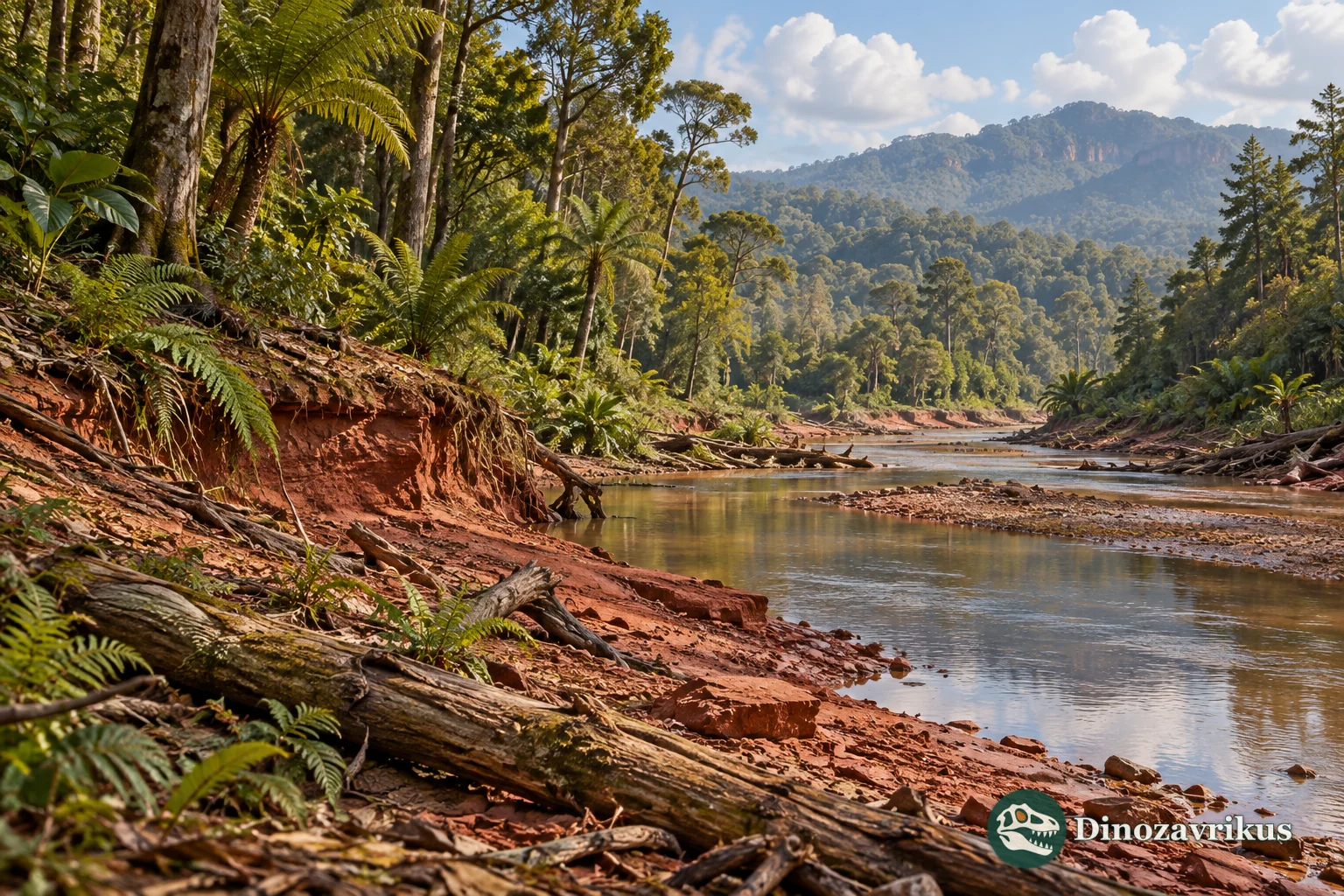
Dinosaur fossils in underlying Cretaceous beds do not prove that Bemalambda and non-avian dinosaurs lived together. The river-forest image illustrates a possible continental setting, not a documented plant community surrounding the type skull.
Frequently asked questions
What is the Bemalambda nanhsiungensis type specimen?
The 1977 monograph identifies IVPP V4116, a relatively complete skull missing incisors and two anterior premolars. V4146 is listed among additional jaw fragments.
Is Bemalambda known only from teeth?
No. Skulls, jaws, vertebrae and numerous limb bones were also described, although individual specimens vary in preservation.
Do we know exactly what Bemalambda ate?
Dental form supports testing feeding ideas, but direct evidence for a precise diet is absent.
Did it live alongside Nanxiong dinosaurs?
The mammal fossils are from Paleocene beds above dinosaur-bearing Cretaceous strata. Vertical proximity does not show coexistence.