

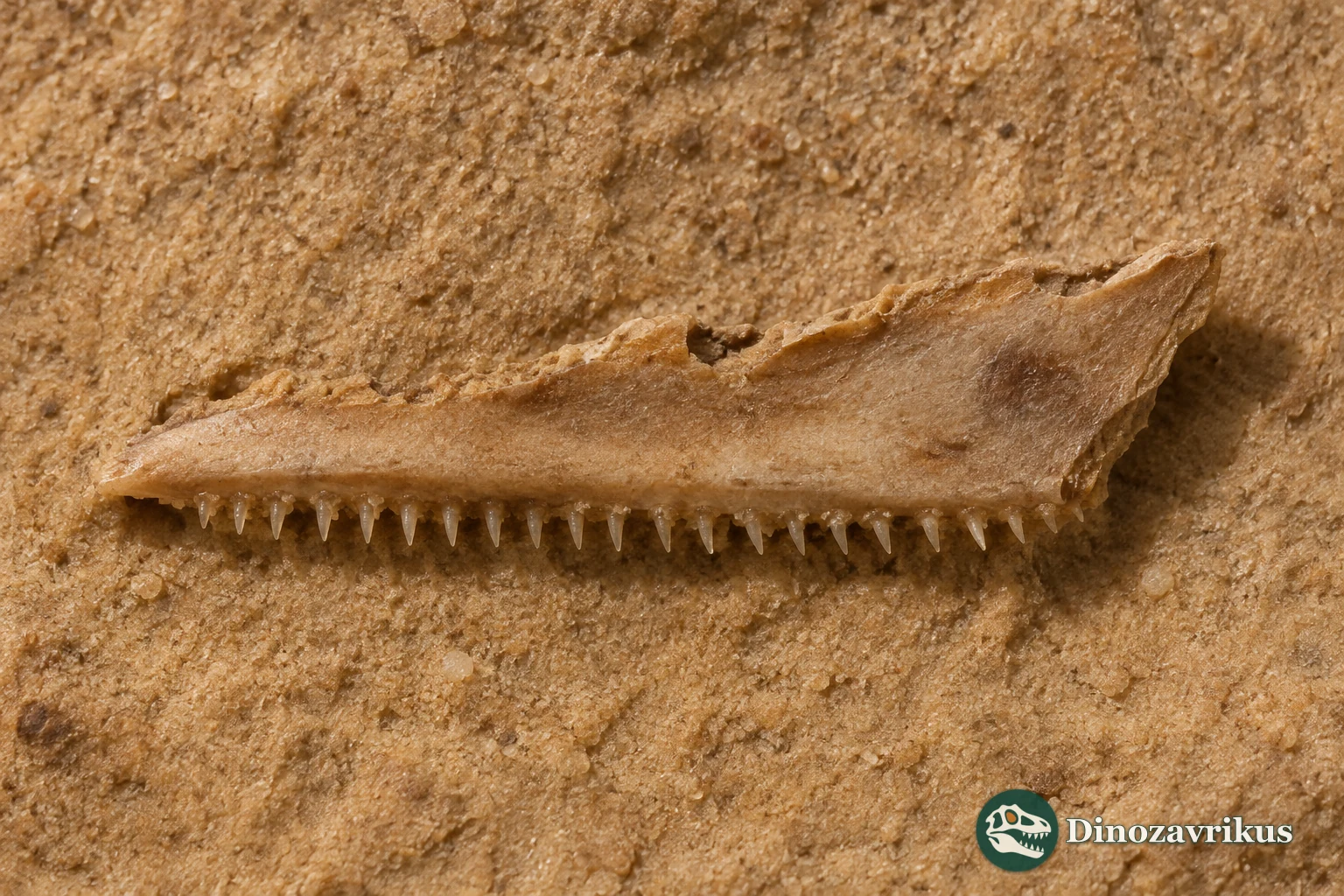
Bissektia nana was a Late Cretaceous amphibian from Dzharakuduk, Uzbekistan. Lev Nessov described it in 1981 from a left maxilla with a closely spaced row of tiny teeth. Initially identified as a salamander, the specimen was later reassigned to frogs.
Quick facts
| Group | Frogs (Anura), family uncertain |
|---|---|
| Age | Late Cretaceous (upper Turonian to Santonian in the original description) |
| Region | Asia (Dzharakuduk, central Kyzylkum, Uzbekistan) |
| Type species | Bissektia nana |
| Scientific name | Bissektia |
| Diet | Exact prey is unknown |
What can the fossils tell us?
The left maxilla ZIN PHA K77-9 has a smooth outer surface and a row of fine teeth. The ascending process is broken away.
Nessov’s revision assigned the fossil to Anura. Its family within frogs remains uncertain.
The fragment leaves body length, colour and diet unresolved. The identity of a few separately collected jaw fragments is uncertain.
A fragment from the Kyzylkum
The holotype, ZIN PHA K77-9, came from an exposure in the middle part of the Taikarsha beds at Dzharakuduk. The original description dated this level to the upper Turonian to Santonian. The outer face of the maxilla is smooth. Nessov counted about twenty teeth along five millimetres of the row. The ascending process is broken off.
From salamander to frog
Nessov introduced Bissektia as a salamander in 1981 and moved it to Anura in 1988. Dzharakuduk also yielded jaw bones of salamanders such as Eoscapherpeton. That mix makes the anatomy of each fragment important when assessing the group it represents. The published material leaves Bissektia unassigned to a family.
Could other fragments belong to it?
Nessov mentioned a posterior piece of another maxilla and two very small dentaries as possible records of Bissektia from the same area. All are isolated. Their tentative identification gives little basis for reconstructing a complete skull.
Frequently asked questions
Where was Bissektia found?
At Dzharakuduk, in the central Kyzylkum of present-day Uzbekistan.
What remains of the type specimen?
The type preserves part of the left upper jaw with tiny teeth. Its ascending process is missing.
Was Bissektia a frog or a salamander?
It was first described as a salamander and later reassigned to the frogs. Its particular family is uncertain.
Can the teeth reveal how long it was?
The spacing of the teeth can be described, but estimating body length reliably would require more of the skull or skeleton.